Phase 10 rules: how to play, all 10 phases, and scoring
* Difficulty is our editorial read on how hard the game is to pick up — not an official rating. Player counts and deck sizes come from the game's rulebook.
Phase 10 is a card game for 2 to 6 players, using a 108-card deck and a 10-card hand. Across a series of rounds, each player works through the same 10 increasingly difficult combinations, called phases, completing them in order. The first player to complete phase 10 and play out their last card in that round wins the game outright.
Setup
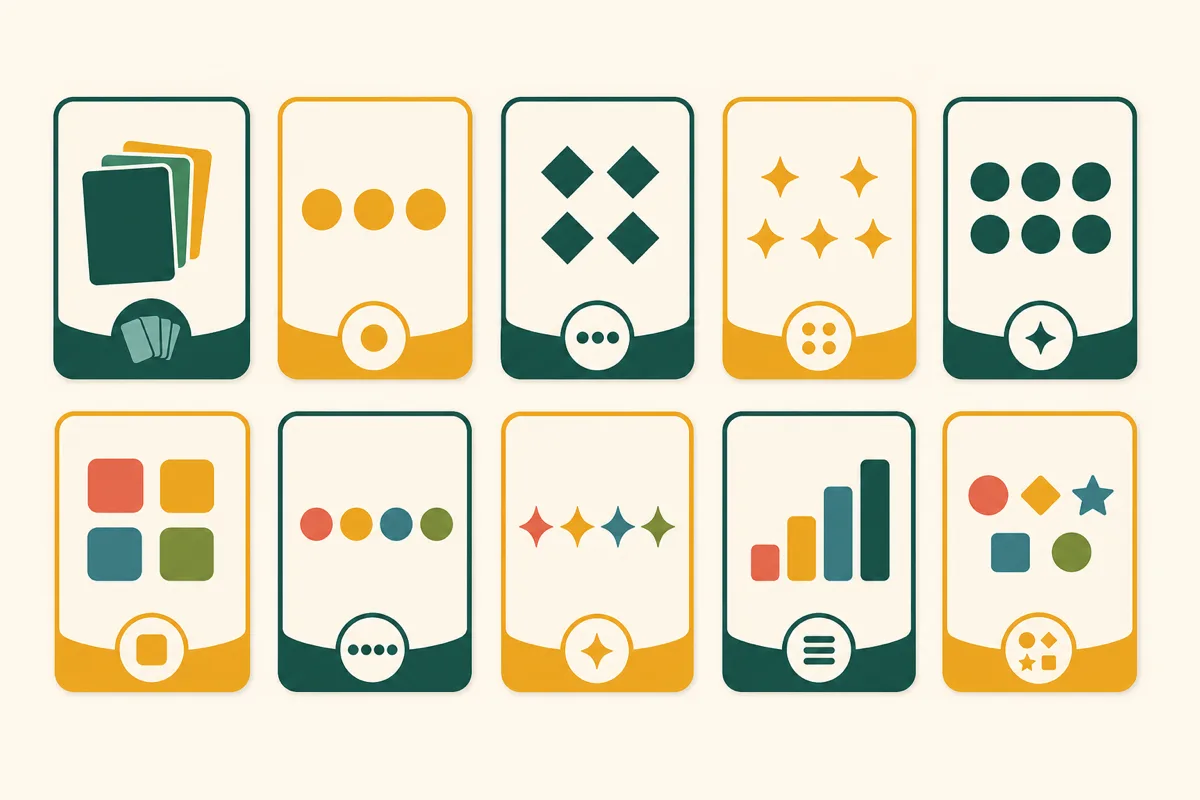
The Phase 10 deck has 108 cards: 96 number cards running 1 through 12 in four colors, two of each number per color, plus 8 Wild cards and 4 Skip cards.
Deal 10 cards to each player. Place the rest of the deck face-down as the draw pile, then flip the top card face-up beside it to start the discard pile. Every player starts the game attempting phase 1, regardless of who deals first. Nobody gets a head start on later phases.
The deck breakdown and phase table below were checked against Phase 10's current rulebook and cross-referenced against multiple independent rule sources before publishing, rather than assumed from a single competitor's page.
Gameplay
Each round, players take turns drawing a card (from either the draw pile or the top of the discard pile) and then discarding one card from their hand, exactly like a standard rummy-style turn. What makes Phase 10 different is what you're building toward while you do it: a specific phase.
| Phase | What it requires |
|---|---|
| 1 | 2 sets of 3 |
| 2 | 1 set of 3 + 1 run of 4 |
| 3 | 1 set of 4 + 1 run of 4 |
| 4 | 1 run of 7 |
| 5 | 1 run of 8 |
| 6 | 1 run of 9 |
| 7 | 2 sets of 4 |
| 8 | 7 cards of one color |
| 9 | 1 set of 5 + 1 set of 2 |
| 10 | 1 set of 5 + 1 set of 3 |
A "set" means two or more cards sharing the same number, regardless of color. A "run" means four or more cards in consecutive numeric order; color doesn't matter there either. Phase 8 is the odd one out: it ignores numbers entirely and just asks for seven cards of a single color.
Completing a phase
You can only lay down your phase once you're holding every card it requires, all at once, in a single turn. Partial progress across multiple turns doesn't count for anything until the whole combination is on the table together. Once you've laid down your phase for the round, you can keep playing extra cards onto your own completed phase or onto phases other players have already laid down that round, as long as the card fits the existing combination.
Using Skip and Wild cards
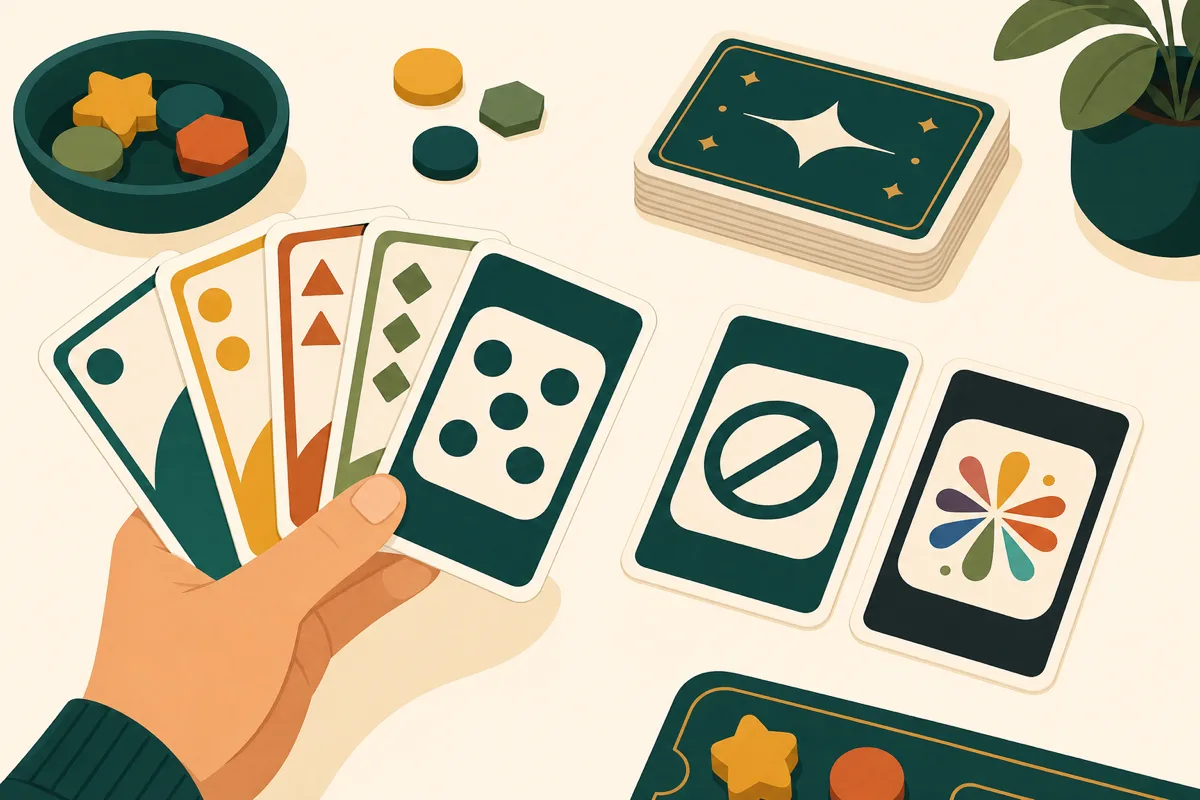
A Wild card can stand in for any card a phase needs, filling a gap in a set, a run, or a color group. A Skip card works differently. Playing one forces a player of your choice to miss their next turn entirely, and it can't be used to help complete a phase at all. It exists purely as an offensive tool, not a building block.
What happens if you don't complete your phase
If a round ends before you've laid down your phase, you don't advance. You simply attempt that exact same phase again the next round, while anyone who did complete their phase that round moves on to the next one. Phase 10 rounds don't reset everyone back to phase 1 together. Different players can be working on entirely different phases at the same table once a few rounds have passed.
Scoring
A round ends the moment one player plays their very last card, whether or not they completed their phase that round. Every other player then scores penalty points for whatever's left in their hand.
| Card left in hand | Points |
|---|---|
| Number card, 1–9 | 5 points each |
| Number card, 10–12 | 10 points each |
| Skip card | 15 points each |
| Wild card | 25 points each |
The player who went out that round scores 0, no matter what phase they were on. Everyone else adds up their leftover hand using the table above, and that becomes their score for the round. Lower totals are better throughout Phase 10. You're trying to stay light on points, not accumulate them.
As for winning the whole game: the game ends the instant a player completes phase 10's combination and discards their last card in that same round. That player wins outright, full stop, regardless of anyone's cumulative score at that point. The only time cumulative score comes into play for determining the winner is the rare case where more than one player finishes phase 10 in that exact same final round. Then, and only then, the lower running total between them breaks the tie.
Variations and house rules
| House rule | What it changes |
|---|---|
| Two-strike phase skip | A player who fails the same phase two rounds running is allowed to move on to the next phase anyway, keeping slow starters from getting permanently stuck |
| Short game | Play to phase 5 or phase 6 instead of phase 10, for a shorter session that still uses the full deck and scoring system |
| No hitting on others' phases | Once a phase is laid down, extra cards can only be added to your own phase for the round, not onto anyone else's, which slows the pace and rewards holding cards back |
None of these appear in the standard rulebook. They're common table agreements, most often used to shorten a long game night or give newer players a fair shot at catching up.
FAQ
What are the 10 phases in Phase 10, in order?
Phase 1 is two sets of 3, phase 2 is a set of 3 plus a run of 4, phase 3 is a set of 4 plus a run of 4, phases 4 through 6 are runs of 7, 8, and 9 cards, phase 7 is two sets of 4, phase 8 is seven cards of one color, phase 9 is a set of 5 plus a set of 2, and phase 10 is a set of 5 plus a set of 3.
Can you skip a phase in Phase 10?
Not in the standard rules. Every player has to complete each phase in order, and failing one means repeating it the next round. Some tables do use a house rule that lets a player advance anyway after failing the same phase twice, but that's a group agreement, not an official rule.
What happens if no one completes phase 10?
The game simply continues. Rounds keep being dealt until someone finally lays down phase 10's combination and discards their last card in that round. There's no time limit or round cap built into the standard rules that forces an early end.
How is Phase 10 different from Uno?
Both use a purpose-built 108-card deck instead of a standard pack, but the games play nothing alike. Uno is a fast matching game centered on color and symbol; Phase 10 is a slower, rummy-style game where you're collecting specific sets and runs, and everyone is working toward their own individual goal rather than reacting to a shared discard pile in the same way.
Can I download Phase 10 rules as a PDF?
This page is written to work as a complete standalone reference, including the full phase table, scoring chart, and variations. Everything you'd need from a printed sheet is already laid out here. Pair it with our score calculator if you'd rather track points digitally than do the arithmetic by hand.