31 card game rules: how to play Scat, knock and keep your lives
31, also called Scat or Blitz, is a draw-and-discard card game for 2 or more players with a standard 52-card deck. Each player holds 3 cards and tries to get as close to 31 as possible in one suit. The lowest hand loses a life, and the last player still in the game wins.
- Card values: ace 11, king, queen, jack and ten 10, two through nine at face value. Only cards of the same suit add up.
- On your turn, take the top discard or the top stock card, then throw one card away. Or knock instead of drawing.
- After a knock, every other player gets one more turn. The lowest hand then loses 1 life. If the knocker alone is lowest, the knocker loses 2.
- Exactly 31 in one suit is a blitz. Show it at once and everyone else loses a life.
- You start with 3 lives. At zero you stay in on a free ride, and your next loss puts you out.
These are the stock-and-lives rules on Wikipedia, Pagat and most rule sites. Bicycle's page describes a different game with 3 open table cards and a chip pot. The table under Variations shows the differences.
Setup
What you need
One 52-card deck and 3 lives per player, as pennies or poker chips. Wikipedia gives 2 to 7 players and Pagat says 2 to 9 or more.
The deal
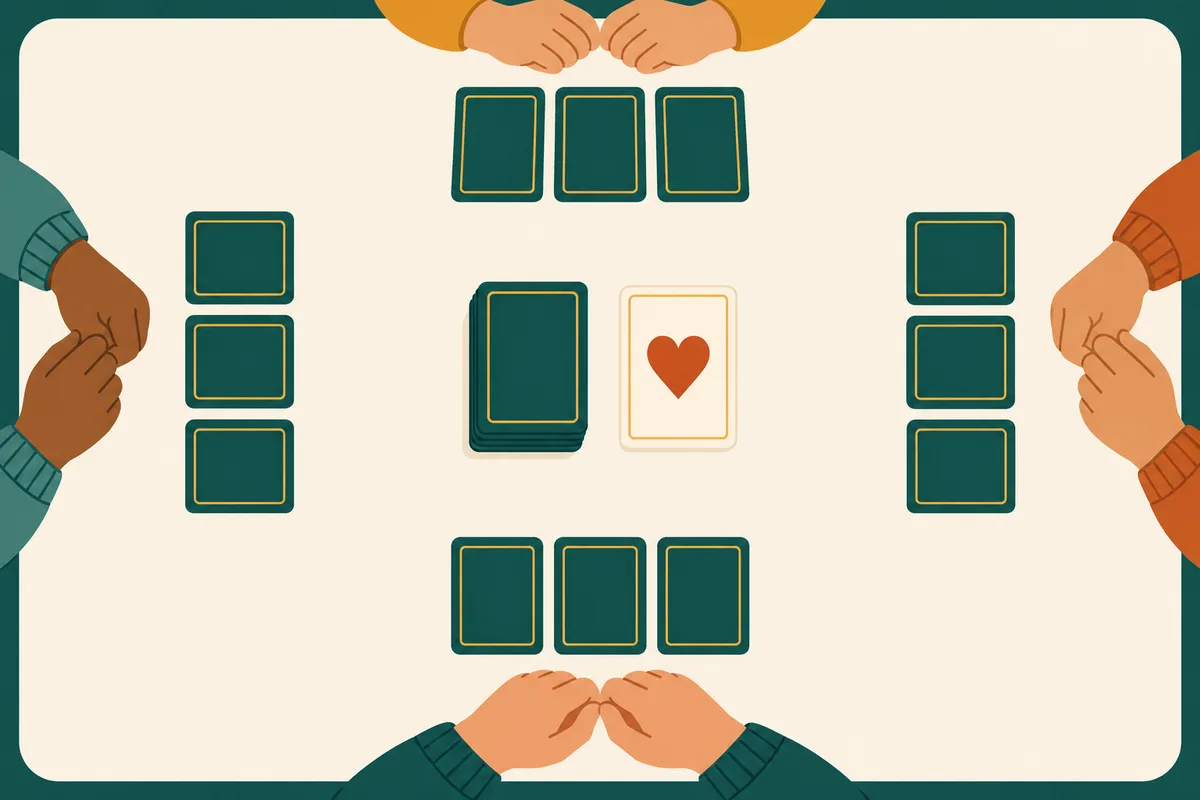
Pick the first dealer any way you like. If you draw for it, Playing Card Decks has the lowest card deal and Game On Family the highest. Deal 3 cards face down, one at a time, starting on the dealer's left. The rest goes in the middle as the stock, with its top card turned face up beside it to start the discard pile. The deal moves one seat clockwise after every hand.
If you were dealt 31, show it right away. Nobody plays that hand and everyone else loses a life. If two or more players were dealt 31, everyone without one loses a life.
Gameplay
The player on the dealer's left goes first, and play moves clockwise. You have two choices on a turn.
- Draw and discard. Take the top card of the stock or the discard pile, then put one card from your hand face up on the discard pile. You always end with 3 cards. A card you took from the discard pile has to stay in your hand that turn, while a card from the stock can go straight back on the pile.
- Knock. Rap on the table instead of drawing. Your hand is now locked.
Knocking and what happens next
Knock when you think your hand won't be the lowest. Beating one player is enough to keep you safe.
Each other player, clockwise from the knocker, gets one last turn to draw and discard as usual. Wikipedia also lets you stand and keep all 3 cards. The knocker doesn't play again. The last turn belongs to the player on the knocker's right, and then all hands go face up.
Blitz: holding exactly 31
The only way to 31 is an ace and two ten-point cards of one suit. Show it the moment you have it. The hand ends and every other player loses a life, with no comparing of hands. Pagat adds a cost for waiting: a 31 you didn't declare right away can't be claimed later, and it counts as 30.
That still applies after a knock. If you make 31 on your last turn, everyone else loses a life, including the knocker. Some groups charge the knocker 2 lives in that spot.
When the stock runs out
Sources split here. On Pagat, players keep taking the top discard, each in turn. As soon as someone doesn't want it, the hand stops and the lowest score loses a life. Wikipedia calls it a draw, so nobody loses a life. This page and its tracker default to Pagat. If every remaining player is on a free ride and they all tie, Pagat replays the hand.
Scoring
31 card game scoring has two parts: what your hand is worth, then who pays lives for it.
Card values
| Card | Points |
|---|---|
| Ace | 11 |
| King, queen, jack, ten | 10 |
| Two through nine | Face value |
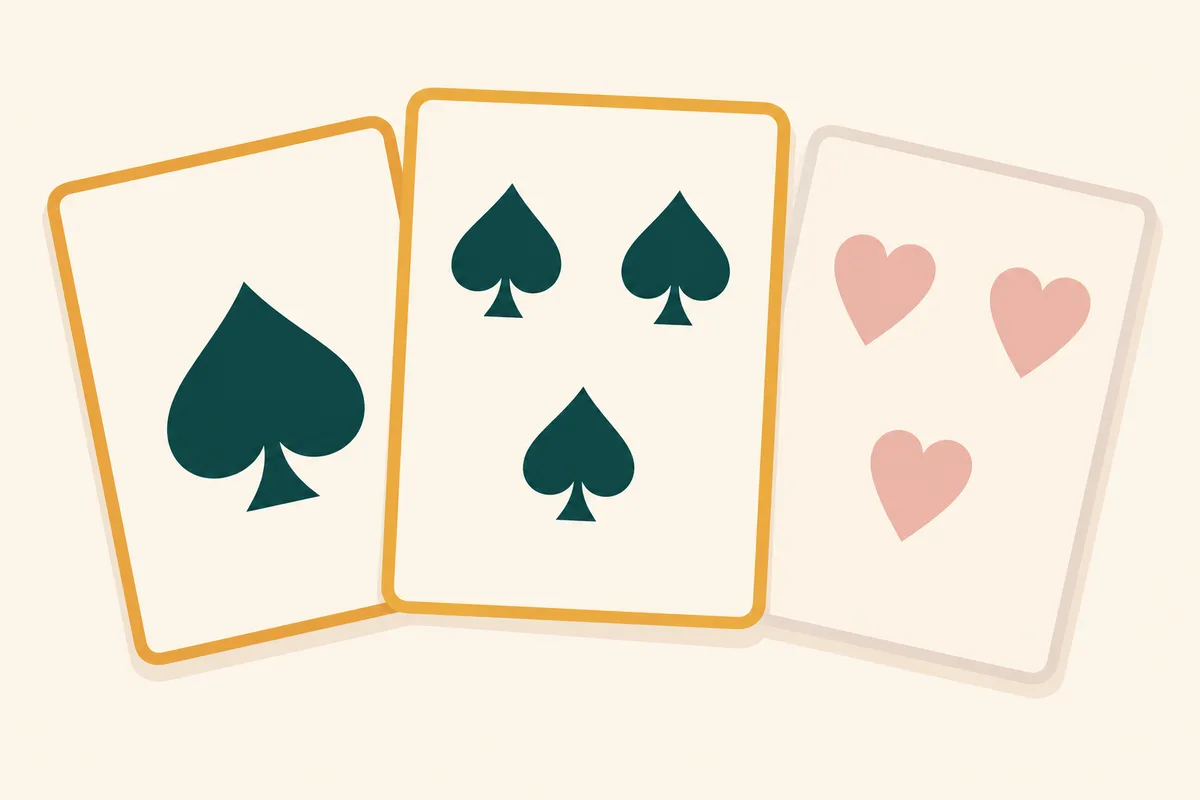
Your hand is worth the highest total you hold in any one suit.
| Hand | Worth | Why |
|---|---|---|
| A♠ Q♠ J♠ | 31 | 11 + 10 + 10, a blitz |
| A♠ K♠ A♥ | 21 | Spades only. The second ace is another suit, so 32 is impossible |
| A♠ 3♥ 4♥ | 11 | The ace alone beats hearts at 7 |
| K♣ 8♦ 3♥ | 10 | Three suits, so the highest card counts |
| 7♠ 7♥ 7♦ | 7 | Three suits, unless your table plays the three-of-a-kind rule below |
Who loses lives
| What happened | Who pays |
|---|---|
| Knock, and one other player is lowest | That player loses 1 |
| Knock, and other players tie for lowest | Each of them loses 1 |
| Knocker ties for lowest | Knocker is safe, the others in the tie lose 1 |
| Knocker is lowest alone | Knocker loses 2 |
| Blitz, whether dealt, before a knock or after one | Everyone else loses 1 |
| Stock runs out with no knock | Lowest loses 1, ties all pay |
Lives and the free ride
Pay one penny into the middle for each life you lose. Losing your last penny doesn't put you out. You keep playing on a free ride, also called "on the county" or "on your honor", and your next loss eliminates you. With 3 lives, your fourth loss ends your game.
Pagat also settles the case of a knocker with 1 life who ends up lowest alone: that player is out at once, because the 2-life penalty takes the last penny and the free ride with it. The last player left wins.
Scoring example
Four players, and Ana knocks. After the final turns:
| Player | Hand | Best suit | Value |
|---|---|---|---|
| Ana (knocked) | K♠ 8♠ 3♥ | Spades, 10 + 8 | 18 |
| Ben | J♦ 9♦ 2♦ | Diamonds, 10 + 9 + 2 | 21 |
| Cara | A♣ 5♣ Q♥ | Clubs, 11 + 5 | 16 |
| Dev | 9♥ 9♠ 6♠ | Spades, 9 + 6 | 15 |
Dev is lowest and loses 1 life. Ana is safe. With K♠ 5♠ 3♥ she would hold 15 and tie Dev, so she stays safe and Dev still pays 1. With 8♠ 5♠ 6♥ she would hold 13, alone at the bottom, so she pays 2 and Dev pays nothing.
More rule settings
| Player | Hand | Knocked | Has 31 | Loses |
|---|
| Hand | What happened |
|---|
| Card | Rank | Suit |
|---|---|---|
| Card 1 | ||
| Card 2 | ||
| Card 3 |
Pick three cards to count the hand.
Type each hand in the table or count it with the calculator: ace 11, king, queen, jack and ten 10, two to nine face value, and only one suit counts. Tick who knocked and who showed 31, and the sheet proposes who loses a life. Change a number in the Loses column if your table plays it differently, then press Apply hand. Your game stays on this device until you start a new game.
Variations
The biggest difference is between the game above and the version on Bicycle's page, which is close to what Wikipedia lists as Banking.
| Stock and lives (this page) | Widow and pot (Bicycle) | |
|---|---|---|
| On the table | Stock and discard pile | 3 face-up cards, the widow |
| A turn | Draw one, discard one | Swap one card with the widow |
| Result of a hand | Lowest loses a life | Highest takes the chip pot |
| Exactly 31 | Everyone else loses a life | Holder wins the pot at once |
| Ties | All tied players pay, knocker safe | Highest card wins, then next highest |
| Knock before any turn | Others still get a last turn | Immediate showdown, no swaps |
House rules
Three of a kind. Not in the regular game on Wikipedia, Bicycle or Denexa. At 30.5, Wikipedia's optional rule, it loses only to a 31. At 30, the standard on Playing Card Decks and Game On Family, it can tie three ten-point cards of one suit. Pagat lists both. This page and the tracker leave it off by default.
First-turn knock. Regular rules don't ban it, though Pagat notes that some computer versions do. In the "hammer" (Pagat) or "out of the gate" (Wikipedia) versions, the first player can end the hand on the spot, with no last turns.
Minimum to knock. Pagat's examples are 17, 19 or 21 points. It also lists tables that allow a knock only with three cards of one suit.
Knocker penalty. Wikipedia's California Quick and West Lansing versions make the knocker pay 2 for a tie at the bottom. Pagat also lists tables where a knocker who is lowest alone pays only 1.
High-card tiebreak. Game On Family has seen tables settle a tie for lowest by the highest card, then the next highest.
Blitz without the group penalty. On Denexa, a blitz ends the hand, but then the lowest hand pays as usual.
Lives. Denexa uses 4 markers, or a $5 bill with four corners to fold, so the fifth loss eliminates you. West Lansing drops the free ride.
FAQ
What does knocking mean in the 31 card game?
You're ending the hand. You knock instead of drawing, keep your cards, and every other player gets one last turn. Then all hands are shown.
What happens if the knocker has the lowest hand in 31?
The knocker loses 2 lives instead of 1, and nobody else pays. That applies only when the knocker is lowest alone.
What happens if there's a tie for lowest in 31?
Everyone tied loses a life, except the knocker, who is safe. The regular lives version has no high-card tiebreak, though Game On Family mentions tables that use one.
Can you knock on your first turn in 31?
Yes. Regular rules have no ban, and everyone else still gets a last turn. Some computer versions don't allow it, and a table can agree to the same limit before the deal.
Is three of a kind worth 30.5 in 31?
Only if your table plays that rule. Others count it as 30, and Playing Card Decks and Game On Family treat 30 as standard. Without the rule, three 7s in three suits are worth 7.
Is Scat the same as 31?
Yes. The game also goes by Blitz, Cadillac, Kitty, High Hat, Ride the Bus and Geronimo. It has no link to Skat, the German national card game, and Schwimmen and Greek 31 are separate games too.
Can you play 31 with 2 players?
Yes, with one extra option, which also applies once a bigger game is down to 2. When your opponent knocks, your last discard is still the top card of the pile, so you may take it back.
- Crazy Eights rules — a shedding game for the same plain 52-card deck
- Golf card game rules — another draw-and-discard game, with the lowest score winning
- Rummy rules — the classic draw-and-discard game built on sets and runs
- Kings Corner rules — a quick family card game for 2 to 4 players
- Classic card games — every traditional deck game on the site in one place
- Best card games for family game night — picks for a mixed-age table