Skip-Bo rules: how to play, setup, and scoring
* Difficulty is our editorial read on how hard the game is to pick up — not an official rating. Player counts and deck sizes come from the game's rulebook.
Skip-Bo is a card game for 2 to 6 players. Each player races to empty a personal stock pile (30 cards for two players, 20 for three or four, 15 for five or six) by building four shared piles in the center of the table in numeric order, 1 through 12. Whoever plays their last stock pile card first wins the hand.
Setup
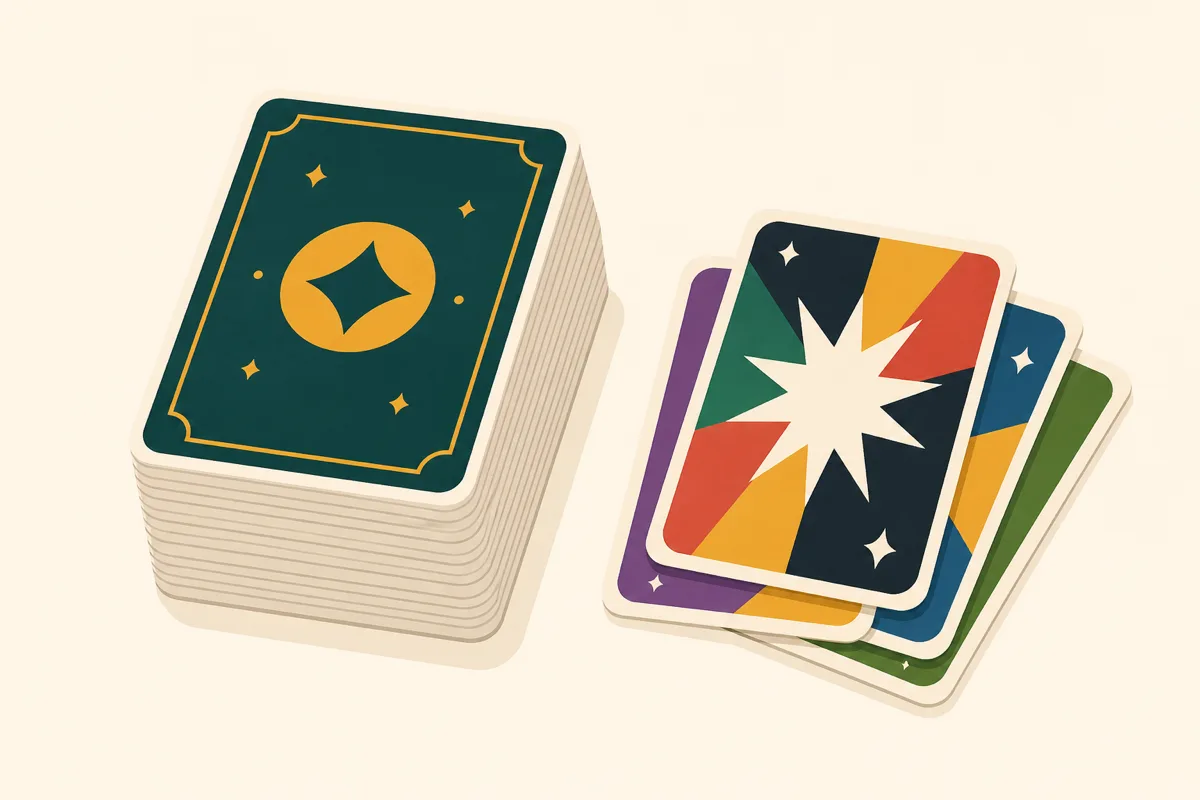
A Skip-Bo deck has 162 cards: 144 numbered cards running 1 through 12 across five colors, plus 18 Skip-Bo cards that act as wild stand-ins for any number. Shuffle everything together into one deck before dealing. The numbered cards and the wilds mix freely; they aren't kept as separate piles.
Deal each player a hand of 5 cards. That hand stays at 5 for the whole game. Whenever it drops below that count, top it back up before the next turn begins.
The real countdown clock is the stock pile, and its size depends on how many people are playing.
| Players | Stock pile size |
|---|---|
| 2 | 30 cards |
| 3–4 | 20 cards |
| 5–6 | 15 cards |
Deal each player's stock pile face-down; only the top card is turned face-up and playable. Nobody looks ahead at their own pile.
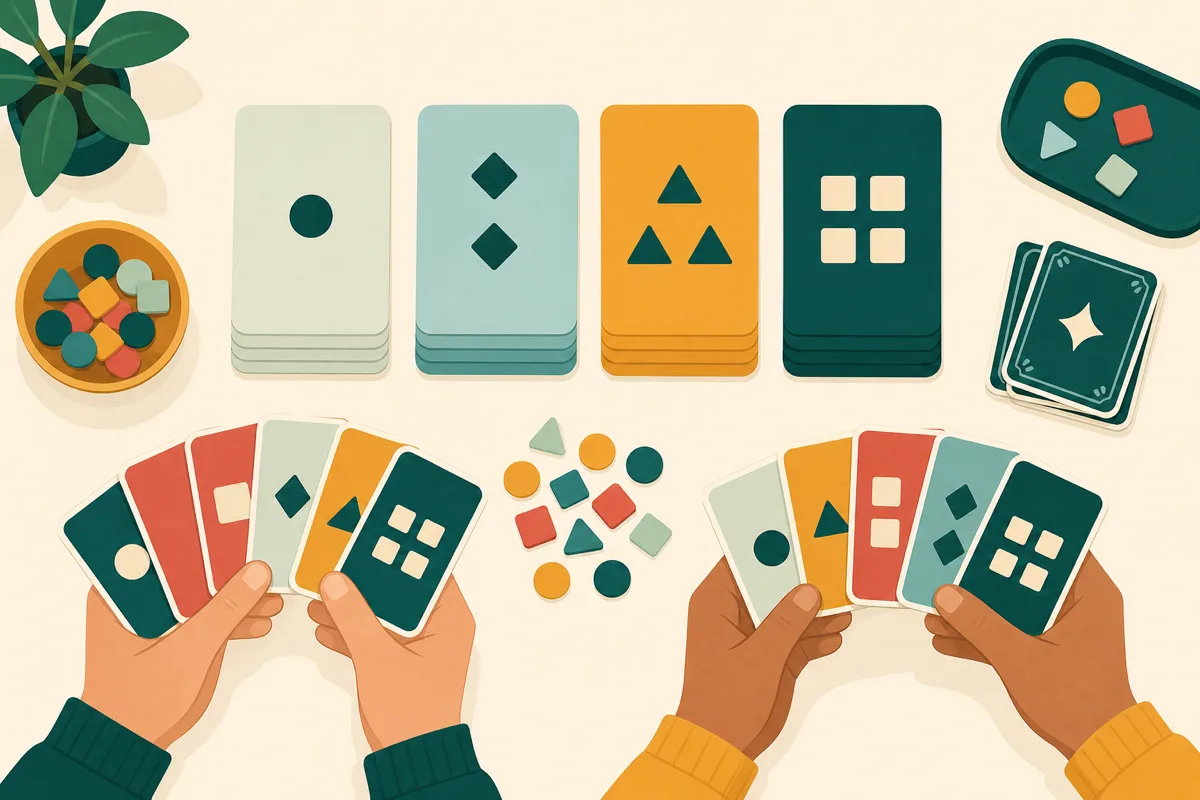
Set four build piles in the middle of the table. They start empty and belong to everyone: any player can add to any of the four on their turn, regardless of who started it. Finally, each player lays out four personal discard piles in front of them, empty at first. These are private. Only that player can draw from their own discard piles, though everyone can see what's on top.
Every count in this section, deck size, hand size, and the stock pile table, was checked against Skip-Bo's current rulebook and cross-referenced against several independently published rule summaries before writing this guide.
Gameplay
Starting your turn
Your turn begins with your stock pile's face-up card in play. From there, you can draw on three sources in any order and any combination: the top of your stock pile, the cards in your hand, and the top card of any of your four personal discard piles. There's no fixed draw phase. You simply keep playing cards onto the shared build piles for as long as you're able to.
Building the center piles
Cards go onto the four shared piles in strict ascending order, starting from 1. A pile sitting at 6 only accepts a 7 next, from any player, from any of their three sources. A Skip-Bo card can substitute for whatever number a pile needs at that moment. Play it as if it were that number, and it stays on the pile doing that job until the pile clears.
Here's how the three sources interact in practice. Say your stock pile shows a 4 on top, your hand holds a 9, a Skip-Bo card, two 3s, and a 7, and one of the center piles currently sits at 3. You play the stock pile's 4 straight onto that pile, which pushes it to 4 and turns over your next stock card. Your hand's Skip-Bo card goes next, standing in for 5 to keep the sequence moving. If neither your hand nor your fresh stock card is a 6, check the top of your four discard piles. If one shows a 6, it moves onto the build pile too. That's the order of priority worth remembering: stock pile first whenever you can, because it's the only pile that actually wins you the game.
Once a build pile reaches 12, it's complete. It gets set aside as a discard heap and a new, empty pile takes its place immediately, ready to start again from 1.
Ending your turn
You keep playing as long as you're able to place a card somewhere. When you run out of moves, or simply choose to stop, close your turn by discarding one card from your hand face-up onto any of your four personal discard piles. Your choice of which one. That card becomes the new top of that pile, available to you (and only you) on future turns. After you discard, refill your hand back to 5 cards before the turn passes to the next player.
One detail that trips up new players: if your hand empties completely in the middle of your turn, before you've ended it, draw back up to 5 right away and keep going. Hand replenishment isn't a once-per-turn event that happens only at the end. It happens the moment you need cards to keep playing, too.
Scoring
For a single hand, there's no point tally to worry about. The player who empties their stock pile first simply wins that hand. That's the whole scoring system if you're playing one round and calling it a night.
Groups who want to play a longer session, or settle who's the better player over several hands, commonly switch to a running tournament score instead. The format that shows up consistently across published Skip-Bo rule summaries works like this: after each hand, the winner scores 25 points, plus 5 more points for every card still sitting in each opponent's stock pile. Add those totals up hand after hand, and the first player to reach 500 points wins the tournament outright.
That scoring math rewards more than just winning; it rewards winning by a wide margin. A player who finishes with 20 cards still stuck in their stock pile hands the winner 100 extra points on top of the base 25, so a single lopsided hand can swing a tournament almost as much as two close ones combined. Worth noting: this tournament format isn't printed identically on every Skip-Bo box edition. If you're playing for anything more than bragging rights, it's worth confirming the exact point values against your own box insert before the first hand starts.
Variations and house rules
Skip-Bo's core rules are simple enough that most groups end up tweaking something, whether that's to speed things up for a weeknight game or slow things down for a more competitive one.
| Variant | What changes |
|---|---|
| Faster 2-player stock | Instead of the standard 30-card stock pile, deal a shorter one, often 15 or 20 cards, so head-to-head games don't run long |
| Lock a pile you started | Once you've added a card from your own hand or stock pile to a build pile, only you can add to it until your next turn. Stops opponents from finishing off a pile you set up |
| Speed round | Deal a tiny stock pile, 5 to 10 cards per player, so a full hand takes a few minutes. Useful for teaching newcomers or running several hands back to back |
| Stock and hand only | Remove the discard-pile option entirely, so players can only play from their stock pile and hand, which raises the difficulty considerably |
| Tournament target | Play repeated hands to a running score instead of stopping after one, using the 25-points-plus-5-per-card format described above |
None of these are official Mattel rules. They're widely used adjustments groups agree on before dealing. Pick whichever fits the night, and just make sure everyone at the table agrees before the first card gets played.
FAQ
How many cards do you deal in Skip-Bo?
Every player gets a 5-card hand, kept topped up to 5 throughout the game. On top of that, each player gets a stock pile that depends on the number of players: 30 cards each for two players, 20 each for three or four players, or 15 each for five or six players.
Can you play Skip-Bo with 2 players?
Yes, and it's one of the most common ways the game gets played. Two players each get a 30-card stock pile, the largest of the three stock-pile sizes, since there's less competition for the four shared build piles. Groups who find 30 cards too slow often shorten it to 15 or 20 as a house rule.
How is Skip-Bo scored?
A single hand doesn't need scoring at all. First to empty their stock pile wins. For longer sessions, the common tournament format awards the hand winner 25 points plus 5 points for every card left in each opponent's stock pile, with the first player to reach 500 points across multiple hands winning the tournament.
What are common Skip-Bo variations?
The most widely used tweaks are a shortened stock pile for faster 2-player games, a rule that locks a build pile to whoever started it until their next turn, a speed round with a tiny stock pile for quick games, a harder stock-and-hand-only mode with no discard pile plays, and the multi-hand tournament scoring format.
What happens when a build pile reaches 12?
It's finished. That pile gets cleared away as a discard heap, and an empty pile immediately takes its place in the center of the table, ready to start counting up from 1 again.
Is Skip-Bo similar to Uno or Phase 10?
Only loosely. All three are Mattel-published card games played with a purpose-built deck instead of a standard 52-card pack, but the core mechanic differs in each one. Skip-Bo is a sequencing race against your own stock pile, not a matching or set-collecting game. If you want to compare notes, our guides to similar family card games and Phase 10 rules break down exactly how each one plays.