Cribbage rules: how to play and count your hand
* Difficulty is our editorial read on how hard the game is to pick up — not an official rating. Player counts and deck sizes come from the game's rulebook.
Cribbage is a card game most commonly played by 2 players (3- and 4-player forms exist too). Each player is dealt 6 cards and discards 2 into the dealer's "crib," then plays cards one at a time while "pegging" points on a running count. After play, everyone counts their remaining hand for more points. The first player to reach 121 wins.
Setup
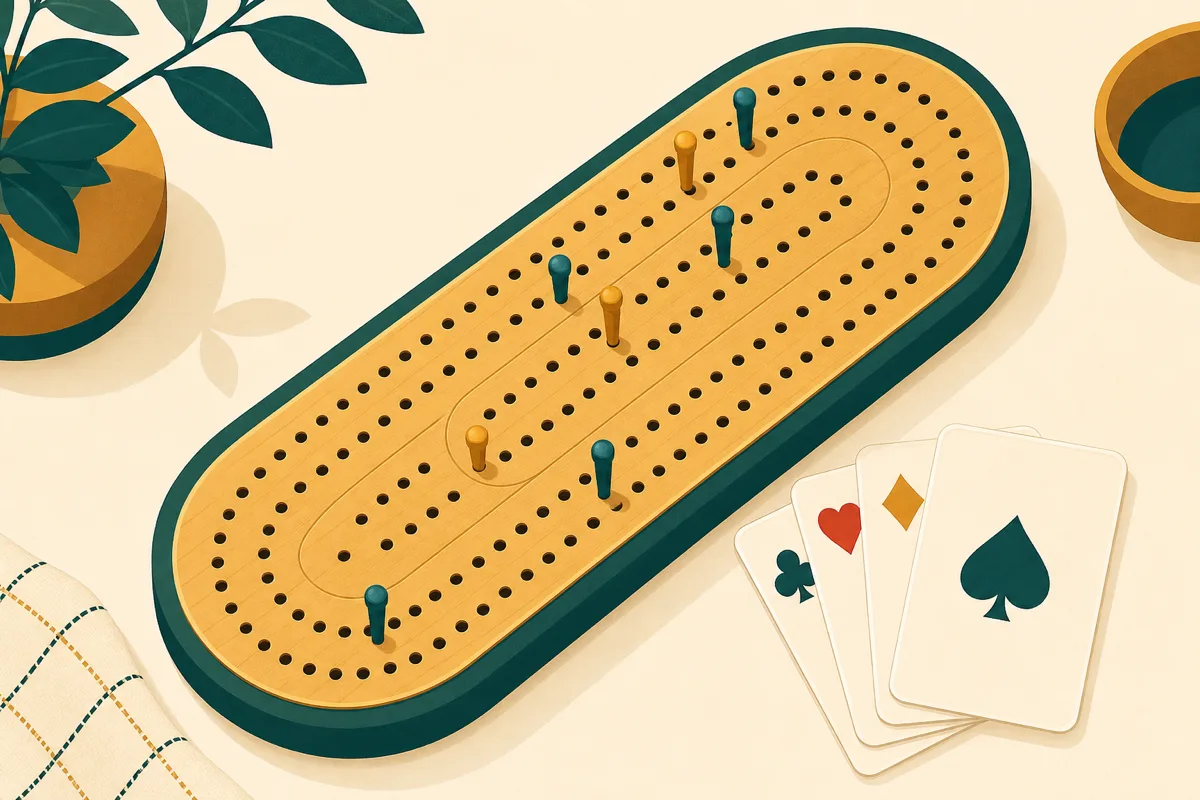
Cribbage is normally played with a standard 52-card deck and a cribbage board, a small tracking board with two rows of holes and a set of pegs for each player. The board isn't strictly required, you can keep score on paper just as easily, but it's the traditional way to track a running total without losing count mid-hand.
How the deal works depends on how many people are at the table.
| Players | Cards dealt each | Discards to the crib |
|---|---|---|
| 2 (standard) | 6 | 2 each, leaving 4 in hand |
| 3 | 5 | 1 each, plus 1 extra card dealt face-down straight into the crib |
In the standard 2-player game, the dealer deals 6 cards to each player, and both players then look at their hand and set aside 2 cards face-down to build the dealer's crib, an extra 4-card hand that only the dealer scores at the end of the round. That leaves each player with 4 cards to play from during the hand.
The 3-player version deals 5 cards to each player instead, and each player contributes just 1 card to the crib rather than 2. Because 3 discards only makes 3 cards, one additional card gets dealt face-down directly into the crib during the deal itself, bringing it up to the same 4-card size as the 2-player version.
Once the crib is set aside, the non-dealer cuts the deck, and the dealer turns the top card of the remaining deck face-up. This is the starter card, and it plays a role in scoring for everyone, including the crib, once the hand is counted. If that starter card happens to be a jack, the dealer immediately pegs 2 points, a bonus traditionally called "his heels." That's separate from "nobs," a different jack-related bonus that only comes up later during counting, worth keeping the two straight since they're easy to mix up.
Gameplay
Playing to 31
Once the crib is set and the starter is turned, the non-dealer plays first. Players alternate playing one card at a time face-up onto a shared pile, and each card played adds to a running count that both players track out loud. That count can never go over 31: if you don't have a card that would keep it at or under 31, you say "go" and pass, and your opponent keeps playing cards (and scoring where they can) until the count itself hits 31 or nobody can play any lower.
Once the count is stopped, whether by hitting exactly 31 or by both players running out of playable cards, the count resets to 0 and whoever didn't play last starts the pile again with whatever cards they have left. This continues until both players have played every card in their 4-card hand.
Scoring during play
Points during the play phase come from specific things happening as the running count builds. Hitting a total of exactly 15 at any point scores 2 points. Playing a card that matches the rank of the card just played scores 2 points for a pair (and more if a third or fourth matching card follows immediately). Playing a card that completes a run of 3 or more consecutive ranks, regardless of the order they were played in, scores 1 point per card in that run. Hitting the count at exactly 31 scores 2 points on the spot.
What happens at go
"Go" is what happens when a player can't play a card without pushing the count past 31. Saying "go" hands the turn to the opponent, who keeps playing (and scoring, if they can) until they can't play either. Whoever plays the last card before the count stops, without hitting exactly 31, scores 1 point for the go. If a played card brings the count to exactly 31, that scores 2 points instead of the usual 1-point go, since reaching 31 exactly takes priority over the ordinary stop.
Scoring: counting your hand
Once every card has been played, each player counts their original 4-card hand together with the starter card, for a possible 5-card combination. The dealer counts the non-dealer's hand first, then their own hand, then finally the crib, which also gets combined with the same starter card. This order matters at the very end of a close game, since the non-dealer's hand is always counted first and can end the game before the dealer even gets to count theirs.
| Combination | Points | Example |
|---|---|---|
| Fifteens | 2 points for every distinct combination of cards (2 or more) that add up to 15 | A 6 and a 9 in the same hand score 2 points, on top of any other combination that also hits 15 |
| Pairs | 2 points per matching pair; 3 of a kind counts as 3 separate pairs (6 points), 4 of a kind as 6 pairs (12 points) | Two 7s score 2 points |
| Runs | 1 point per card in a run of 3 or more consecutive ranks; suit doesn't matter | 4-5-6 scores 3 points |
| Flush | 4 points if all 4 hand cards share one suit; 5 points if the starter also matches. A crib flush only counts if all 5 cards, including the starter, share a suit | 4 hand cards all diamonds, starter a different suit, scores 4 points |
| Nobs | 1 point for holding the jack that matches the starter card's suit | Jack of clubs in hand with a clubs starter scores 1 point |
Here's a full hand counted step by step. Say your hand at the end of play is 5♠, 6♠, 7♦, 9♣, and the starter card turns out to be 8♥. First, check for fifteens: 6+9 makes 15 (2 points), and 7+8 makes 15 (2 points), for 4 points total. Next, look for runs: the full set is 5-6-7-8-9, five consecutive ranks in a row, worth 5 points as one single run rather than several smaller overlapping ones. There are no pairs, no flush (the suits are mixed), and no jack for nobs. Add it up, 4 points for fifteens plus 5 for the run, and the hand counts for 9.
Want to double-check a hand fast without doing the arithmetic yourself? Use the Cribbage score calculator to enter your cards and get the same breakdown instantly.
Variations and house rules
| Variant | What changes |
|---|---|
| 3-player Cribbage | 5 cards dealt to each player, 1 discarded to the crib by each, plus 1 extra card dealt face-down straight into the crib to bring it up to 4 cards. Otherwise plays like the standard game, in rotation |
| 4-player partnership Cribbage | 4 players split into 2 fixed partnerships seated alternately around the table. Each player is dealt 5 cards and discards 1 to the crib. Partners' scores combine, and play (including pegging) passes around the table in turn order regardless of partnership |
| Muggins | An optional house rule letting either player claim points the other player missed while counting their hand, added to the claimant's own score instead. Mostly used in more competitive settings, since it punishes careless counting |
Games are commonly played to 121 points. Some tables also play an optional "skunk" bonus: if the loser hasn't reached 91 points by the time the winner hits 121, that's worth an extra game in some scoring formats, and a "double skunk" at 61 points is an even less universal variant on top of that. Neither skunk rule is part of every group's standard scoring, so it's worth confirming before a game if bragging rights are on the line.
FAQ
How do you count 15s in Cribbage?
Add up every possible combination of 2 or more cards in your 5-card hand (your 4 cards plus the starter) that sum to exactly 15. Each distinct combination scores 2 points, so a hand can score 15 several times over if more than one grouping of cards adds up to 15 in different ways.
What is nobs in Cribbage?
Nobs is 1 point scored for holding the jack that matches the starter card's suit. It's different from "his heels," which is a separate 2-point bonus the dealer scores if the starter card itself turns out to be a jack, scored the moment it's turned, not during counting.
How many points do you need to win Cribbage?
The standard game runs to 121 points, tracked on a cribbage board across two laps of the track plus one extra hole. Some groups add an optional bonus if the loser is well behind when the winner reaches 121, but this "skunk" rule varies by table and isn't part of every group's standard scoring.
Can you play Cribbage with 3 players?
Yes. Each player gets 5 cards and discards 1 to the crib, with 1 extra card dealt face-down directly into the crib to bring it to the usual 4-card size. Play, pegging, and counting otherwise work the same way as the 2-player game, just with an extra player rotating through the turn order.
What does "go" mean in Cribbage?
"Go" is what a player says during the play phase when they can't play a card without pushing the running count past 31. Saying go passes the turn to the opponent, who keeps playing until they can't either. Whoever plays the last card before the count stops scores 1 point for it, or 2 points if that last card happens to bring the count to exactly 31.
Can I download Cribbage rules as a PDF?
There's no separate downloadable PDF on this page, but the counting table above and the 121-point track are written to work as a standalone quick reference on their own. A printable version covering a simple crib-board diagram, the counting table, and the scoring track is planned separately from this page.