How to play Nertz (Nerts): card game rules and scoring
* Difficulty is our editorial read on how hard the game is to pick up — not an official rating. Player counts and deck sizes come from the game's rulebook.
Nertz, also spelled Nerts, is a racing solitaire game for two or more players, and each player or team uses a separate 52-card deck. Nobody takes turns. Everyone plays at once, trying to empty a 13-card Nertz pile onto their own work piles or onto shared ace piles in the middle of the table. The first to empty it calls "Nertz!" and the hand stops.
- Layout per player: a 13-card Nertz pile with the top card face up, four face-up work piles and a face-down stock of 35.
- Work piles build down in alternating colors. Center piles start with an ace, build up in suit, and anyone can add to them.
- Turn the stock three cards at a time; only the top card of the waste pile is playable.
- After each hand: +1 for every card of yours in the center, −2 for every card left in your Nertz pile.
- Play hands until someone reaches 100 points (150 in the National Nertz Association rulebook). Highest total wins.
Nertz setup
Players and decks
Pagat, John McLeod's card game reference, calls Nertz very good for two players and fun for three or four. With five individual players it starts to get chaotic, so for an even number of six or more Pagat suggests partnerships: two people sit side by side and share one deck. Bicycle lists 2 to 4 players. The RulesPal rulebook, written in the terms of the National Nertz Association (NNA), allows 2 to 8 teams of one or two.
Each player or team needs a complete 52-card deck, and no two decks can share a back design. After the hand, the center piles get sorted by back so everyone can count their own cards.
How to set up Nertz
Shuffle your own deck and deal your own layout (the tableau):
| Pile | Cards | Face | What it does |
|---|---|---|---|
| Nertz pile | 13 | 12 down, top card up | The pile you race to empty |
| Work piles | 4, one card each | Up, side by side | Your own building space |
| Stock | The other 35 | Down | Turned three at a time |
| Waste pile | 0 at the start | Up | Top card playable |
| Center | 0 at the start | Up | Ace piles shared by all players |
Sit around a table or on the floor so everyone can reach the shared space in the middle.
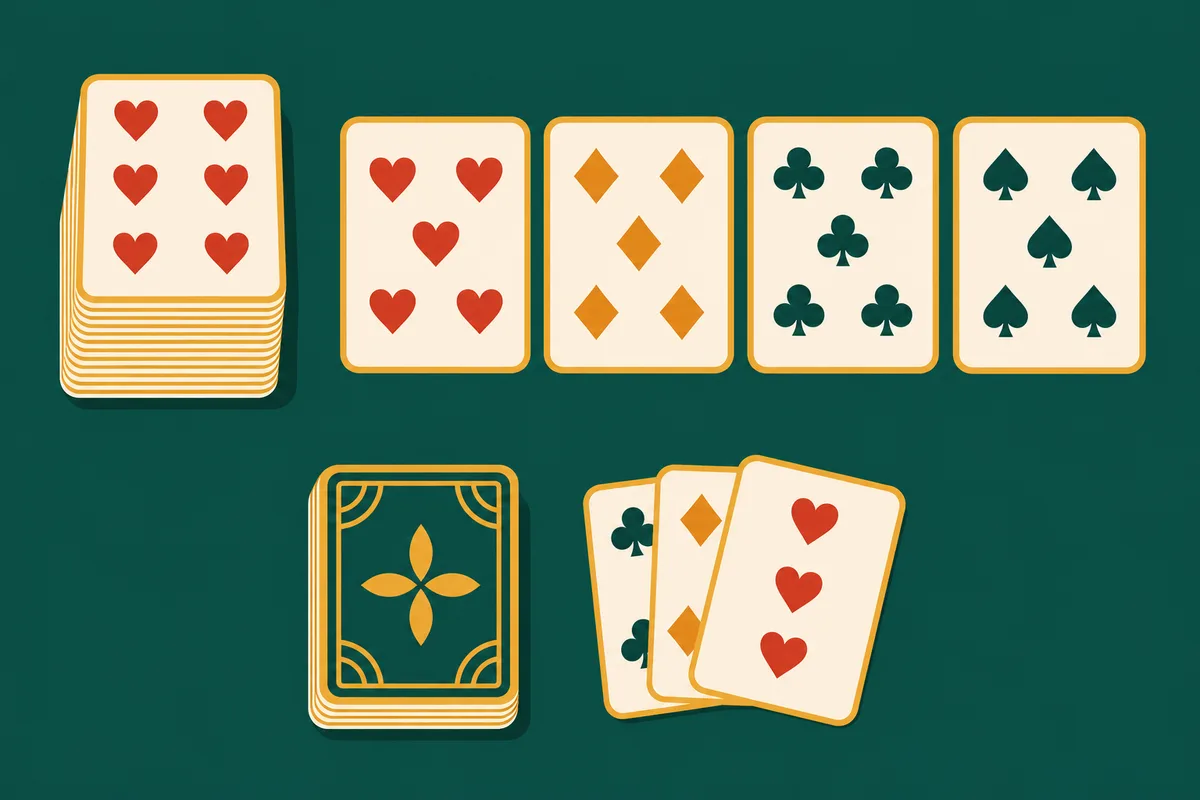
How to play Nertz
Everyone plays at once
When everyone has dealt, one person counts down and the hand starts. Move cards as fast as you like. You may touch only your own tableau and the center, and a card placed in the center stays there.
Pagat and Bicycle allow one hand for moving cards, with the stock held in the other. The NNA rulebook lets players use both hands. The default here is one hand. Cards move one at a time, except a run shifted from one work pile to another.
Work piles
Work piles build downward in alternating colors, overlapped so every card shows: a black 9 goes on a red 10, a red 8 on the black 9. You can move a card from one work pile to another where it fits, taking along every card on top of it. The lowest card of each pile is free to play to the center.
An empty work pile can be filled with your top Nertz card, your top waste card or cards from another work pile. RulesPal says you don't have to fill it right away. While a space is open, you can also save a move by slipping a card under a pile when it is one rank higher and the opposite color of that pile's bottom card, for example a black queen under a pile that starts with a red jack. With all four piles occupied, that move is illegal (Pagat, RulesPal).
Your Nertz pile
Only the top card of the Nertz pile is in play. It can fill an empty work-pile space, go onto a work pile where it fits or go straight to the center. Once it's gone, turn up the next card. You can't look at or dig out the cards underneath.
The center piles
Any available ace can start a new pile in the center. Each pile builds up in its own suit from the 2 to the king, and any player can add to any pile. Since every player brings a full deck, several piles of one suit can run at the same time.
When two players reach for the same pile at once, the first card down stays and the others go back where they came from. If nobody can tell, Pagat keeps both. A pile that reaches the king is turned face down and set aside.
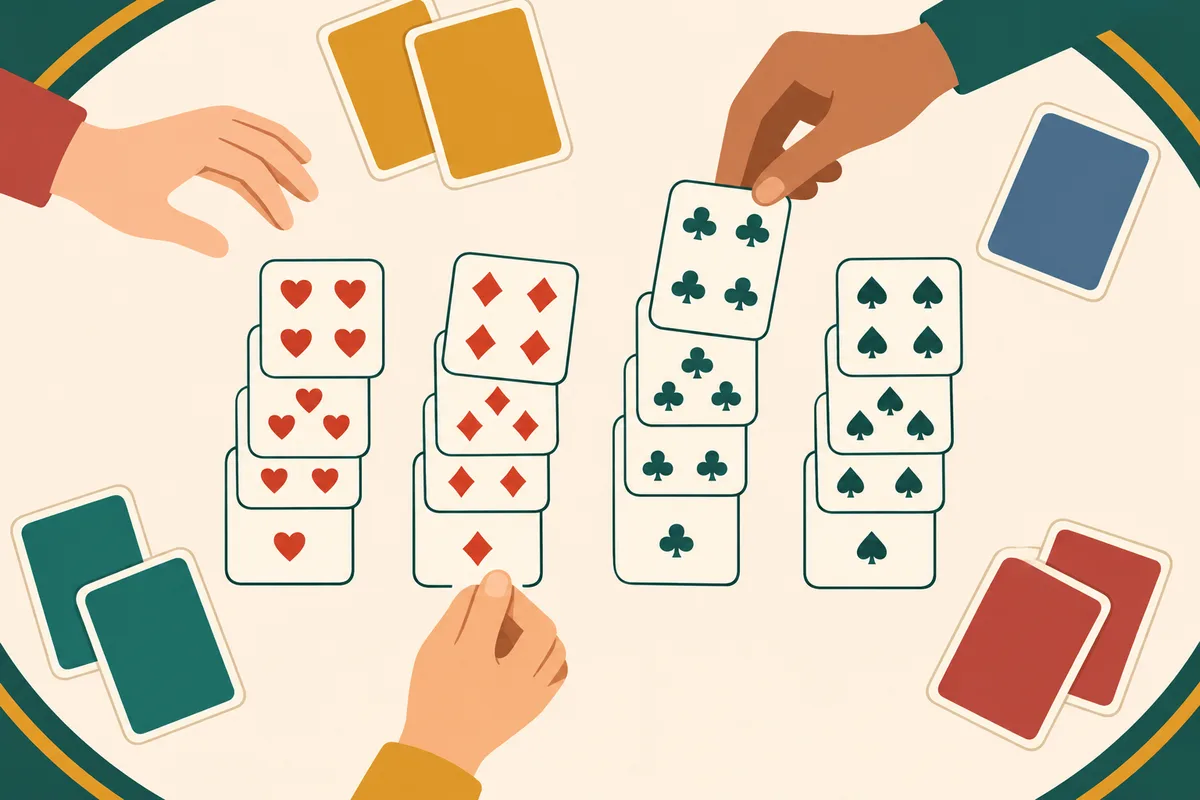
Stock and waste pile
The waste pile starts empty. Turn cards from your stock in groups of three onto it without changing their order. Only the top waste card can be played, to a work pile or the center.
When one or two cards are left in the stock, turn them onto the waste pile, then flip the whole waste pile face down as your new stock. Don't slide the waste pile under those last cards to turn a full group of three.
When everyone is stuck
If nobody can move, or nobody wants to, all players pick up their waste piles as new stocks and move the top stock card to the bottom, then keep playing (Pagat). If only you are stuck, you wait. Pagat notes this happens often with two players and seldom with more. If the table stays blocked and no stock card will play, the hand ends with no caller and gets scored as usual: everyone loses 2 points for each card left in their Nertz pile.
The NNA rulebook calls this an idled game and handles it with a "burn." After every team goes through its stock twice without a play, all teams move their top stock card to the bottom together. Three burns with no play at all allow the same move with the top Nertz card.
Do you have to play a card?
Pagat and Bicycle say no: holding a card back is always allowed. The NNA rulebook is stricter. Every available ace must go to the center at once, and a Nertz card that fits in the center has to go there unless an open work-pile space can take it. The default here follows Pagat, with no forced plays.
Calling "Nertz!"
Once your Nertz pile is empty you may call "Nertz!" and the hand stops right away. A card already on its way may land, and nothing else is played. You don't have to call the moment you finish; Pagat lets you keep playing to add more cards to the center first. If two players call at about the same time, RulesPal has the table decide who was first, and exactly simultaneous calls split its 10-point bonus 5 and 5.
Nertz scoring
After the call, sort the center piles by card back and score each player:
- +1 point for each of your own cards in the center
- −2 points for each card still in your Nertz pile (the caller has none)
Hand scores below zero are normal (RulesPal, Wikipedia). Add each hand to a running total and keep dealing until at least one player reaches or passes the target. The highest total then wins. RulesPal breaks a tie with one more hand.
Default rules vs the NNA rulebook
| Rule | Default (Pagat, Bicycle) | NNA rulebook (RulesPal) | Other sources |
|---|---|---|---|
| Target score | 100 | 150 | cardsjd: 100. Wikipedia: a set score such as 100 |
| Bonus for calling Nertz | None | 10 | Wikipedia: 10 is "fairly common." Pagat variation: 25 |
| Penalty per card left in the Nertz pile | 2 | 2 | Pagat variation: 1 |
| Hands for moving cards | One | Both | Not covered |
| Forced plays | None | Aces, and Nertz cards that fit the center | Not covered |
The tracker below can switch to NNA scoring.
Scoring example
Three players, default rules. Each cell: cards in the center, cards left in the Nertz pile, hand score.
| Hand | Maya | Jordan | Luis |
|---|---|---|---|
| 1 (Maya calls) | 14 in, 0 left: 14 | 9 in, 4 left: 1 | 5 in, 7 left: −9 |
| 2 (Jordan calls) | 11 in, 2 left: 7 | 16 in, 0 left: 16 | 8 in, 3 left: 2 |
| Total | 21 | 17 | −7 |
Maya and Jordan each got 25 cards into the center, but Jordan's four leftover Nertz cards in hand 1 cost him 8 points, while Maya's two in hand 2 cost her 4. With the NNA bonus, Maya would have 31 and Jordan 27.
After the call, sort the center by card back and type, for each player or team, the cards in the center and the cards left in the Nertz pile. Tick the player who called Nertz: their pile counts as empty and the bonus from the settings is added. If everyone got stuck and nobody called, leave every box unticked and type every pile. A hand scores the center cards minus the penalty for each card left, so it can go below zero. The game stops after the hand in which someone reaches the target, and the highest total wins; a tie at the top plays another hand. Switching a setting recalculates every hand already entered. Your game stays on this device until you start a new game.
Variations and house rules
Agree on these before the first deal.
- Bigger bonus: some players give the caller 25 points (Pagat).
- Lighter penalty: lose 1 point per Nertz card instead of 2 (Pagat).
- Shorter Nertz pile: 12 cards (11 face down) or 11 cards (10 face down), as Pagat records.
- Single cards: turn the stock one card at a time instead of in threes (Pagat).
- Jokers: add two per deck as wild cards. Before moving a joker to the center, name the rank and suit it stands for (Pagat).
- Stacking: move several available cards onto a center pile in one motion. Your table decides; RulesPal says NNA events allow it.
- Single hands: treat each hand as its own game, highest score wins (Pagat).
- Margin finish: stop when the gap between first and last place passes a set number such as 100 (Wikipedia).
FAQ
What does Nertz mean?
It's the name of the game and the word you shout when your Nertz pile runs out. Wikipedia gives Nerts as the US name and Racing Demon as the UK one; Pagat adds Pounce, Peanuts, Squeal and Scrooge. Card game historian David Parlett, cited by Wikipedia, traces the game to England in the 1890s as Racing Demon.
How is Nertz different from Solitaire?
The building rules come from Klondike, covered on the Solitaire rules page: columns go down in alternating colors, and suit piles climb from ace to king. Klondike is a one-player game with seven columns and four foundations. Nertz gives each player four work piles plus a 13-card pile to empty, and the ace piles in the center belong to the whole table.
Can two people play Nertz?
Yes. Pagat calls it a very good two-player game. Expect to get stuck more often than in bigger groups.
How many cards go in the Nertz pile?
Thirteen: 12 face down and 1 face up on top, which leaves 35 cards for the stock. Pagat records groups that deal 12 or 11 instead.
Can you play Nertz with one deck?
Not under standard rules. Each player or team needs a separate deck with its own back, or the center can't be sorted for scoring. Boxed sets exist, including Nertz by Bicycle (Wikipedia), and Pagat names Dutch Blitz and Ligretto as commercial relatives with their own 40-card decks.
Who wins a game of Nertz?
The player or team with the highest total once someone reaches the target, 100 by default. Calling Nertz doesn't guarantee the best hand score: as Pagat points out, another player who got more cards into the center can still outscore the caller.
- Solitaire rules — Klondike, the one-player game whose piles Nertz borrows
- Skip-Bo rules — the boxed game where you race to empty your own stockpile
- Best 2 player card games — picks for two, including fast games like this one
- Best card games for family game night — games that work for mixed ages at one table
- Best card games for adults — faster and trickier games for grown-up groups
- Classic card games — every traditional deck game on the site in one place