Euchre rules: how to play, call trump and the 3-player variant
* Difficulty is our editorial read on how hard the game is to pick up — not an official rating. Player counts and deck sizes come from the game's rulebook.
Euchre is a trick-taking card game for 4 players split into 2 fixed partnerships, using a stripped-down 24-card deck. Each player gets 5 cards, and trump is decided by bidding on a single turned-up card before play starts. The first partnership to reach 10 points wins.
Setup
Euchre uses a 24-card deck: only the 9, 10, jack, queen, king, and ace of each suit, with every card from 2 through 8 removed entirely. That short deck is one of the first things that trips up players coming from a full 52-card game like Spades or Rummy, since it changes what counts as a strong hand.
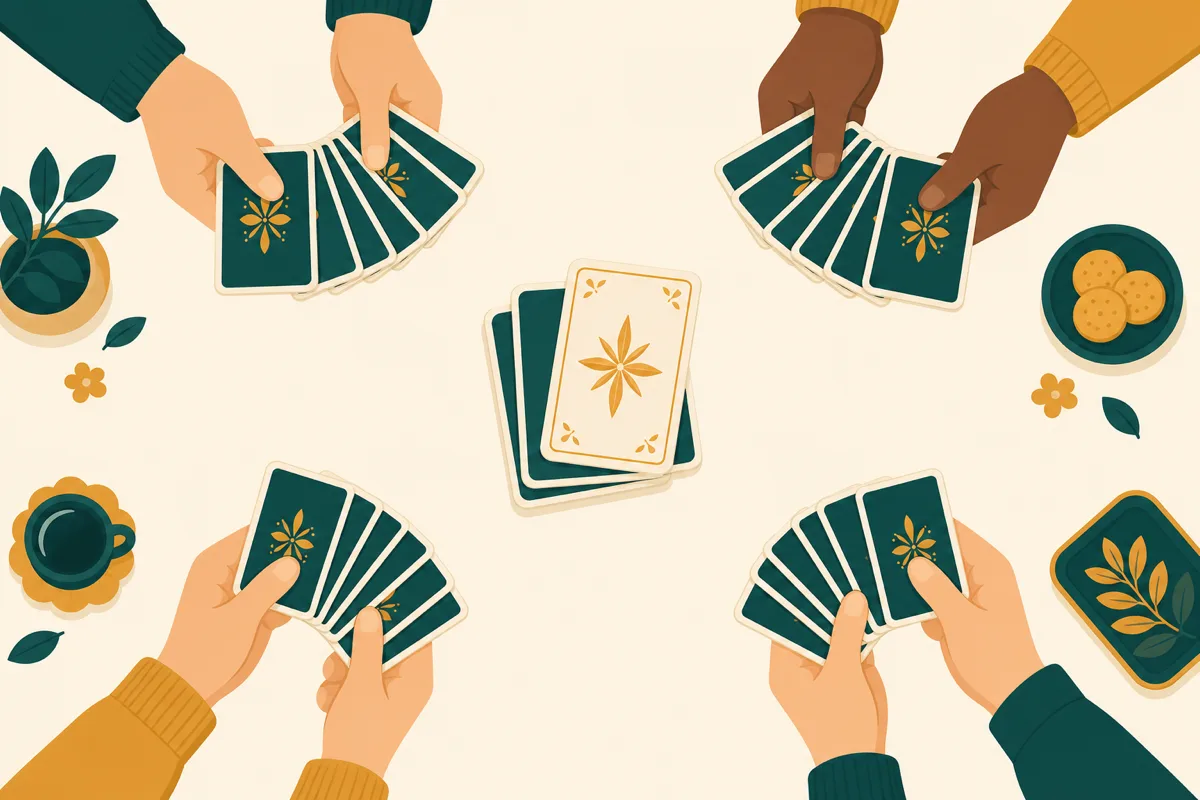
The dealer deals 5 cards to each of the 4 players, either in a 3-2 or 2-3 pattern (3 cards to a player, then 2 more later, or the reverse), whichever the dealer prefers, though the same pattern has to stay consistent all the way around the table during that deal. After dealing, 4 cards are left over and set face-down as the kitty, with the top card of that kitty turned face-up for everyone to see. That single turned-up card kicks off the entire bidding process described below.
Gameplay
Ordering it up
Bidding starts with the player to the dealer's left and moves around the table. Each player, in turn, either passes or "orders up" the turned-up card's suit as trump for the hand. Ordering it up doesn't mean taking the card yourself, it means committing that suit as trump and letting the dealer pick the turned card into their hand, discarding one card back face-down in exchange. If every player passes on this first round, the turned card gets flipped face-down and bidding moves to a second round.
Calling a different suit
In the second round, players again go in turn, but this time they can name any suit except the one that was just turned down as trump, a move usually called "calling" trump rather than ordering it up. There's no kitty pickup involved in this round, the caller simply declares the suit and play begins with that as trump. If every player passes again in this second round too, house rules vary on what happens next, some groups simply reshuffle and redeal, others force the dealer to name a suit rather than let the hand go to waste (see the "stick the dealer" variant below).
Going alone
At either bidding round, whoever orders up or calls trump can also announce they're going alone. Their partner sits out the entire hand, contributing no cards and taking no tricks, while the lone player plays their own 5 cards against both opposing players by themselves. It's a bigger risk since there's no partner to help cover tricks, but it pays out more if it works, covered in the scoring table below.
Right bower and left bower
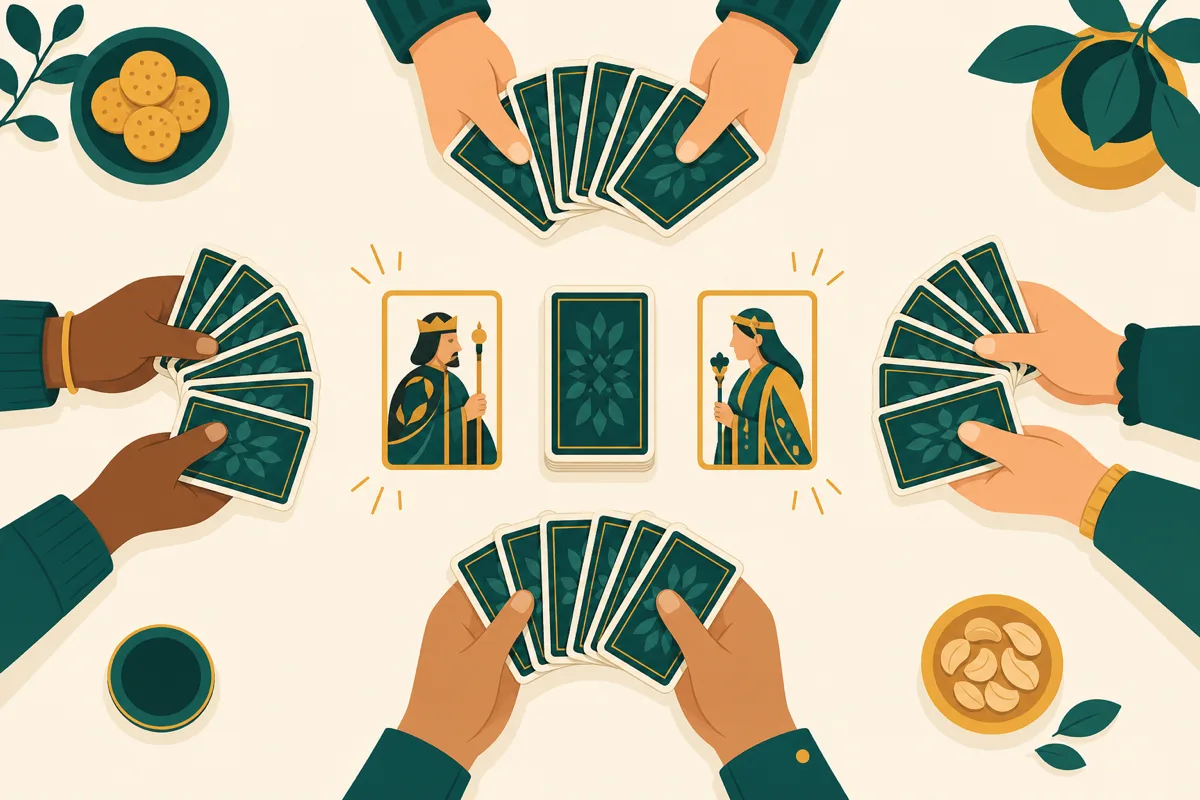
Once trump is set, two specific cards become the two most powerful cards in the hand, regardless of what trump suit was chosen. The jack of the trump suit is called the right bower, and it's the single highest card in play. The jack of the other suit that shares the same color, clubs and spades share black, hearts and diamonds share red, is called the left bower, and it becomes the second-highest card, counting as trump rather than its printed suit for the rest of the hand.
That last part matters for following suit: if trump is led, and you're holding the left bower, you have to play it as if it belongs to the trump suit, even though it's printed in the other suit. Likewise, if that other suit gets led instead, you're not required to follow with the left bower, since for play purposes, it isn't that suit anymore.
Following suit and winning a trick
Whoever wins a trick leads the next one. Every other player has to follow the suit that was led if they can, remembering that the left bower always counts as trump rather than its printed suit. A player with no cards in the suit led can play any card, including a trump. Whoever plays the highest trump card wins the trick outright, and if nobody plays a trump, the highest card of the suit that was led wins instead.
Scoring
Scoring happens once all 5 tricks in a hand have been played, and it depends on how many tricks the bidding side actually won.
| Outcome | Points |
|---|---|
| Bidding side wins 3 or 4 tricks | 1 point |
| Bidding side wins all 5 tricks (a "march") | 2 points |
| Lone player wins all 5 tricks (a lone march) | 4 points |
| Bidding side wins fewer than 3 tricks ("euchred") | 2 points to the defending side, regardless of who ordered up trump |
Going alone and taking all 5 tricks pays out double what a regular team march does, which is the whole reason players risk it despite losing a partner's help for the hand. Getting euchred is the flip side of that risk: if the side that named trump can't take at least 3 of the 5 tricks, the other side scores 2 points outright, whether or not anyone went alone.
Games are commonly played to 10 points, though some tables agree on a shorter 5- or 7-point game before starting, since there's no single number printed as the one official target the way there is for a game like Gin Rummy's 100. Confirm the target with your table before the first hand if it matters.
Variations: regional trump rules and the 3-player game
Euchre carries more regional house-rule variety than most games in this niche, and a few of these variants show up often enough to be worth knowing before you sit down at an unfamiliar table.
| Variant | What changes |
|---|---|
| Stick the dealer | If every player passes in the second round of bidding, the dealer isn't allowed to pass too, they're forced to name a trump suit rather than letting the hand be reshuffled and redealt. A common house rule specifically meant to keep the game moving |
| No trump | After the turned-up card is passed on in the first round, some tables let a player declare "no trump" instead of naming a suit. Every card then plays at its plain printed rank with no bowers and no trump suit boosting anything above its face value |
| Farmer's hand | A player dealt an unusually weak hand, commonly defined as holding only 9s and 10s, can trade a set number of their cards for unseen cards from the kitty instead of playing the hand as dealt, or force a re-deal, depending on the house's version of the rule |
| Joker as highest trump ("the Benny") | Some regional variants, more common outside North America, add a joker to the deck that outranks even the right bower as trump no matter which suit was called. Not part of the standard 24-card game covered above |
The 3-player game (Cutthroat Euchre)
Euchre also has a well-documented 3-player variant, sometimes called Cutthroat Euchre, that drops partnerships entirely rather than trying to force a fourth player into the game.
Each player still gets 5 cards, the same as the 4-player game, and bidding, ordering up, and calling trump all work exactly as described above, just among 3 individual players instead of 2 partnerships. Where sources genuinely disagree is the exact size of the kitty and how the leftover cards get handled, some published versions trim the deck down before dealing so a smaller kitty is left over, others keep the full 24-card deck and size the kitty differently. Because that detail varies by rule set, confirm the specific kitty-and-discard convention your table already uses before the first hand, rather than assuming one universal version.
The bigger change is in scoring and strategy rather than dealing mechanics. There are no partnerships at all, every player bids and plays entirely for themselves, and points typically go to whichever individual player calls trump and takes the majority of tricks. The exact scoring convention for this variant isn't as standardized as the core 4-player game, so, again, it's worth confirming the specific version your table plays before the first hand.
FAQ
How do you call trump in Euchre?
The dealer turns one card face-up after dealing, and players in turn either order that suit up as trump or pass. If everyone passes, a second round lets any player call a different suit entirely, except the one just turned down. Whoever orders up or calls trump can also choose to go alone, playing without their partner for a bigger potential payout.
What are the bowers in Euchre?
The right bower is the jack of the trump suit, the single highest card in the hand. The left bower is the jack of the other suit sharing the same color, and it counts as the second-highest trump card rather than its own printed suit, including when it comes to following suit during a trick.
How many points do you need to win Euchre?
Most games are played to 10 points, though it's a table agreement rather than one fixed universal number, some groups play shorter games to 5 or 7 points instead. Confirm the target before the first hand if it matters to your group.
Can you play Euchre with 3 players?
Yes, in a well-documented variant sometimes called Cutthroat Euchre. Each player still gets 5 cards, but there are no partnerships, every player bids, plays, and scores individually against the other two. The exact kitty size and scoring convention vary between published rule sets, so confirm those two details with your table before the first hand.
What's the difference between Spades and Euchre?
Both are trick-taking games with a trump element, but the mechanics differ in most other ways. Spades uses a full 52-card deck, fixed partnerships for the whole game, and a bidding phase where everyone independently commits to a number of tricks before play starts. Euchre uses a stripped-down 24-card deck, a trump suit chosen fresh each hand through bidding on a single turned-up card, and a shorter 5-trick round instead of Spades' 13-trick hands. If you already know Spades, Euchre plays faster and lighter, with trump changing hand to hand instead of always being spades.