How to play Chicken Foot dominoes: rules and scoring
Chicken Foot dominoes, also spelled Chickenfoot, is a domino game usually played by 2 to 8 people with a double-9 set of 55 tiles. Each round starts from one double, and the first tiles must cover all four sides of it. After that, every double played needs three tiles fanned out on its far side (the chicken foot) before anyone can play elsewhere.
- Hand size depends on the table: with a double-9 set, 20 tiles each for two players, 14 for three, 11 for four.
- Round 1 starts with the 9-9, round 2 with the 8-8, and so on down to the 0-0: 10 rounds on a double-9 set.
- No match? Draw one tile from the chicken yard, play it if it fits, otherwise pass.
- A round ends when someone plays their last tile or nobody can move.
- The others score the pips left in their hands, the double-blank counts 50, and the lowest total after the last round wins.
Setup
What you need
A double-9 set has 55 tiles, one for every pairing of the numbers 0 to 9. Pagat (John McLeod's game reference) says Chicken Foot normally uses a double-9 or larger set. Two or three players can manage with a double-6, and a big group can move up to a double-12 (91 tiles). Pagat calls the game best with four or more players. Wikipedia gives 2 to 12 players, best with 4 to 7.
In this game the draw pile is called the chicken yard and the layout on the table is the barnyard (Pagat).
How many tiles each player draws
Turn the tiles face down and shuffle, then each player draws a hand. Counts vary by source. The default here is a table from Puremco, one of the big domino makers, as reprinted by Pagat. Puremco leaves the double-9 column blank above six players, so those two rows come from shop guides.
| Players | Double-9 set: tiles each | Left in the chicken yard | Double-12 set: tiles each | Left in the chicken yard |
|---|---|---|---|---|
| 2 | 20 | 15 | Not listed | Not listed |
| 3 | 14 | 13 | Not listed | Not listed |
| 4 | 11 | 11 | 18 | 19 |
| 5 | 9 | 10 | 14 | 21 |
| 6 | 7 | 13 | 12 | 19 |
| 7 | 6 | 13 | 10 | 21 |
| 8 | 5 or 6 | 15 or 7 | 9 | 19 |
For seven and eight players on a double-9, Yellow Mountain Imports deals 6 and 5 each, and MexicanTrainFun deals 6 each to eight. Yellow Mountain Imports also gives two players 21 each and five players 8 each. Every deal here leaves tiles in the chicken yard for stuck turns.
Pagat passes on suggestions of smaller hands: 10 tiles each for four players on a double-9, 11 for three and 12 for two, or 5 each for two or three players on a double-6. Wikipedia's basic deal is 7 tiles each, or 15 for four players on a double-12. Everyone draws the same number of tiles every round (MexicanTrainFun).
The starting double
Round 1 uses the highest double in the set, the 9-9 on a double-9. Whoever drew it places it in the middle of the table, and play then moves to the left. If nobody has it, everyone draws one more tile from the chicken yard until it turns up (Pagat, Yellow Mountain Imports).
Each later round starts with the next double down: 8-8 in round 2, 7-7 in round 3, and 0-0 in the last round.
Gameplay
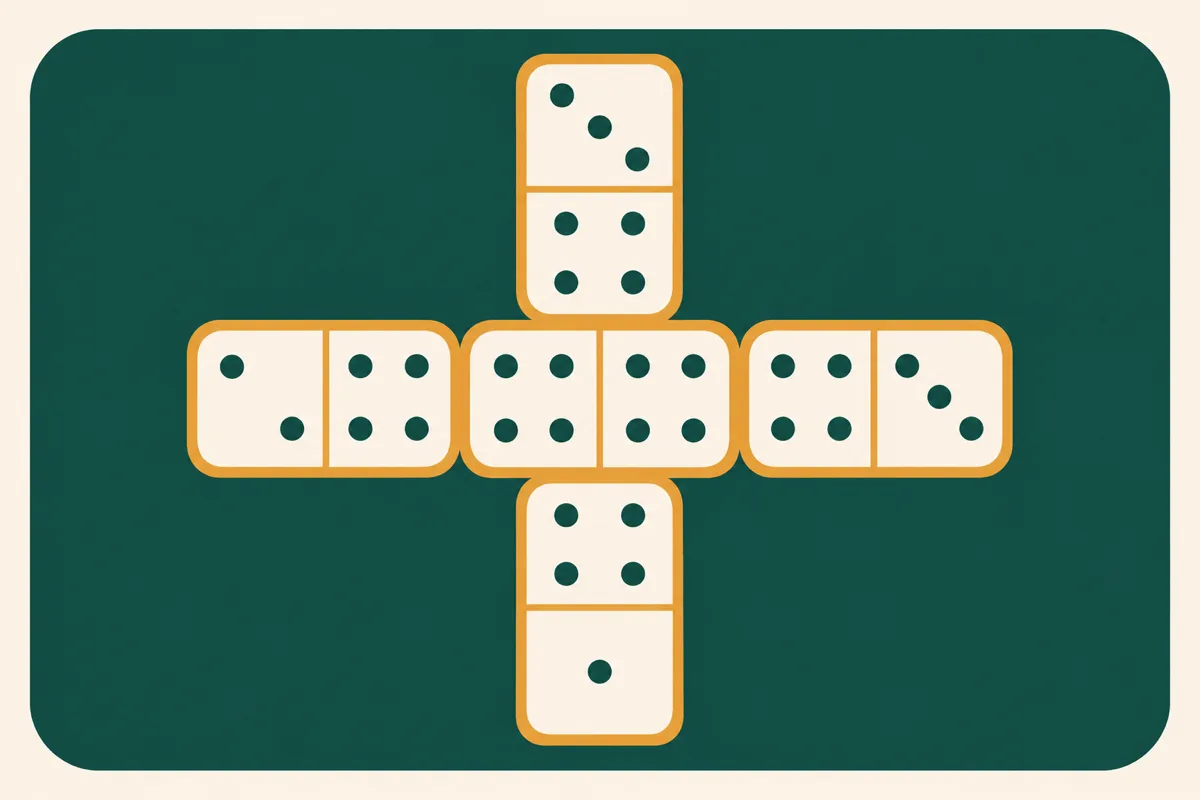
Cover all four sides of the starting double
The first four tiles played all go against the starting double, one per side, so the opening looks like a cross. In round 1 each needs a 9 touching the double. Nobody adds a second tile to any arm until all four sides are filled (Pagat, Wikipedia).
Why four? Pagat treats it as the rule every double follows: a double needs four matching tiles next to it before play moves on. A later double already touches one, the tile it was played on, so it needs three more. The starting double touches none, so it needs all four.
A player without the right number draws one tile from the chicken yard and plays it if it matches. Otherwise the turn passes left.
Building out from the cross
Once the cross is done, play on any open end in the barnyard, matching numbers end to end. If you can't, draw one tile and play it right away if it fits; otherwise pass. With the chicken yard empty, you just pass.
How a chicken foot works
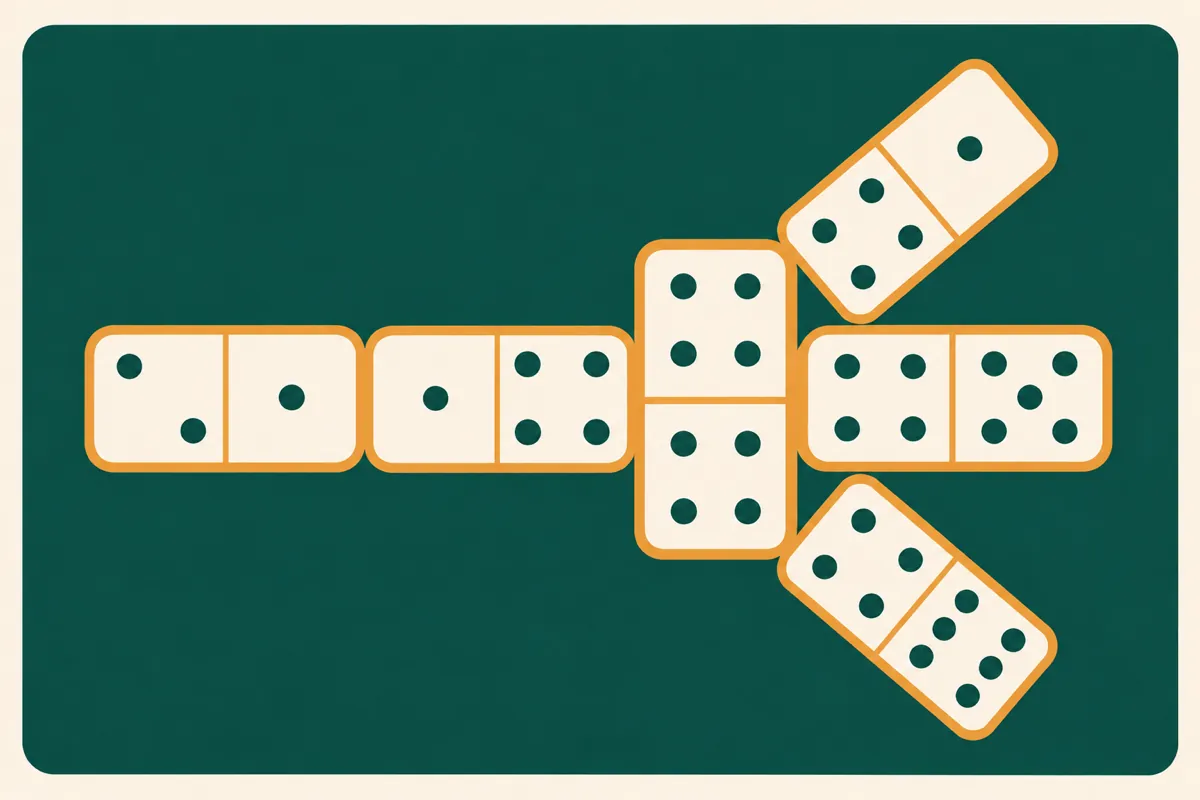
Whenever you play a double, lay it crosswise against the tile it matches and call it out ("chicken foot," "chickie," or "chickie sixes" for a 6-6) so everyone knows the foot rule is on (Pagat, Wikipedia, Yellow Mountain Imports).
The next three tiles anyone plays must go on the far side of that double: one straight out and two angled away from it, like toes. Until the third toe is down, nobody plays anywhere else, and a player without a matching tile draws as usual. Once the foot is complete, the next player can play on any open end again, toes included.
Pagat offers one tactic built on this rule: play a double when an opponent is down to one tile. Unless that last tile fits the foot, they have to draw.
When the round ends
A round is over the moment one player plays their last tile. It also ends if the game blocks: the chicken yard is empty and nobody has a legal play. Wikipedia gives one way this happens: someone plays a double when fewer than three unplayed tiles carry that number, so the foot can never be finished.
Announcing that you're down to one tile is a courtesy under Pagat's rules, not a requirement.
Scoring
Chicken Foot scoring happens at the end of every round, and low is good. Each player adds the pips on the tiles still in hand to a running total. Whoever went out scores 0.
What the double-blank is worth
The 0-0 has no pips, yet three of the four rule sets on this page charge 50 for it.
| 0-0 left in your hand | Who plays it this way |
|---|---|
| 50 points (default here) | Pagat, MexicanTrainFun, and Wikipedia, citing Jennifer Kelley's Great Book of Domino Games (1999) |
| 25 points | A variation listed by Pagat |
| 0 points (just its pips) | Yellow Mountain Imports, which lists 50 only as an optional rule |
Any other tile with a blank half counts only the number on its other half, so a 6-0 is worth 6 (Wikipedia). Pagat's advice follows from the 50: get rid of the 0-0 early.
How many rounds, and who wins
One round per double, from the highest down to 0-0:
| Set | Tiles | Rounds | First and last starting double |
|---|---|---|---|
| Double-6 | 28 | 7 | 6-6 to 0-0 |
| Double-9 | 55 | 10 | 9-9 to 0-0 |
| Double-12 | 91 | 13 | 12-12 to 0-0 |
Pagat and Yellow Mountain Imports state the 10 rounds for a double-9. The 7 and 13 are worked out from Wikipedia's one-round-per-double rule; no source prints them.
After the 0-0 round, the lowest total wins (Pagat, Wikipedia, Yellow Mountain Imports, MexicanTrainFun). Pagat also describes playing to an agreed high total: whoever reaches it loses, and the lowest score wins. None of the four rule sets has a tiebreaker, so the tracker below treats a tie for lowest as a shared win.
Scoring example
Four players, Ana, Ben, Cal and Dee, use a double-9 set and draw 11 tiles each. Each cell shows the tiles left in hand, then the points with the 0-0 at 50.
| Round | Ana | Ben | Cal | Dee |
|---|---|---|---|---|
| 1 (9-9) | Went out: 0 | 6-4, 0-0: 60 | 5-3, 2-1: 11 | 9-7: 16 |
| 2 (8-8), blocked | 3-2: 5 | 4-4: 8 | 1-0: 1 | 6-5, 2-0: 13 |
| 3 (7-7) | 9-8: 17 | 1-1, 3-0: 5 | Went out: 0 | 0-0: 50 |
| Total after round 3 | 22 | 73 | 12 | 79 |
Ben and Dee trail because each got caught with the 0-0. Count the double-blank as 0 instead and the totals become Ana 22, Ben 23, Cal 12, Dee 29. At 25 points, Ben has 48 and Dee 54.
Game setup
Players and the domino set are locked after the first round. New game unlocks them. The 0-0 value can change at any time and every total follows.
| Player | Pips left | Held 0-0 | Went out |
|---|
Count every pip on the tiles still in hand. The 0-0 has no pips: tick Held 0-0 instead of typing 50. Nobody went out? Leave Went out empty for a blocked round. Playing "no going out on a double"? Add 50 to that player's pips.
Each cell shows the points for that round, then your running total. The lowest total in a row is shaded. Lowest total after the 0-0 round wins, and a tie for lowest is a shared win. Switching the 0-0 value recalculates every saved round. Tap Edit on a saved round to correct it. Your game stays on this device until you start a new game.
Variations and house rules
Settle these before the first round.
- Double chicken foot opening: the starting double gets three tiles on each side, six in all, before play spreads. MexicanTrainFun makes it the main rule; Pagat lists it as a variation.
- Three-sided opening: some groups fill only three sides of the starting double (Wikipedia). Yellow Mountain Imports leaves 4 or 6 sides to the players.
- Missing starting double: instead of drawing until it shows up, start with the next lower double, or reshuffle and draw new hands (MexicanTrainFun, and Pagat for the double chicken foot).
- Set the double out first: place the round's double face up before the draw and rotate who starts (Pagat).
- Chicken little rule: you must announce your last tile. If someone catches you forgetting, you draw a tile, or miss your next turn when the chicken yard is empty (Pagat).
- No going out on a double: Wikipedia, citing Kelley, says a player whose last tile is a double takes 50 points.
- A longer game: after the 0-0 round, MexicanTrainFun plays back up from 1-1 to 9-9.
FAQ
Is it Chicken Foot or Chickenfoot?
Both are right. Wikipedia says about three quarters of reliable sources use one of those two spellings. Other names are Chickie Dominoes and Chicken-Foot Dominoes.
How many dominoes does each player get in Chicken Foot?
With a double-9 set: 20 tiles each for two players, 14 for three, 11 for four, 9 for five, 7 for six (Puremco), then 6 for seven and 5 or 6 for eight (shop guides). The double-12 numbers are in the Setup table.
Is Chicken Foot the same as Mexican Train?
No. Both run rounds from the highest double down and score the pips left in hand, lowest total winning. Under Mexican Train rules, each player has a personal train and everyone shares one more. Chicken Foot has no trains at all: the whole table builds one branching layout that starts as a cross, and every double has to grow a three-toed foot before play continues.
What happens if nobody can finish a chicken foot?
Players without a matching tile keep drawing on their turns. Once the chicken yard is empty and nobody can play, the round is blocked and everyone scores their hand.
Who invented Chicken Foot?
Wikipedia credits Louis and Betty Howsley in 1986, citing Kelley's 1999 book. Pagat only says the game seems to have started in Texas or Mexico.
- Dominoes rules — Block and Draw, the basic games for a double-6 set
- Mexican Train rules — the double-12 game with personal trains and a shared one
- Mexican Train score sheet — round-by-round scoring for Mexican Train, online or printed
- Dice and board games — every dice, domino and solo game on the site in one place
- Best family board games for game night — a mixed-age lineup that includes dominoes and Mexican Train