How to play Crazy Eights: card game rules and scoring
The Crazy Eights card game is for 2 to 8 players and uses one standard deck, or two past five players. You match the top card of the discard pile by suit or rank, eights are wild, and the first player out of cards wins the deal.
- Deal 5 cards each, or 7 each with two players. Turn the next card face up to start the discard pile.
- On your turn, play a card of the same suit or rank, or play any 8 and name the next suit.
- Can't play? Draw from the stock until you can. You may also draw while holding a playable card.
- Cards left in a hand are worth: 8 = 50, king, queen, jack and 10 = 10, ace = 1, everything else face value.
- There are two ways to score. The winner collects from the others (Bicycle's printed rule), or everyone keeps penalty points and the lowest total wins once someone reaches 100 (200 in some versions).
Setup
What you need
One standard 52-card deck, plus paper or the tracker below for the score. Past five players, shuffle two decks together. Player limits differ by rule set: Wikipedia says 2 to 7, Pagat (John McLeod's card game reference) says 2 to 8, Gamerules.com and Dice Game Depot go to 10, and Bicycle, the playing card brand, just lists 5+ at the top end. Bicycle rates the game for ages 4 and up.
The deal
Deal face down, one card at a time, from the dealer's left until everyone has 5. With two players, the default here is 7 each, as in Pagat and Wikipedia. Bicycle deals 5 at any table size.
Put the rest face down as the stock. Its top card goes face up next to it as the first discard.
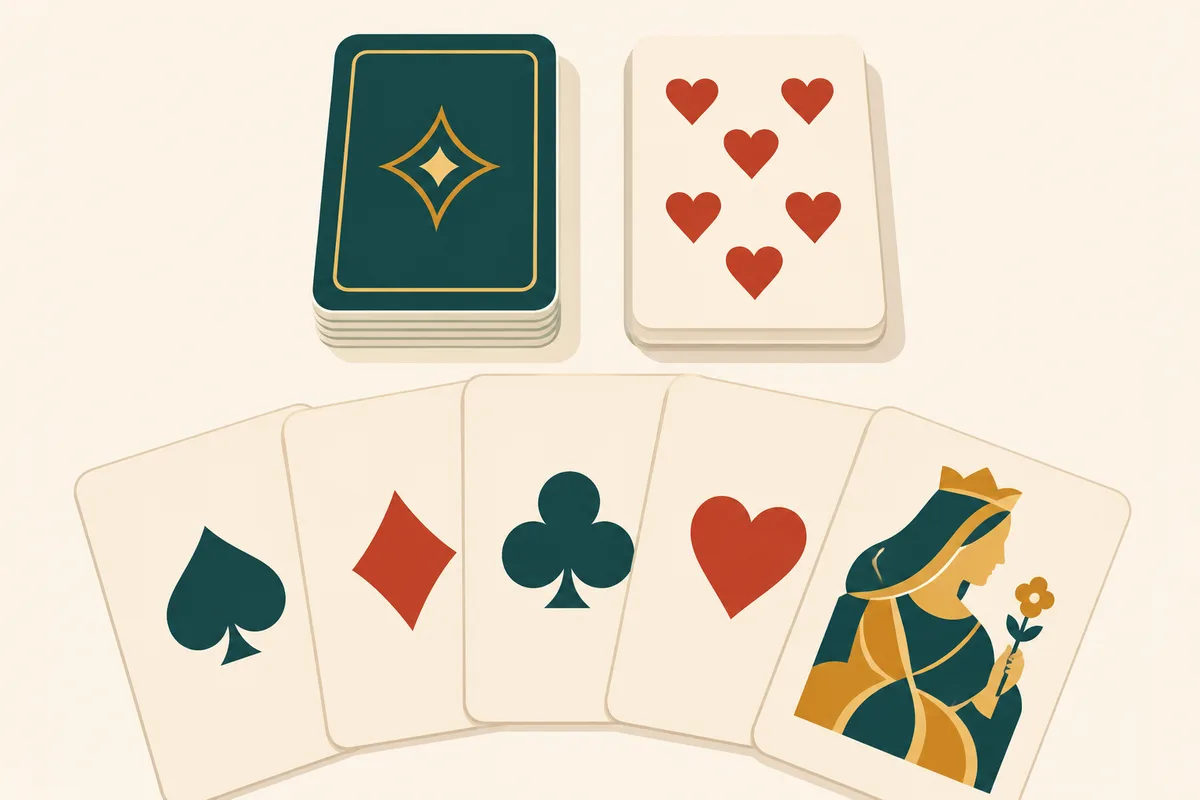
If the first card is an 8
Bicycle's rule is the default here: put the 8 back in the middle of the stock and flip a new card.
Pagat counts it as the dealer's own play. The dealer checks their hand and calls a suit, and the player to their left has to answer with that suit or an 8.
Gameplay
The player on the dealer's left goes first, and play moves clockwise. On your turn, you put one card on the discard pile or you draw.
What you can play
- Any card of the same suit as the top card.
- Any card of the same rank.
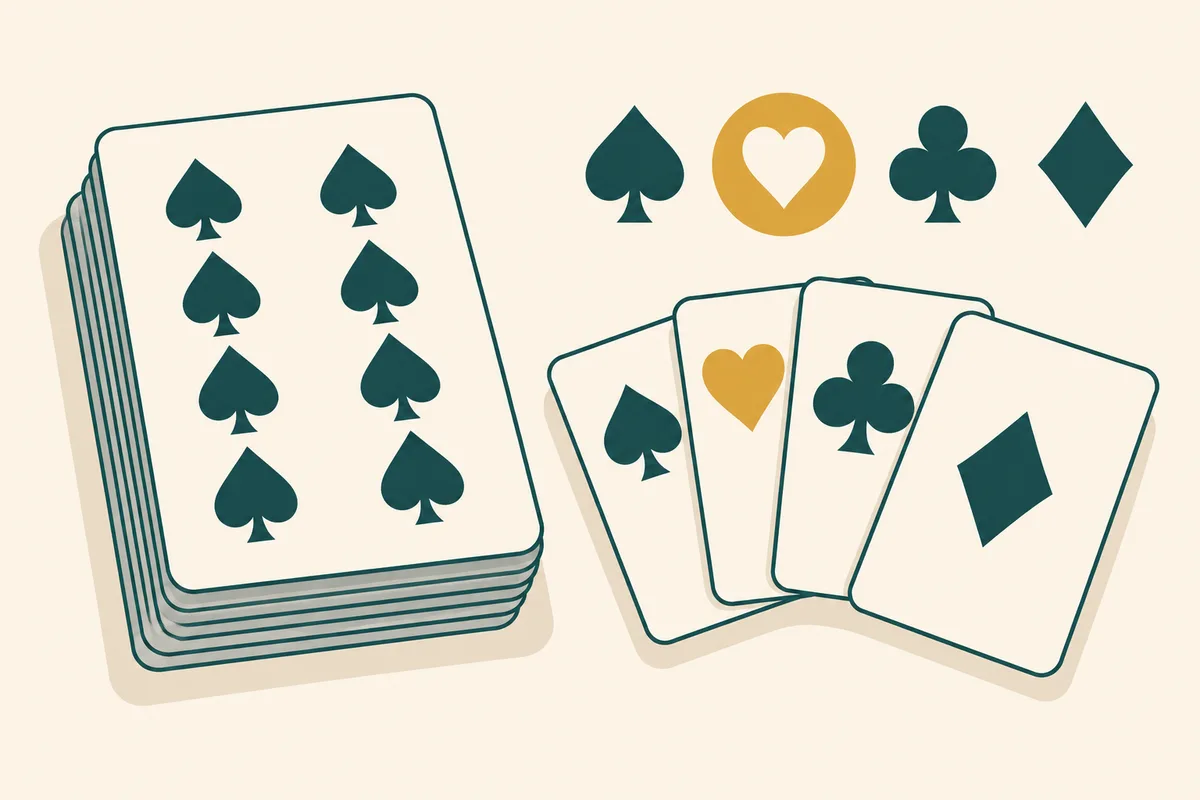
- Any 8, whatever is showing. Name a suit as you play it, not a number.
With the 9 of hearts on top, you can play any heart, any 9 or any 8. After an 8, the next player needs a card of the named suit or another 8.
Can you draw if you have a playable card?
Yes. Bicycle, Pagat and Wikipedia all allow it. Pagat also mentions tables that let you draw only when you have nothing to play.
How many cards do you draw?
The default here is to keep drawing until you can play, as Bicycle and Wikipedia have it. Pagat's basic game is different: a draw is one card, and your turn ends. Pagat also lists groups that let you play that card at once if it fits, and groups that cap the draw at a fixed number.
Bicycle and Wikipedia don't say how many cards you may take when you draw by choice, so settle that at the table.
What happens when the stock runs out?
The default here comes from Pagat and Wikipedia: leave the top discard where it is, shuffle the others and place them face down to draw from.
Bicycle has no reshuffle. If you can't play, you pass. Pagat's author says most rule books print this version, though he doubts many people play it. A full round of passes blocks the deal, and everyone counts what they hold. Under penalty points, each player adds their own hand. Under winner collects, only the lowest hand scores: it takes the gap to each other hand, so with hands of 5, 12 and 30, the 5 scores 7 + 25 = 32.
Going out
The deal ends the moment someone plays their last card. You can finish on an 8. Bicycle lets you play one on any turn, and none of the rule sets above makes an exception for your last card. SuitedGames, an online version of the game, says so outright and adds that some families forbid it. No source covers naming a suit at that point, but nobody plays next, so it wouldn't matter.
Scoring
Crazy Eights scoring counts the cards still in hand when a deal ends. Bicycle, Pagat and Wikipedia agree on the values.
| Card left in hand | Points |
|---|---|
| Each 8 | 50 |
| King, queen, jack or 10 | 10 |
| Ace | 1 |
| 2 through 7, and 9 | Face value |
Two ways to keep score
The values stay the same. The systems differ in who gets the points.
| What changes | Penalty points | Winner collects |
|---|---|---|
| After each deal | Each player adds their own hand. The player who went out adds 0. | The player who went out adds the total of everyone else's hands. |
| Target | 100, or 200 for a longer game | 50 per player: 100 for two, 200 for four, 350 for seven |
| Who wins | Lowest total once someone reaches the target | First player to reach the target |
| Where it comes from | Pagat gives the penalty points but no target. Gamerules.com and Dice Game Depot play to 100, lowest total wins. SuitedGames plays to 200 the same way. | Bicycle and Wikipedia. The target is Wikipedia's; Bicycle names none. |
The default here is penalty points to 100. Everyone adds up only their own hand, which is easier with kids at the table, and the tracker below opens that way. You can change the target, and the switch moves to winner collects if your group plays by the printed rule.
None of these sources says what happens when two players tie for the lowest total. The tracker shows the tie and offers another deal.
Scoring example
Three players use penalty points to 100. Each cell shows what that player added, with their hand in brackets.
| Deal | Ana | Ben | Cal |
|---|---|---|---|
| 1 | 0 (went out) | 63 (8, K, 3) | 18 (Q, 7, A) |
| 2 | 11 (9, 2) | 0 (went out) | 56 (8, 6) |
| 3 | 9 (5, 4) | 80 (K, Q, 10, 8) | 0 (went out) |
| Total | 20 | 143 | 74 |
Ben passes 100 on deal 3, so the game stops and Ana wins with 20.
Under winner collects, the same three deals give Ana 63 + 18 = 81, Ben 11 + 56 = 67 and Cal 9 + 80 = 89. The target for three players is 150, so that game keeps going.
Tick the player who went out, then type the points left in every other hand: each 8 is 50, king, queen, jack and 10 are 10 each, an ace is 1, and 2 to 7 and 9 are face value. If the deal was blocked and nobody went out, leave everyone unticked and type every hand. Switching the scoring system recalculates every deal already entered. Your game stays on this device until you start a new game.
Variations and house rules
Crazy Eights rules shift from table to table. Pagat's author doubts you'd find two groups with identical house rules, so settle yours before the deal.
Action cards: queen, ace and two
Bicycle doesn't use these, so they're off by default here. Pagat calls them typical and Wikipedia lists them as common.
| Card | What it does | If it's the first card turned |
|---|---|---|
| Queen | Skips the next player | First turn goes to the player two seats left of the dealer |
| Ace | Turns play the other way | Player on the dealer's right starts, and play runs counterclockwise |
| Two | Next player draws 2 or plays another 2. Each 2 in a row adds 2 more cards, and an 8 won't get you out of it. Cards drawn this way can't be played that turn. | First player plays a 2 or draws 2 |
With two players, a queen gives you another turn and an ace does nothing. If the deal ends on an action card, skip its effect: a 2 played as your last card costs no one anything.
How this connects to Uno
Uno belongs to the same family of games, and Pagat calls it probably the best-known commercial version. If you know Uno rules, the cards map closely: Skip acts like the queen, Reverse like the ace, Draw Two like the two, and a Wild like an 8.
Uno deals 7 at any table size, plays to 500, and gives you one card when you have no match. Mattel's sheets give no way to pass a Draw Two along. If your last Uno card is a Draw Two, the next player still draws, the opposite of the rule above.
Other house rules
- Pagat has a player with one card say "last card" before the next turn starts, or draw 2. Bicycle and Wikipedia have no such rule, so it's optional here.
- Some groups let you play several cards of one rank together, as long as the first is legal.
- Some groups make an 8 match suit or rank like any other card. Others let it go anywhere with no suit named, so the next player follows the 8's own suit.
Crazy Eights Countdown
Pagat calls this version popular in North America. Everyone starts on 8 points with 8 cards. When you run out, your number drops by 1 and you get that many new cards, while everyone else keeps playing what they hold. Your number is also your wild card, so at 6, sixes are wild for you. First to zero wins.
FAQ
How many cards do you deal in Crazy Eights?
Five each, or seven each with two players, per Pagat and Wikipedia. Bicycle deals 5 at every table size, and some groups start with 8.
Can you finish Crazy Eights on an 8?
Yes under Bicycle, Pagat and Wikipedia, since none of them bars it. SuitedGames notes that some families do, so ask before you deal. Nobody has to follow a suit once your hand is empty, and you avoid being caught holding a card worth 50.
How many points is an 8 worth in Crazy Eights?
Fifty, the most of any card. Kings, queens, jacks and tens are worth 10, aces 1, and everything else its face value.
Is Crazy Eights the same as Uno?
No. Crazy Eights uses a standard 52-card deck with eights wild, and Uno has its own deck, 108 cards in the classic printing. They are in the same family.
- Uno rules — the boxed game from the Crazy Eights family, with its own deck
- Kings Corner rules — a family card game where you also try to empty your hand
- 31 card game rules — a plain-deck game where you knock and keep lives
- Rummy 500 rules — a draw-and-discard game for a standard deck, scored to 500
- Classic card games — every traditional deck game on the site in one place
- Best card games for family game night — picks for a mixed-age table