How to play Liverpool Rummy: rules for all seven hands
* Difficulty is our editorial read on how hard the game is to pick up — not an official rating. Player counts and deck sizes come from the game's rulebook.
Liverpool Rummy is a contract rummy card game for 3 to 8 players, played over seven hands with two or more decks and their jokers. Each hand has a contract, a fixed mix of books and runs you must lay down before playing any other cards. The lowest total after hand 7 wins.
- Book: 3 or more cards of one rank. Run: 4 or more cards in a row, all one suit.
- Contracts for hands 1 to 7: two books; book and run; two runs; three books; two books and a run; book and two runs; three runs. Deal 10 cards in hands 1 to 4 and 12 in hands 5 to 7.
- Buying: if the player whose turn it is passes on the top discard, anyone else can take it plus a penalty card from the stock.
- Calling Liverpool: after you're down, a discard that fits a meld on the table can be called, and you take it back plus a penalty card.
- Cards left in hand count against you: 2 to 9 score 5, 10 to K score 10, aces and jokers 15.
Setup
Players, decks and jokers
Wikipedia lists 3 to 8 players, and Pagat (John McLeod's card game reference) calls four ideal. Shuffle standard 52-card decks together with their jokers, which are wild. The deck count varies by rule set:
| Players | Default (Wikipedia) | Sun City Texas club | Pagat |
|---|---|---|---|
| 3 | 2 decks, 4 jokers | 3 decks, 6 jokers | 2 decks, 2 jokers |
| 4 | 2 decks, 4 jokers | 3 decks, 6 jokers | 2 decks, 3 jokers |
| 5 | 3 decks, 6 jokers | 3 decks, 6 jokers | 2 decks, 4 jokers |
| 6 | 3 decks, 6 jokers | 5 decks, 10 jokers | Not listed |
| 7 or 8 | 4 decks, 8 jokers | Not listed | Not listed |
The 3 to 6 rows follow Wikipedia's Liverpool Rummy article and the 7 or 8 row its Contract Rummy article. Pagat uses one joker fewer than the number of players.
Dealing
Pick the first dealer at random; the deal then passes to the left each hand. Deal one card at a time, stack the rest face down as the stock (draw pile) and turn its top card up to start the discard pile. The player left of the dealer goes first.
| Hand | Default (Wikipedia) | Pagat, Sun City, Denexa | Rummy Rulebook, six hands |
|---|---|---|---|
| 1 to 3 | 10 | 10 | 10 |
| 4 | 10 | 12 | 10 |
| 5 and 6 | 12 | 12 | 10 |
| 7 | 12 | 12 | Not played |
The Rummy Rulebook's Contract Rummy page and gamerules.com deal like Wikipedia; Denexa, a playing card maker, deals like Pagat.
Gameplay
The seven contracts
The game has seven hands, also called rounds or deals. Your first lay-down in each hand must match its contract exactly.
| Hand | Contract | Cards to lay down | Cards dealt |
|---|---|---|---|
| 1 | Two books | 6 | 10 |
| 2 | One book and one run | 7 | 10 |
| 3 | Two runs | 8 | 10 |
| 4 | Three books | 9 | 10 |
| 5 | Two books and one run | 10 | 12 |
| 6 | One book and two runs | 11 | 12 |
| 7 | Three runs, whole hand, no discard | All, at least 12 | 12 |
Wikipedia's Liverpool article alone lists hand 7 as one run of seven; every other seven-hand rule set here, including its Contract Rummy article, uses three runs.
Books, runs and aces
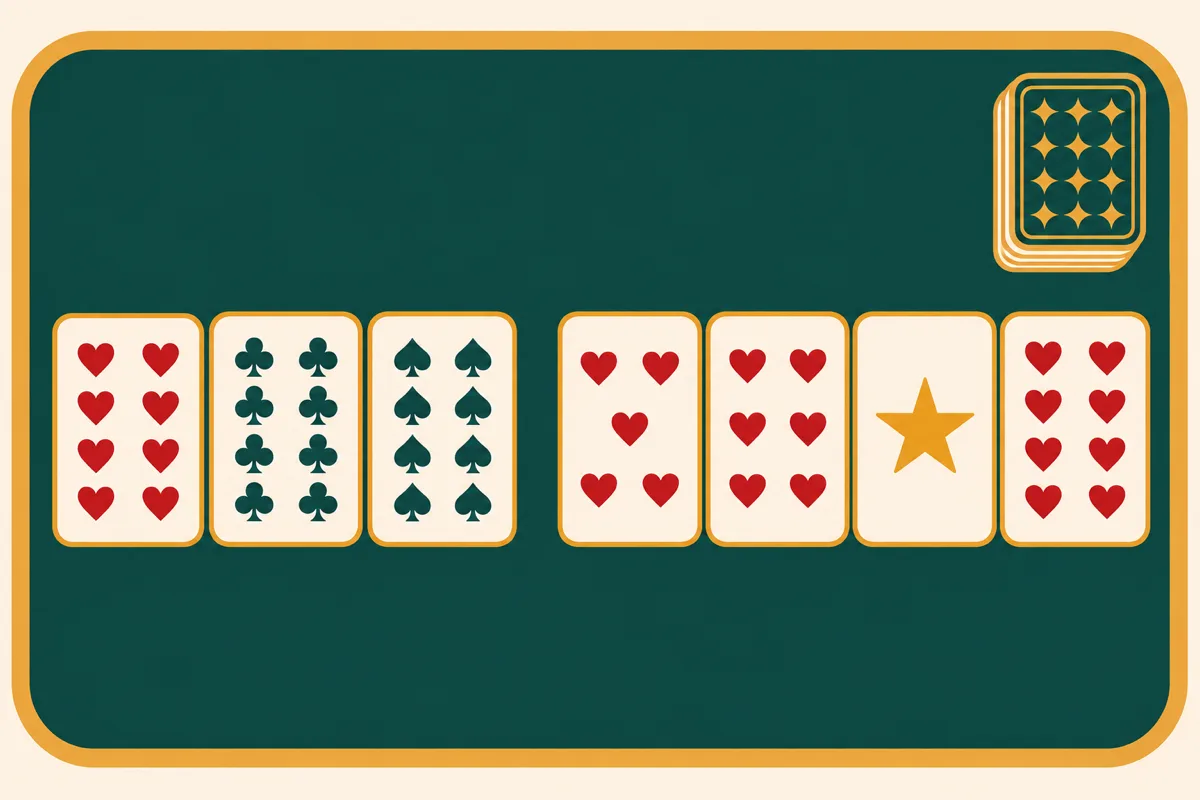
A book is three or more cards of one rank, any suits. A run is four or more cards of one suit in sequence. Aces are high or low, not both: A-2-3-4 and J-Q-K-A work, K-A-2-3 doesn't. The longest run is 14 cards, ace to ace.
When you lay down the contract, put down only 3 cards per book and 4 per run; extras wait for your next turn. Two runs in one suit can't join end to end: 3-4-5-6 and 7-8-9-10 of hearts count as one run, not two. Sun City also bars two books of the same rank in one contract.
Taking a turn
- Draw the top card of the stock or the discard pile.
- Lay down your contract if you can. It's optional and happens once per hand.
- From your next turn on, lay off cards onto any meld on the table, yours or another player's.
- Discard one card face up, but not the card you just took from the discard pile.
Starting a lay-down you can't complete costs 50 points (Wikipedia). When the stock runs out, shuffle all discards except the top card into a new stock.
Buying a discard
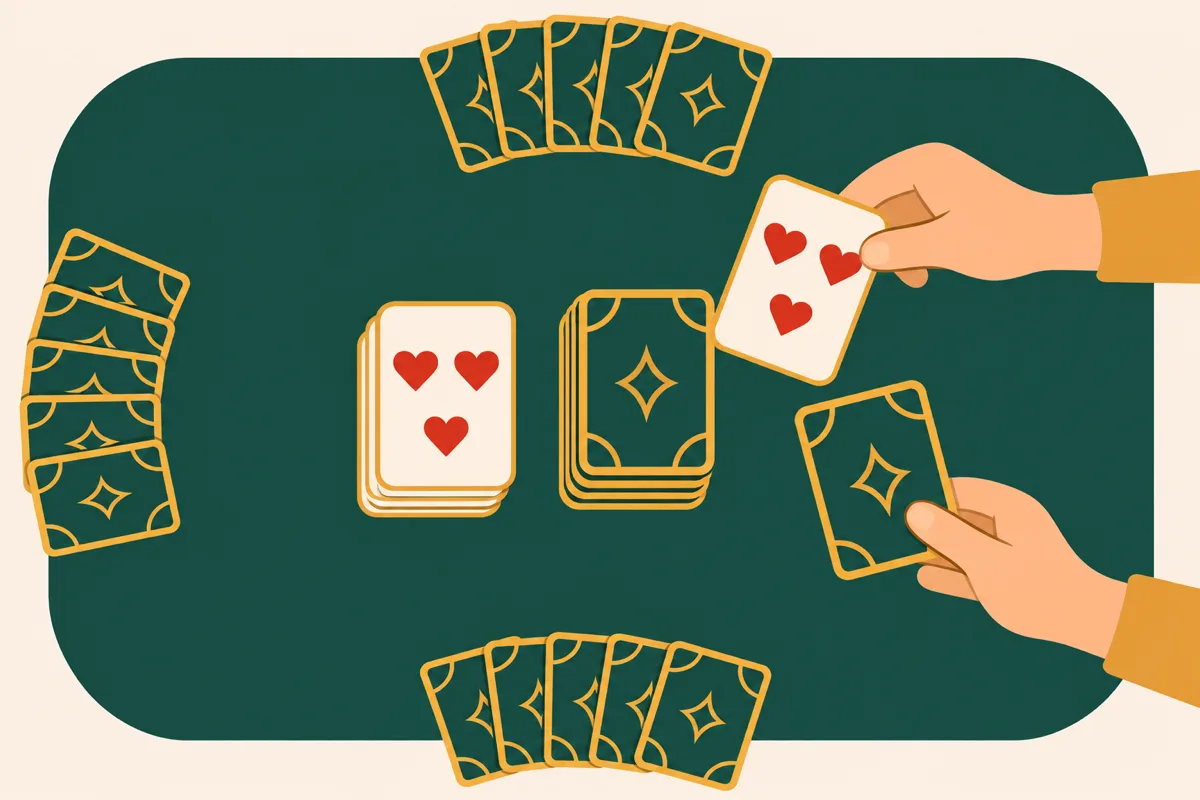
Buying, which Pagat calls the "May I?", lets you take the top discard out of turn.
- The player whose turn it is has first claim. Taking the card is their normal draw, and nobody can buy it.
- If they draw from the stock instead, anyone else may buy the discard. The price is a penalty card off the stock, so the buyer picks up two.
- With several buyers, the one next in turn after the current player gets it. In Wikipedia's other version, the first to call "I'll buy that" gets it.
- The buyer doesn't lay down or discard. Play returns to the current player, and their stock draw closes the window.
- Pagat and Denexa set no limit on buys per hand, but no one may buy two cards in a row.
Jokers
A joker stands for any card. A new book needs at least two natural cards and a new run of four at least three, so each meld you lay down holds one joker at most (Wikipedia, Sun City). Sun City also bans two jokers side by side. Pagat sets no cap.
If a joker sits in a run and you hold the card it stands for, you can swap them, as long as you laid down on an earlier turn. The joker must be played again that same turn. Jokers in books stay put. Sun City also allows a swap to complete your own lay-down; Pagat's "May I?" bans swaps.
Calling Liverpool
Once you've laid down, your discard must not fit any meld on the table. If it does, another player can call it before the next player's turn starts. Wikipedia gives two versions:
- "Calling rummy" (default here): any other player can call, and you take the discard back plus a penalty card from the stock.
- "Liverpool": only players who have laid down can call, and the first caller may get rid of one card onto the discard pile.
The chance passes once the next player draws or lets someone buy. A discard that takes you out can't be called.
Going out and floating
You go out by discarding your last card, which ends the hand. It's customary to knock on the table when you're down to one card.
If you lay off everything and have no card left to discard, you're floating and the hand goes on. You can keep laying off, but to go out you must draw a stock card you can't play and discard it (Wikipedia). Pagat and Denexa instead end the hand as soon as anyone's hand is empty. If the stock and discard pile both run out, the hand ends and everyone scores.
The last hand
In hand 7 you lay down your whole hand at once as three runs, with no discard, which ends the game. With 12 cards dealt plus your draw you hold at least 13, so one run needs five or more cards. Pagat's "May I?" version plays hand 7 like the others.
Scoring
When someone goes out, they score 0 and everyone else totals the cards left in hand. Scores carry over, and the lowest total after hand 7 wins. No rule set here breaks a tie; the tracker below calls it a shared win.
Card values
| Rule set | 2 to 9 | 10, J, Q, K | Ace | Joker |
|---|---|---|---|---|
| Wikipedia, Liverpool (default) | 5 each | 10 | 15 | 15 |
| Pagat, Denexa, gamerules.com | Face value | 10 | 15 | 15 |
| The Rummy Rulebook (Contract Rummy) | Face value | 10 | 15 | 25 |
| Sun City Texas | 5 each | 10 | 20 | 50 |
Wikipedia's Contract Rummy article puts the joker at 15 or 20, and Pagat's "May I?" version at 25.
Scoring example
Four players use the default values. Each cell shows the cards left in hand, then the points.
| Hand | Ana | Ben | Cal | Dee |
|---|---|---|---|---|
| 1 (two books) | Went out: 0 | K, Q, 7, 4: 30 | A, 9: 20 | 10, 3: 15 |
| 2 (book and run) | A, K, J, 9, 8, 6, 6, 4, 3, joker: 80 | Went out: 0 | 5: 5 | Q, Q, 8: 25 |
| Total | 80 | 30 | 25 | 40 |
Ana never laid down in hand 2 and was caught with ten cards. On Sun City's scale that hand costs 120; counted at face value as Pagat does, 86.
Game setup
Players, game length, deal and first dealer are locked after the first hand. New game unlocks them.
| Player | Points | Went out |
|---|
Add up the cards still in hand. The player who went out scores 0. Nobody went out? Leave Went out empty. The cut bonus (minus 50) is not tracked here.
Count a hand for me
Wikipedia scale: 2 to 9 = 5, 10 to K = 10, ace = 15, joker = 15. Other scales: type the points yourself.
0 points
Each cell shows the points for that hand, then your running total. The lowest total in a row is shaded. Lowest total after the last hand wins, and a tie for lowest is a shared win. Tap Edit on a saved hand to correct it. Your game stays on this device until you start a new game.
Variations and house rules
Settle these before the first deal.
- Six hands: The Rummy Rulebook's Liverpool page drops hand 7, deals 10 cards every hand and makes hand 6 the all-at-once lay-down.
- Cut bonus: before each deal the player on the dealer's right cuts. Cutting exactly the cards needed for the deal plus the up card takes 50 points off that player's score (Pagat, citing Paul Welty; Wikipedia). With four players in hand 1, that's 41 cards.
- No buying, which The Rummy Rulebook suggests for beginners.
- Two buys per hand, each costing two penalty cards, as in Pagat's Shanghai Rummy.
- Lay off on the same turn you lay down (Wikipedia's Contract Rummy article).
- No discard pickups once you're down (Sun City).
FAQ
How many cards do you deal in Liverpool Rummy?
Ten in hands 1 to 4 and twelve in hands 5 to 7. Pagat, Sun City and Denexa switch to 12 at hand 4.
Is Liverpool Rummy the same as Contract Rummy?
Nearly. Pagat and Wikipedia say the only difference is the cut bonus. The Rummy Rulebook lists Liverpool as another name for Contract Rummy, though its own Liverpool page describes the six-hand version. Pagat traces the family to Zioncheck, a 1930s game by Ruth Armson with six contracts.
How is Liverpool Rummy different from Phase 10 and basic rummy?
Wikipedia calls Phase 10 a proprietary version of Contract Rummy, published in 1982. Under Phase 10 rules you use a special 108-card deck, repeat a phase until you make it, and the game ends when someone completes phase 10. Liverpool always lasts seven hands, and everyone moves to the next contract, made or not. Compared with standard rummy rules, runs need four cards instead of three, and nothing goes down until the contract is met.
Can two people play Liverpool Rummy?
Most rule sets say no: Wikipedia, Pagat and the others here start at three. Only The Rummy Rulebook lists Contract Rummy for 2 to 5 or more players, best with 3 or 4.
Can you pick up a joker from the discard pile?
Yes. Sun City's rules say a discarded joker can be taken like any other card, even one turned up to start the discard pile.
- Rummy rules — the basic game, plus how the rummy family compares
- Rummy 500 rules — rummy with a spread discard pile, played to 500 points
- Phase 10 rules — the boxed game built on contract rummy, with all 10 phases
- Phase 10 scoring calculator — track phases and totals for every player
- Gin Rummy rules — the two-player rummy with knocking
- Classic card games — every traditional deck game on the site in one place