Spades rules: how to play, scoring and bidding strategy
* Difficulty is our editorial read on how hard the game is to pick up — not an official rating. Player counts and deck sizes come from the game's rulebook.
Spades is a trick-taking card game for four players split into two fixed partnerships, seated across the table from their partner. Each player gets 13 cards from a standard 52-card deck, spades are always trump, and before a hand is played every player bids the number of tricks they expect their side to win. The first partnership to reach a target score, commonly 500 points, wins the game.
Setup
Spades uses a standard 52-card deck with no jokers. Deal all 13 cards to each of the four players, one at a time, going around the table until the deck runs out.
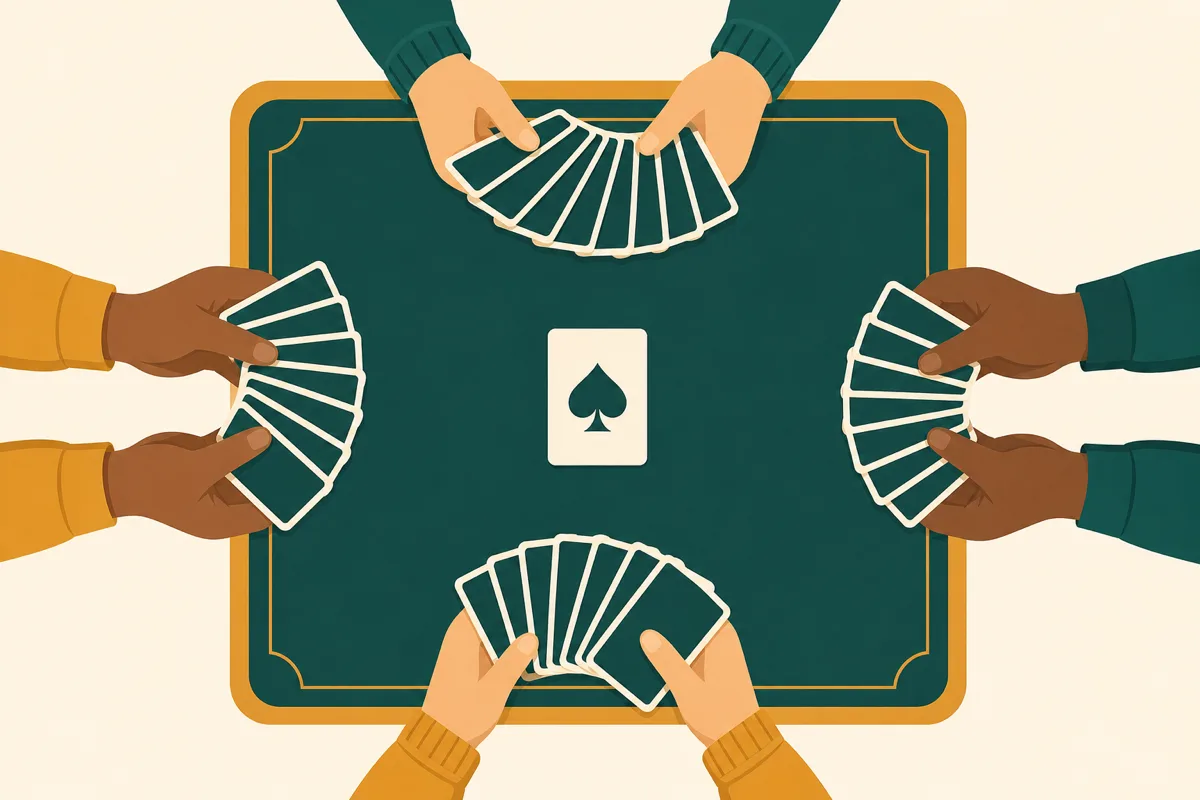
The four players split into two partnerships of two, and partners always sit across from each other, not next to each other. That seating matters because a partnership plays as a team across the whole hand: your side's bids combine into one number, and your side's score rises or falls together.
Spades themselves are always the trump suit, meaning any spade beats any card from another suit, no matter the rank. But a spade can't be led to start a trick until it's been "broken," which happens the first time a player discards a spade because they had no cards left in the suit that was led, or because someone chose to play a spade on a trick they couldn't otherwise win. Until that first spade lands on the table, players have to lead with a non-spade suit even if their hand is full of them.
Gameplay
The bidding phase
Before a single card is played, every player looks at their hand and bids a number, the count of tricks they think they can personally win during that hand. Bids happen in turn order, usually starting with the player to the dealer's left, and once made, a bid can't be changed.
Partnership totals matter more than individual bids. If one partner bids 4 and the other bids 3, the partnership needs 7 tricks combined to make its bid, it doesn't matter which partner actually wins them.
A player can also bid Nil, which means committing to win zero tricks for the entire hand. It's a high-risk, high-reward call: your partner still bids and plays normally, but you're now trying to avoid winning a single trick while they try to win as many as possible.
The trick-taking phase
Play proceeds clockwise. Whoever leads a trick can play any card except a spade, unless spades have already been broken or that player's hand is nothing but spades. Every other player must follow suit if they can, meaning they have to play a card in the same suit that was led. If a player has none of the led suit, they can play any card, including a spade, which breaks spades for the rest of the hand if it happens to be the first one played.
Whoever plays the highest card of the suit that was led wins the trick, unless someone plays a spade, in which case the highest spade played wins regardless of what was led. The trick winner leads the next trick.
Bidding Nil
Nil is worth calling out separately because it changes how a hand is played, not just how it's scored. A player who bid Nil generally tries to duck every trick, playing their lowest cards and avoiding situations where they'd be forced to win. Their partner, meanwhile, often plays more aggressively to soak up tricks the Nil bidder can't take, since accidentally winning even one trick fails the Nil bid entirely.
Bidding strategy
There's no official bidding formula printed in any rulebook, but experienced players read a handful of signals in their hand before committing to a number. The table below is a strategy reference, not a hard rule, treat it as a starting point rather than a guarantee.
| Hand strength signal | Suggested bid range |
|---|---|
| Ace or King of spades, plus 4+ total spades | Count this card as close to a guaranteed trick; add 1 to your baseline count |
| Each additional spade beyond your first 2 | Add roughly 1 trick per extra spade, since a long spade suit tends to win tricks late in the hand even without high cards |
| Off-suit Ace (non-spade) | Usually good for 1 trick, unless the suit is very short in your hand and likely to run out fast |
| Off-suit King with 3+ cards in that suit | Roughly a coin-flip trick, count it as half a trick when totaling your bid |
| Very short, weak hand with no spades and no high cards | Consider Nil if your partner's hand looks strong enough to cover the tricks you'd otherwise be expected to win |
| Doubleton or singleton in a non-spade suit | Slight bump to your estimate, short suits let you ruff (trump) an opponent's trick with a spade later in the hand |
A common rough method is to add up your near-certain tricks (spade honors, off-suit aces) and half-credit your maybes (off-suit kings, mid-length suits), then round to the nearest whole number. Partners typically compare bids only after both have committed, since the whole point of independent bidding is that each player reads their own hand honestly.
Scoring
Scoring in Spades happens partnership by partnership, hand by hand, and it's built to punish both underbidding and overbidding.
| Outcome | Scoring |
|---|---|
| Partnership makes its combined bid | Bid × 10 points, plus 1 point for every trick won beyond the bid (each extra trick is a "bag") |
| Partnership fails its combined bid | Bid × 10 points subtracted, regardless of how many tricks were actually won that hand |
| Player bids Nil and wins zero tricks | 100 points added to the partnership's score (bagged tricks the partner won still count separately) |
| Player bids Nil and wins at least one trick | 100 points subtracted from the partnership's score |
| Player bids Blind Nil (commits before looking at their hand) | 200 points added if successful, 200 points subtracted if failed; usually only allowed for a partnership trailing by 100 or more points |
| Partnership accumulates 10 bags across multiple hands | 100-point penalty, and the bag count resets toward the next cycle of 10 |
Bags are the mechanism that keeps players from bidding low on purpose just to win extra "free" tricks safely. Every trick won past your bid adds a bag, and once a partnership racks up ten of them over the course of a game, it costs a full 100 points, often erasing several hands' worth of careful bidding in one hit.
Games are commonly played to 500 points, meaning the first partnership to cross that total, at the end of a full hand, wins. Some groups play a shorter version to 200 points for a quicker session; either target is a table agreement rather than a fixed universal number, so it's worth confirming before the first hand is dealt.
Variations: the 3-player game
Spades is built around two fixed partnerships, but a genuinely popular variant handles exactly three players without inventing a fake fourth hand.
Since 52 cards don't divide evenly by three, one card is set aside before dealing, commonly the 2 of clubs, since it's the lowest-ranked card and rarely changes how a hand plays out. Each of the three players then receives 17 cards instead of the usual 13.
The bigger structural change is that there are no partnerships at all. Every player bids and scores individually, competing against the other two rather than pairing up. Bidding still works the same way, each player commits to a number of tricks before play starts, and Nil bids are still available on the same terms. Scoring follows the same made-bid and failed-bid math as the 4-player game, just tracked per player instead of per team, and the same bag penalty applies to each player's individual overtrick count.
Because there's no partner to lean on, 3-player Spades tends to reward more conservative bidding. There's nobody to cover a bad Nil attempt or pad a light bid, so every call is entirely on you.
FAQ
How do you play Spades?
Four players split into two partnerships, each get 13 cards from a 52-card deck, and every player bids how many tricks they expect to win before a single card is played. Players then take turns playing tricks, following suit when they can, with spades always beating any other suit. Partnerships add their bids together, and whichever side reaches the target score first, commonly 500, wins the game.
What happens if you bid Nil in Spades?
Bidding Nil means committing to win zero tricks for the entire hand. If you succeed, your partnership gains 100 points on top of whatever your partner scores from their own bid. If you accidentally win even one trick, your partnership loses 100 points instead, regardless of how the rest of the hand goes.
How many points do you need to win Spades?
Most games are played to 500 points, with the first partnership to reach that total at the end of a completed hand winning outright. Shorter sessions sometimes use 200 points as the target instead, so it's worth agreeing on a number before the game starts.
Can you play Spades with 3 players?
Yes. Remove one card from the deck, usually the 2 of clubs, and deal 17 cards to each of the three players instead of 13. There are no partnerships in this version, every player bids and scores individually, and the same bag penalty applies per player rather than per team.
What's the difference between Spades and Euchre?
Both are trick-taking games with a fixed trump element, but the mechanics differ in almost every other way. Spades uses a full 52-card deck, fixed partnerships across the whole game, and a bidding phase where every player independently commits to a number of tricks before play starts. Euchre uses a stripped-down 24-card deck, a trump suit chosen fresh each hand rather than fixed to one suit, and a shorter 5-trick round instead of Spades' 13-trick hands. If you already know Spades, Euchre will feel faster and lighter, with a trump suit that changes hand to hand instead of always being spades.
What does "breaking spades" mean?
It means the moment a spade is legally played on a trick that was led by another suit, either because a player had no cards left in that suit or chose to play a spade to try to win. Before spades are broken, players can't lead a trick with a spade even if their hand is full of them.
- Euchre rules — another trump-based trick-taking game, faster-paced with a shorter 24-card deck
- Rummy rules — a meld-and-run-building game, a useful contrast to Spades' trick-taking structure
- Gin Rummy rules — the 2-player meld game in the same wave 2 cluster
- Cribbage rules — another classic 2-player (or more) card game with its own scoring system
- Classic Card Games hub — the category hub for trick-taking and traditional card games on this site
- Hearts rules — the point-avoidance trick-taking cousin of Spades, no trump suit and no fixed partnerships