Rummy 500 rules: how to play 500 rummy and keep score
Rummy 500, also called 500 rummy or 500 rum, is a card game for 2 to 8 players. Cards you put on the table score points, cards left in your hand cost points, and totals carry over until someone reaches 500.
- Deal 7 cards to each player, or 13 each with 2 players. Use one 52-card deck, or two decks with 5 or more players.
- Draw from the stock (top card only) or pick any card in the discard pile. Picking a discard means taking every card above it too, and you must play the card you picked that turn.
- Put down sets and runs, add cards to anyone's melds, then discard one card.
- The round ends as soon as a player has no cards left. Your score is points on the table minus points in your hand, and the score sheet in the Scoring section adds it up.
- Number cards are face value, J, Q and K are 10, an ace is 15 (1 in A-2-3). If two players reach 500 in the same round, the higher total wins.
Setup
If you know basic Rummy rules, the big changes are that cards score when you play them and that you can dig deep into the discard pile. No single official rulebook exists, so these 500 rummy directions follow Bicycle's rules, fill its gaps from Pagat and GameRules, and note where published rules differ.
What you need
One standard 52-card deck and something to keep score on. The game plays best with 3 to 5 people. From 5 players up, shuffle two decks together (GameRules waits until there are more than 5). Bicycle's version uses no jokers.
How many cards to deal
| Players | Cards each | Decks |
|---|---|---|
| 2 | 13 | 1 |
| 3 or 4 | 7 | 1 |
| 5 to 8 | 7 | 2 |
Bicycle, Pagat, GameRules, Gather Together Games and Wikipedia all give 13 and 7.
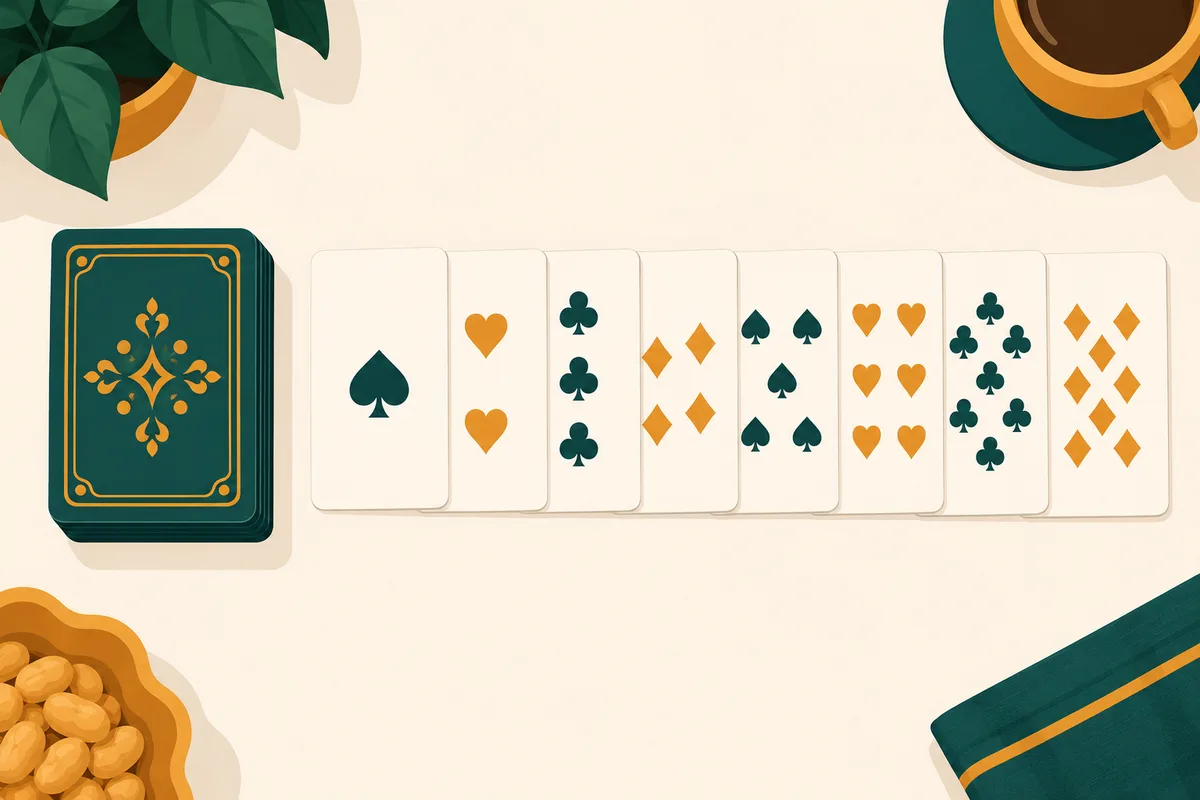
Draw cards to pick the first dealer, who deals one card at a time, clockwise. The undealt cards form a face-down stock. Flip its top card next to it, and that's the first discard. Fan the discard pile out so every card shows. The player on the dealer's left goes first, and the deal moves one seat left each round.
Gameplay
Every turn runs in the same order: draw, meld, discard.
Drawing: how the discard pile works
Your one draw each turn is either the top stock card or any card you choose in the discard pile. Picking a discard comes with two conditions:
- You also take every card above the one you want.
- The card you want has to be played on this turn, in a new meld or laid off on a meld already on the table.
The extra cards go into your hand, or you can meld them on the same turn. Say the pile reads, from the top, 6 of clubs, jack of hearts, 9 of spades, and you hold two 9s. Pick up all three cards and meld your three 9s. The jack and the 6 join your hand.
What about the top card alone? Bicycle's conditions apply to it as well, and Pagat says most card game books agree, so that's the default here. The main versions at Pagat and GameRules let you take only the top card and keep it without melding. Settle this before the deal.
Melding and laying off
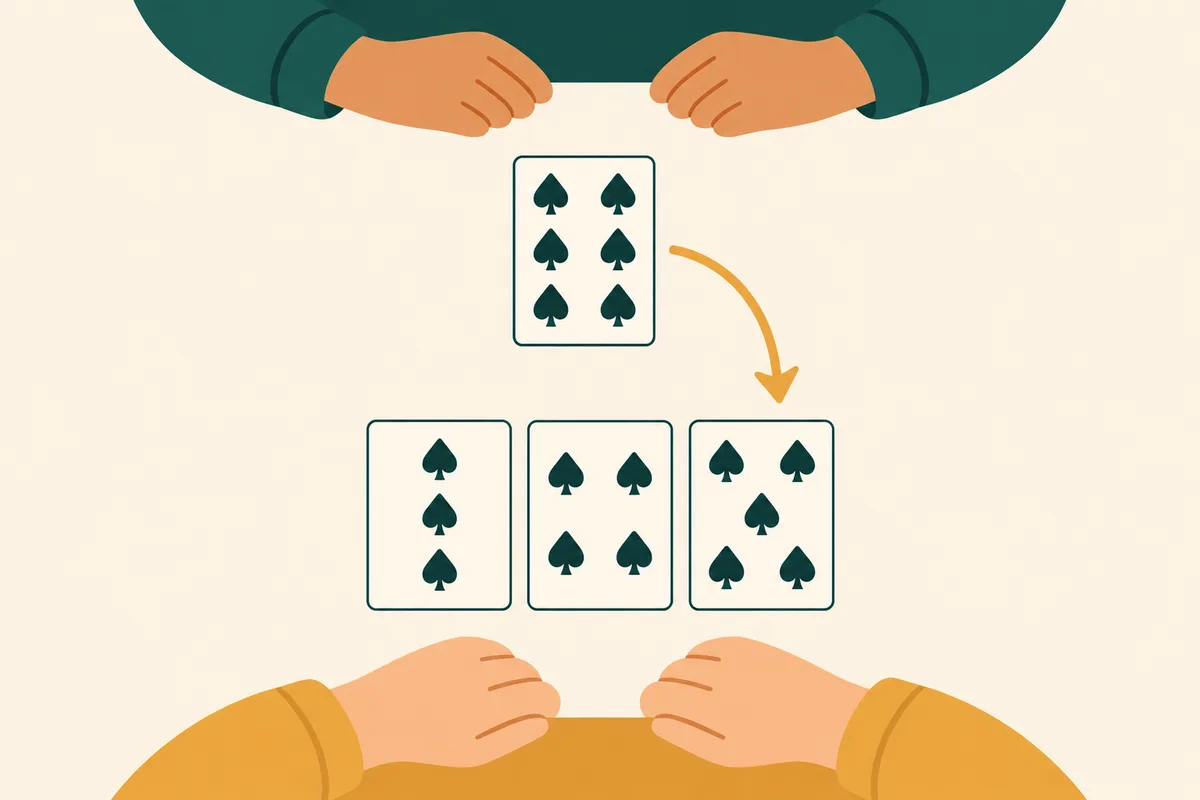
A meld is a set (3 or 4 cards of one rank) or a run (3 or more cards in a row in one suit). On your turn you can put down as many melds as you like, or none. Holding a finished meld is legal, but it counts against you if someone else goes out first. Once a meld is down, it stays down until the round ends.
Laying off means adding a card to a meld already on the table, yours or anyone else's. The card scores for you, not for the meld's owner, so keep it on your side of the table and name the meld it extends. When a card fits two melds, that call is final. A jack of clubs could extend the 8-9-10 of clubs or join three jacks, and only the first choice opens the run to the queen of clubs.
Aces go high or low in a run, so Q-K-A and A-2-3 are both fine. K-A-2 is not, because the ace can't go around the corner.
Discarding and going out
End your turn by discarding one card face up. If you took only the top discard, you can't throw that same card back. After picking up several cards, you can discard any of them except the one you had to play.
You go out by emptying your hand, either by melding everything or by melding all but one card and discarding it. Bicycle and Pagat don't require a final discard. Pagat also reports that many players do, and Wikipedia calls that requirement often standard, so confirm this one at your table.
When a round ends
A round stops the moment a player has no cards left, or when the stock is empty and the player whose turn it is won't take from the discard pile. Bicycle doesn't cover the empty stock, so that part comes from Pagat and GameRules. Nobody can meld or lay off after that, and every card still held counts against its owner, even a playable one.
Scoring
Rummy 500 scoring is one subtraction per player per round: points on the table minus points in hand. Add the result to your total. Either one can go negative. Going out earns no bonus.
Bicycle's page gives that subtraction but no card values, so the values below come from Pagat and GameRules.
| Card | Points |
|---|---|
| 2 through 10 | Face value |
| Jack, queen, king | 10 |
| Ace in a set or a high run (Q-K-A) | 15 |
| Ace in a low run (A-2-3) | 1 |
| Ace left in your hand | Minus 15 |
| Joker, if you use them | 15 (minus 15 in hand) |
Scoring example
Three players, and player A goes out.
| Player | On the table | In hand | Round score |
|---|---|---|---|
| A | Q-K-A of spades 35, three 8s 24, 4 of hearts laid off on C's run 4. Total 63 | Nothing, 0 | 63 − 0 = 63 |
| B | A-2-3 of diamonds 6, three kings 30. Total 36 | Ace, 9, 4. Total 28 | 36 − 28 = 8 |
| C | 5-6-7 of hearts. Total 18 | Q, J, 10, 7. Total 37 | 18 − 37 = minus 19 |
The 4 of hearts sits on C's run but scores for A. B's aces show the swing: the one in A-2-3 earned 1 point, and the one in hand cost 15.
Reaching 500
Keep dealing until at least one player reaches 500. If two or more get there in the same round, the higher total wins, and an exact tie means another round. Say A started that example on 440 and B on 498. A finishes on 503 and B on 506, so B wins even though A went out. Under Wikipedia's rule, the player who went out wins instead, and a Pagat variation says only a player who goes out can win.
For each player, add up the cards they put on the table (their own melds plus every card they laid off on any meld), then add up the cards still in their hand. The sheet subtracts. Card values: 2 to 10 face value, jack, queen and king 10, ace 15 in a set or in Q-K-A and 1 in A-2-3. An ace left in a hand counts 15 in the hand box, and a joker is 15 on the table or in the hand. Your game stays on this device until you start a new game.
Variations and house rules
These are the splits between published 500 rummy rules not covered above. The middle column is what this page uses.
| Rule | Default here | Other versions |
|---|---|---|
| Buried discard | New meld or lay-off (Bicycle, Pagat) | New meld of 3 or more only (Wikipedia, Gather Together Games, a Pagat variation) |
| Aces in runs | High or low (Bicycle, Pagat) | Low only (GameRules, Gather Together Games) |
| Card values | Face value, ace 15 or 1 (Pagat, GameRules) | 2 to 9 all worth 5, low ace 5 (Pagat, Wikipedia). Ace always 15, or 25 (Wikipedia) |
| First meld | No minimum (Bicycle, Pagat) | At least 30 points (Wikipedia) |
Jokers and two decks
Pagat says the game originally had no jokers, and its main version adds two. A joker is wild and can stand for any card, even one already melded. Say what it represents when you play it, because that can't change. With two decks, every card in a set must be a different suit.
Calling "Rummy"
Bicycle leaves this out, and Pagat says most card game books do too. Pagat and GameRules play it, so agree before the deal.
Before the next player draws, anyone except the discarder can call "Rummy!" if the last discard is playable or a playable card sits in the pile. The caller takes that card plus everything above it, plays it, and discards. Play continues from the caller's left, which can skip seats. You can't call after the round has ended.
Floating
Some tables that require a final discard let you meld your last card anyway and float with an empty hand. On your next turn, draw and discard to end the round, or meld again and keep floating.
FAQ
How many cards are dealt in 500 rummy?
Seven to each player with 3 or more players, and 13 each with 2 players. Don't carry over the basic Rummy deal of 10, 7 or 6.
What are the Rummy 500 rules for 2 players?
The same rules with a bigger hand: 13 cards each and one deck. The deal alternates each round.
Do you have to discard to go out in Rummy 500?
Not under the Bicycle and Pagat rules: meld your last card and the round ends. Wikipedia describes a required final discard as often standard, so ask first.
Can you take a card from the middle of the discard pile?
Yes. Take everything above it and play that card on the same turn. You can't take a buried card and save it for later.
Can you play on someone else's meld, and who gets the points?
Yes, on your turn, and the points are yours. Keep the card in front of you. Bicycle and Pagat don't ask for a meld of your own first.
How much is an ace worth in Rummy 500?
15 points in a set or in Q-K-A, only 1 in A-2-3, and minus 15 if it's stuck in your hand. Wikipedia lists other values, including 5 low and 25.
Can an ace go around the corner in Rummy 500?
No. Q-K-A and A-2-3 are legal and K-A-2 isn't, under both Bicycle and Pagat. Wikipedia lists going around as an optional rule.
What happens when the stock runs out?
The player whose turn it is can still take from the discard pile. If they won't, the round ends and everyone scores table minus hand. Wikipedia also lists a reshuffle, playing on until someone goes out, and a version where nobody subtracts.
Who wins if two players reach 500 in the same round?
The higher total, under Bicycle, Pagat and GameRules. An exact tie means another round. Wikipedia gives the win to the player who went out.
- Rummy rules — the basic game this one grew out of
- Gin Rummy rules — the two-player rummy with knocking and a 100-point game
- Canasta rules — a partnership game that developed from 500 rum
- 31 card game rules — a draw-and-discard game with a 3-card hand, played for lives
- Best 2 player card games — more picks when there are only two of you
- Classic card games — every traditional deck game on the site in one place