How to play Pitch (Setback): card game rules and scoring
* Difficulty is our editorial read on how hard the game is to pick up — not an official rating. Player counts and deck sizes come from the game's rulebook.
Pitch, also called Setback or High-Low-Jack, is an American trick-taking game for 2 to 6 players, most often played by four in two partnerships. Everyone gets six cards, the table bids once around, and the high bidder leads the first card. That card's suit is trump for the hand. Each hand has four points to win, and a side that bids and falls short loses the amount it bid.
- Deal six cards each, three at a time, from a 52-card deck with no jokers. The rest of the deck sits out.
- Bid once around, starting left of the dealer: pass, 2, 3 or 4, always higher than the last bid. The dealer may match the top bid to take it and must bid 2 if everyone else passes.
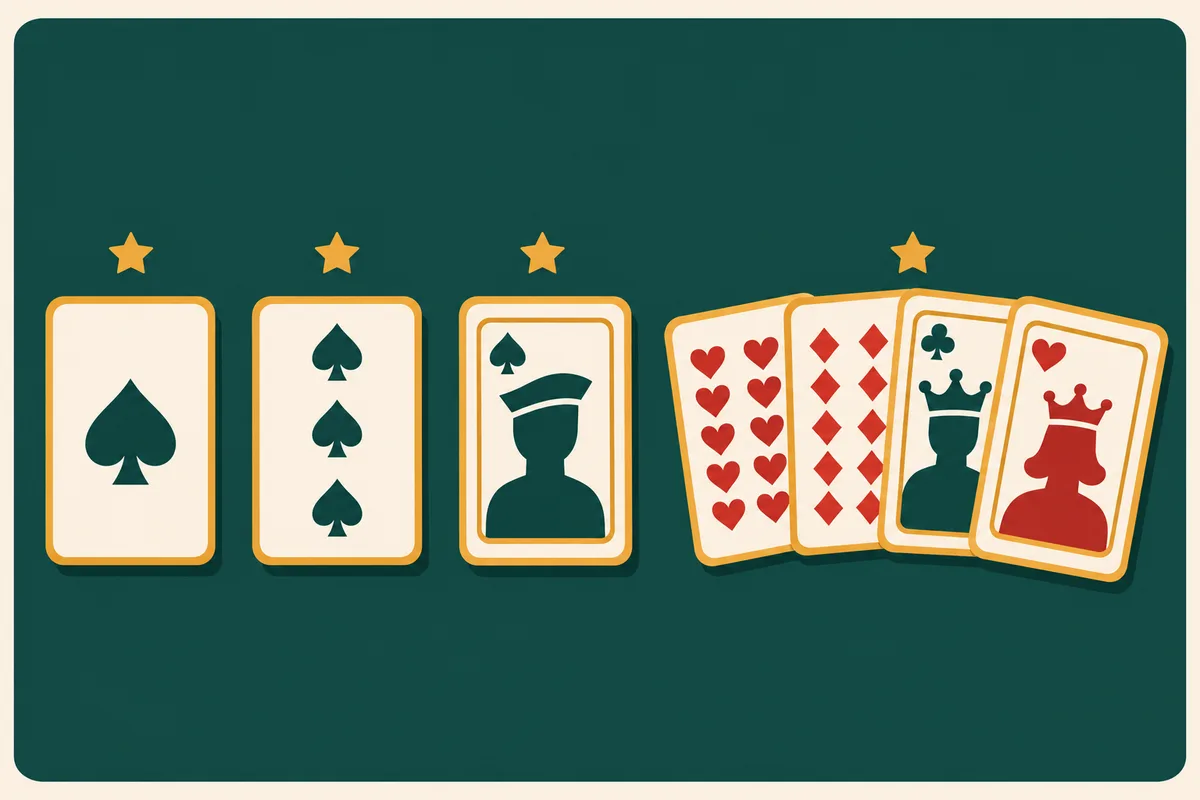
- The four points: High (highest trump played), Low (lowest trump played), Jack (jack of trump) and Game (most card value in your tricks: 10 = 10, ace 4, king 3, queen 2, jack 1).
- Make your bid and you keep every point you took. Miss it and the bid comes off your score, even below zero. The other side always keeps what it took.
- First to 11 wins, but only on a hand where they bid and made it. Partnership games often go to 21.
Pitch setup
Players and partnerships
Umesh Shankar's Setback rules allow two to six players, Bicycle lists 2 to 4, and Game Rules Guru 2 to 8. The usual table is four players in two teams, partners facing each other (Pagat, Denexa, NeuralPlay). Otherwise everyone plays alone, which Pagat calls Cutthroat Pitch. Six can also play as three teams of two, with eight cards each and two discarded once trump is known (Pagat).
If your group plays Euchre, Pitch will feel familiar: partners across the table and a new trump suit every hand. Pitch, though, deals six cards from a full deck.
Cards and deal
Use a standard 52-card deck without jokers, ranked from ace (high) down to 2. Cut for the first deal (Wikipedia), and the deal then passes left after each hand.
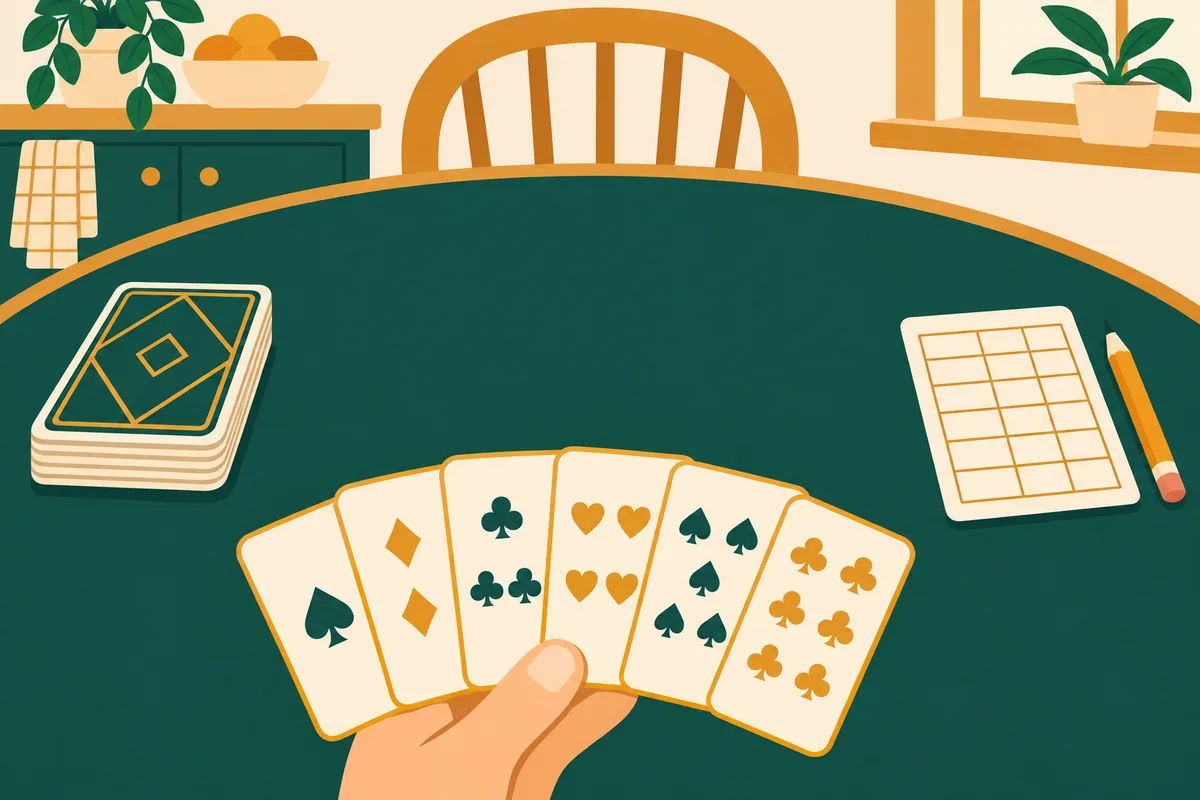
The dealer gives each player six cards, three at a time, starting on the left. The rest of the deck stays face down for the whole hand. With four players that leaves 28 cards out (NeuralPlay), so the ace, the 2 or the jack of trump may never appear.
Bidding in Pitch
How the auction works
Bidding starts with the player to the dealer's left and goes around once. Each player passes or bids the number of points they expect to take, 2, 3 or 4, and every bid must beat the one before. In a partnership game the bid commits the whole team. The top bidder becomes the pitcher (Pagat, Bicycle, Denexa).
Stealing the bid
The dealer bids last and may take the contract by matching the highest bid instead of beating it. Pagat, Denexa and Game Rules Guru call this stealing the bid, and Bicycle allows it too. Pagat's Oklahoma ten-point rules forbid it.
If everyone passes
If everyone before the dealer passes, the dealer has to bid at least 2. Pagat and Denexa call this a force bid, and NeuralPlay names the option "stick the dealer." Some tables redeal instead (Wikipedia), but the force bid is the default here.
Smudge (shoot the moon)
Many tables allow one bid above 4, called smudge or shooting the moon. The bidder promises all four points and all six tricks (Pagat, Denexa, Game Rules Guru, highlowjack.com), which can't be done if the jack of trump wasn't dealt. Bicycle makes a bid of 4 the smudge, and even the dealer can't take it over.
The default here: a made smudge wins the game at once (Game Rules Guru, highlowjack.com), and a missed one sets you back 5 (Pagat, Game Rules Guru). Bicycle makes one exception: below zero, a made smudge scores only the 4 points.
How to play Pitch
The pitch sets trump
The pitcher leads to the first trick, and the suit of that card is trump for the whole hand. Wikipedia adds that a card led by mistake still sets trump.
Following suit or trumping
- On a trump lead, play a trump if you have one (Bicycle).
- On any other lead, follow suit or play a trump, even when you hold the suit led (Pagat, Bicycle, Wikipedia, Denexa, highlowjack.com).
- With no card of the suit led, play anything.
The highest trump wins the trick. With no trump in it, the highest card of the suit led wins, and the winner leads any card to the next trick. Play all six tricks before scoring (Bicycle, Denexa), even after a smudge is lost, so the other side can still score (Pagat).
Pitch scoring
The four points
| Point | Who scores it | Details |
|---|---|---|
| High | Whoever plays the highest trump of the hand | It always wins its trick. The ace, if it was dealt |
| Low | Whoever wins the trick with the lowest trump played | The 2 if it was dealt, otherwise the 3 or the next card up |
| Jack | Whoever wins the trick with the jack of trump | Nobody scores it if the jack wasn't dealt |
| Game | The side with the most card value in its tricks | 10 = 10, ace = 4, king = 3, queen = 2, jack = 1, 2 to 9 = 0, any suit. A tie scores nothing |
The deck holds 80 card points in all, half of them in the four tens (Pagat). If only one trump was dealt, it counts as both High and Low (Game Rules Guru).
Pagat, Denexa, NeuralPlay, Umesh Shankar and highlowjack.com give Low to whoever captures the card, the default here. Wikipedia's main rules and Cardrulesplus give it to the player who was dealt it, so a 2 thrown on an opponent's trick still scores for its owner.
Making the bid or getting set
If the pitcher's side reached its bid, it scores every point it took: a bid of 2 that takes 3 points scores 3. If it fell short, it's set. The bid comes off its score, and its points that hand don't count. The other side scores its own points either way (Pagat, Bicycle, Denexa, NeuralPlay).
Bicycle calls a total below zero being "in the hole" and circles it on the score sheet.
Winning the game
Play to 11 (Wikipedia, Cardrulesplus, NeuralPlay, Umesh Shankar, highlowjack.com). The default rule is "bidder goes out" (Wikipedia's term): you win only at the end of a hand in which you bid and made it, with a total at or over the target (Pagat, Denexa, Game Rules Guru, highlowjack.com). A side that passes the target while defending waits for a successful bid of its own, so the winner can finish with fewer points than the loser.
Bicycle counts out instead: the pitcher's points go on the sheet first, then High, Low, Jack and Game in that order, and the first to reach the target wins.
Default rules vs other common rules
| Rule | Default | Also played |
|---|---|---|
| Target score | 11 | 21 (Pagat, Denexa, partnerships), 7 (Bicycle), 15 (Wikipedia's Roadhouse pitch) |
| Minimum bid | 2 | 1 (Wikipedia, Cardrulesplus) |
| Everyone passes | Dealer must bid 2 | Redeal by the same dealer (Wikipedia) |
| Low | Side that captures it | Player who was dealt it (Wikipedia, Cardrulesplus) |
| Game tie | Nobody scores | Bidder takes it (NeuralPlay option) |
| Winning | Only on a hand you bid and made | Count out: pitcher first, then High, Low, Jack, Game (Bicycle, Wikipedia) |
| Smudge made | Wins the game | 5 points (Pagat, Denexa); 4 points if below zero (Bicycle) |
| Smudge missed | −5 | Lose the game (highlowjack.com, Cardrulesplus) |
Scoring example
Four players, default rules, playing to 11: Dana and Eli (Team A) against Rosa and Sam (Team B).
In hand 1, Dana bids 3 and pitches the ace of spades, so spades are trump and High is hers. The 2 of spades wasn't dealt, which makes the 3 of spades Low, and Sam wins the trick it falls on. Eli captures the jack of spades, and Team A's tricks hold 31 card points to Team B's 19. Team A makes its 3 with High, Jack and Game; Team B scores 1 for Low.
| Hand | Bid | Team A | Team B |
|---|---|---|---|
| 1 | A bids 3 | High, Jack, Game: +3, total 3 | Low: +1, total 1 |
| 2 | B bids 4 | Jack: +1, total 4 | High, Low, Game, set: −4, total −3 |
| 3 | A bids 2 | All four: +4, total 8 | None: 0, total −3 |
| 4 | B bids 3 | Low: +1, total 9 | High, Jack, Game: +3, total 0 |
| 5 | B bids 2 | High, Jack: +2, total 11 | Low, Game: +2, total 2 |
| 6 | A bids 2 | High, Low: +2, total 13, wins | Jack, Game: +2, total 4 |
Team A reached 11 in hand 5 while Team B held the bid, so play went on. Under Bicycle's count-out, Team A would have won right there: Team B's 2 points count first, then High takes Team A to 10 and Jack to 11.
Game setup
Mode, sides, target and rules are locked after the first hand. Names stay editable. New game unlocks them.
Pick who bid and the bid, then for each of High, Low, Jack and Game the side that took it. Jack can be "Not dealt" and Game "Tie: nobody". A side that makes its bid scores every point it took; a side that misses loses the bid and can drop below zero. The other sides always score what they took. The dealer moves one seat each hand and is for reference only. The rules are set before the first hand and locked after it. Tap Edit on a saved hand to correct it. Your game stays on this device until you start a new game.
Variations and house rules
Setback and High-Low-Jack are the same game under other names (Pagat).
10-point pitch
Ten-point Pitch adds scoring trumps so each hand is worth 10 points. These are Larry Charbonneau's rules, which Pagat links to:
| Rule | Charbonneau's 10-point pitch |
|---|---|
| Trump order | Ace, king, queen, jack, off-jack (the other jack of the same color), two jokers, then 10 down to 2 |
| Points | Ace, jack, off-jack, each joker, 10 and 2 of trump: 1 each. 3 of trump: 3. Total 10 |
| Deal | Nine cards each. After trump is named, everyone discards non-trumps and refills to six; the bidder gets any cards left |
| Bidding | One round, minimum 4. The dealer must take it for 4 if all pass |
| Play | Only trumps may be played. A player out of trumps sits out the rest of the hand |
| Scoring | A made bid scores the bid; a missed one loses it. Charbonneau says nothing about the other team's points |
| Shoot the moon | Take all 10 points to jump to 52, or to zero from below zero. Miss and you lose the game |
| Target | 52 |
Pagat's Oklahoma version starts bidding at 2 and makes the 3 of trump optional, which leaves 7 points. The off-jack is the card Euchre calls the left bower (Wikipedia).
Other house rules
- Draw: after trump is set, players discard non-trumps and the dealer refills each hand to six (Pagat).
- Must follow suit: trump only when you can't follow (Wikipedia's Roadhouse pitch, a Pagat Oklahoma option).
- No junk points: only the bidding side scores (Wikipedia, NeuralPlay).
- Smear: a group of close Pitch variants, some with an off-jack and jokers as extra trumps (Pagat, Wikipedia).
FAQ
Is Setback the same as Pitch?
Yes. Pagat lists Setback and High-Low-Jack as other names for Pitch, and Wikipedia treats auction pitch and setback as one game. The name comes from the penalty: a bidder who falls short is set back by the bid (Umesh Shankar). House rules still differ. highlowjack.com plays a nine-card throw-away version and tells readers never to call it Pitch.
Why is it called Pitch?
Pitching means leading the first card, and that lead picks trump (Wikipedia). The game grew out of All Fours, a 17th-century English game with the same High, Low, Jack and Game points, where a card turned up from the deck set trump (Pagat, Bicycle).
Is the 2 of trump always Low?
No. Only part of the deck is dealt, so if nobody holds the 2, the 3 is Low, then the 4 and so on (Pagat, Denexa).
How many points do you need to win Pitch?
Eleven by default, 21 in many partnership games (Pagat, Denexa) and 7 in Bicycle's cutthroat rules. Under the default rules you also need to make your bid on the winning hand.
- Euchre rules — partners, a trump suit and five-card hands from a 24-card deck
- Spades rules — a partnership bidding game where spades are always trump
- Oh Hell rules — bid the exact number of tricks you'll take, with a score tracker
- Hearts rules — a trick-taking game where you dodge points instead of chasing them
- Classic card games — every traditional deck game on the site in one place
- Best card games for adults — faster and trickier games for grown-up groups