How to play the Oh Hell card game: rules and scoring
The Oh Hell card game, also called Up and Down the River, is a trick-taking game for 3 to 7 players with one standard 52-card deck. After each deal, everyone bids the exact number of tricks they will take. Only an exact hit earns the 10-point bonus, so one trick too many misses just like one too few.
- Deal 10 cards each with 3 to 5 players, 8 with six and 7 with seven. Each hand after that has one card fewer, down to 1, then one more per hand back up.
- Turn the next card face up after the deal. Its suit is trump for that hand.
- Bidding starts on the dealer's left. The dealer bids last and can't make the bids add up to the number of cards dealt. This rule is called the hook.
- Follow suit if you can. If you can't, play any card, trump included.
- Common scoring: 1 point per trick plus 10 for making your bid exactly. The highest total after the last hand wins.
Setup
What you need
Three to seven players and a standard 52-card deck, aces high. Pagat (John McLeod's card game reference) says the game plays best with 4 to 6. There are no partners, so each player bids and scores alone. Everyone draws a card, the highest card deals first, and the deal moves one seat to the left (clockwise) every hand.
How many cards to deal
The first hand uses the most cards the deck allows for your table, up to 10 each. Every hand after that has one card fewer per player until everyone holds a single card. Then the count climbs by one per hand back to the start. This is Pagat's sequence, and it's the default here.
| Players | Cards in the first and last hand | Hands in a game | Cards left over after trump is turned |
|---|---|---|---|
| 3 | 10 | 19 | 21 |
| 4 | 10 | 19 | 11 |
| 5 | 10 | 19 | 1 |
| 6 | 8 | 15 | 3 |
| 7 | 7 | 13 | 2 |
With seven players the hands go 7, 6, 5, 4, 3, 2, 1, then 2, 3, 4, 5, 6, 7: thirteen hands, as in Pagat's own example. Six and seven players start lower because 9 cards each for six (54) or 8 each for seven (56) is more than the deck holds.
Dealing and turning trump
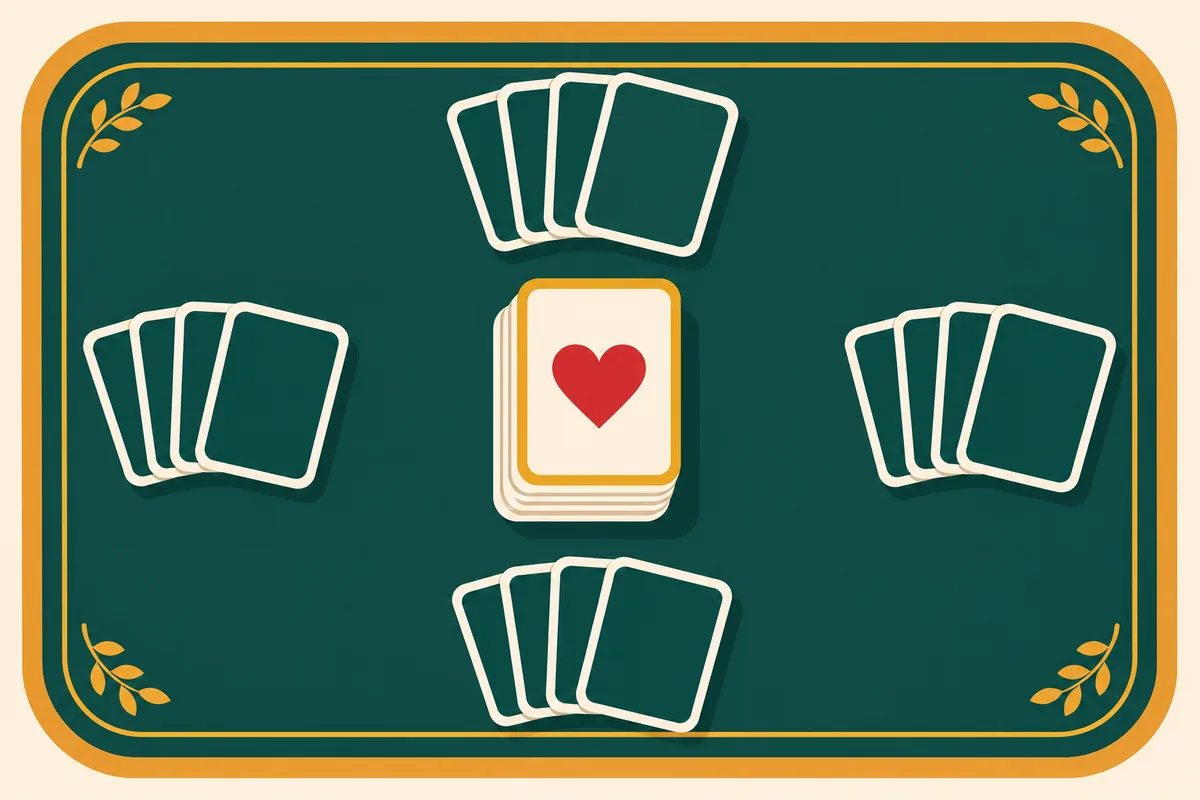
Deal one card at a time. Once everyone has the right number, turn the next card face up. Its suit is trump for this hand and beats any card of the other three suits. The undealt cards sit face down under it, out of play until the next deal, so some high cards may not be in anyone's hand.
Gameplay
Bidding
The player on the dealer's left bids first, and bidding goes clockwise to the dealer, who bids last. A bid is the number of tricks you plan to take, from zero up to the number of cards in your hand. Nobody passes. A zero bid means you'll try not to win a single trick. Pagat lets you change a bid only until the player on your left has bid.
If you know Spades rules, this will feel familiar. Here, though, there are no partners, and one trick over your bid counts as a failed bid.
The hook: what the dealer can't bid
The hook means the bids can never add up to the number of cards each player holds. Only the dealer is restricted, since only the dealer bids with every other bid known. So at least one player fails every hand.
To find the dealer's forbidden bid, subtract the other bids from the number of cards dealt:
- Ten cards each, other bids 3, 2 and 2. They total 7, so the dealer can't bid 3.
- Four cards each, other bids already total 5. No bid brings the total to 4, so the dealer may bid anything.
- One card each, other bids total 1. The dealer can't bid 0, so they have to bid 1.
Some groups drop the hook altogether (see Variations).
Playing the tricks
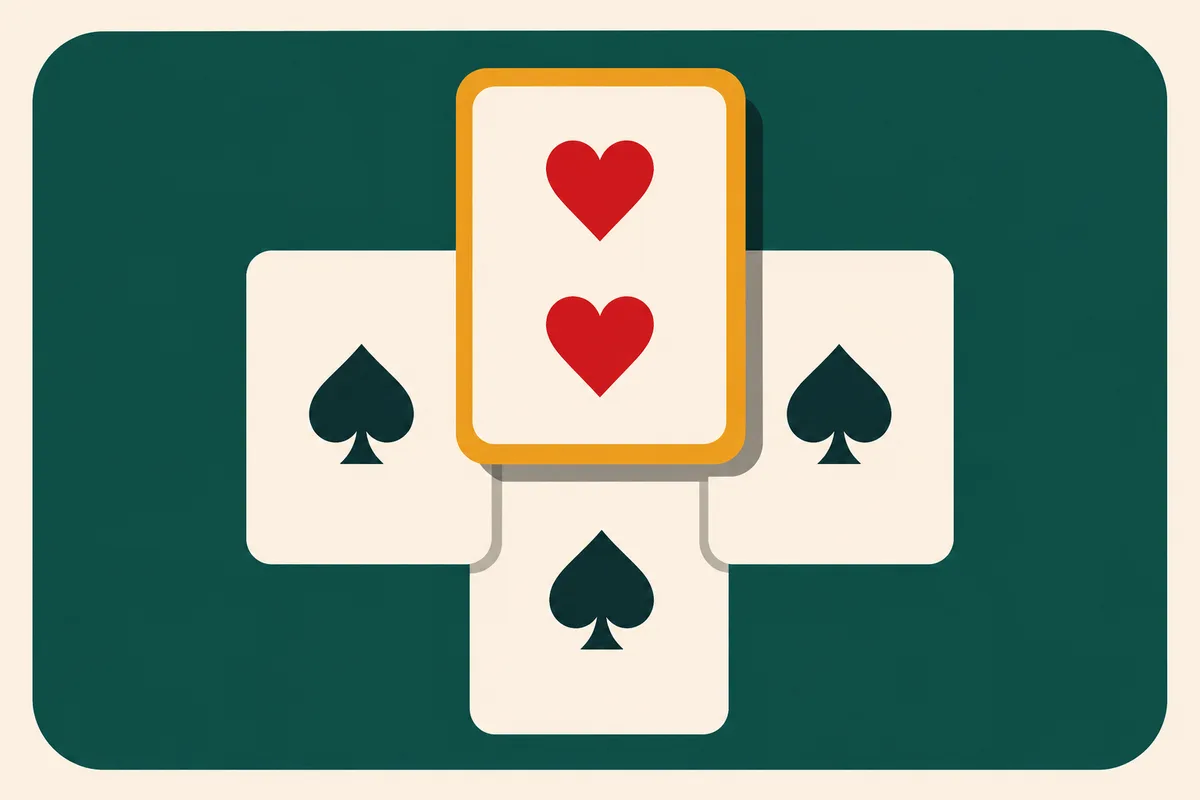
The player on the dealer's left leads the first trick with any card, trump included. Play goes clockwise. You must follow the suit led if you can. If you can't, play any card: a trump to try to win, or another suit to throw a card away. You never have to trump.
The highest trump wins the trick. With no trump in it, the highest card of the suit led wins. The winner leads next, and the hand ends when all the cards are played. The deal then passes left.
Scoring
Oh Hell scoring happens after every hand and uses only each player's bid and the tricks they took. Pagat says there are many ways to score; Wikipedia lists these two first, as simple and common scoring.
Two ways to score
| What happens | 1 per trick + 10 bonus (default here) | 10 + bid, exact bids only |
|---|---|---|
| You make your bid exactly | 1 per trick + 10 | 10 + your bid |
| You miss, over or under | 1 per trick, no bonus | 0 |
| Bid 2, took 2 | 12 | 12 |
| Bid 2, took 3 | 3 | 0 |
| Bid 0, took 0 | 10 | 10 |
| Where it comes from | Pagat ("perhaps the most widespread"), Wikipedia, Trickster Cards, NeuralPlay, CardGames.io | Pagat, which calls it the simplest, and Wikipedia |
A made bid scores the same either way. The systems differ only when a bid fails.
The default here is 1 point per trick plus the bonus, since most of the sources above use it. Once your bid is lost, each trick is still worth a point, so you have a reason to keep playing the hand. The tracker below works as an Oh Hell score sheet and can switch to the other system.
Who wins
Points go into a running total, and the highest total after the last hand wins. Ties have no single rule. Pagat mentions groups that keep dealing hands at the maximum card count until one player is ahead alone, and any player can win those hands, not only the tied ones. CardGames.io's game lets tied players share the win. The default here is a shared win, and the tracker offers an extra hand.
Scoring example
Four players sit clockwise as Ana, Ben, Cal and Dee, in the middle of a 19-hand game. Each cell shows bid / tricks taken, then points under the default scoring.
| Hand | Ana | Ben | Cal | Dee |
|---|---|---|---|---|
| 9 (2 cards, Ana deals) | 2 / 0: 0 | 0 / 1: 1 | 1 / 1: 11 | 0 / 0: 10 |
| 10 (1 card, Ben deals) | 0 / 0: 10 | 1 / 0: 0 | 0 / 0: 10 | 1 / 1: 11 |
| 11 (2 cards, Cal deals) | 1 / 1: 11 | 0 / 0: 10 | 0 / 0: 10 | 0 / 1: 1 |
| Points from these hands | 21 | 11 | 31 | 22 |
The hook limited every dealer. In hand 9 the other three bid 1 in total, so Ana couldn't bid 1 and went for 2. In hand 10 they again totaled 1, which ruled out a zero: Ben had to bid 1 on a single card, and he lost it. In hand 11 Cal faced the same total, couldn't bid 1 and bid 0.
Under 10 + bid with exact bids only, Ben's point in hand 9 and Dee's in hand 11 disappear: Ana 21, Ben 10, Cal 31, Dee 21. Dee drops into a tie with Ana.
Game setup
Players, first dealer, most cards and the hands are locked after the first hand. New game unlocks them.
| Player | Bid | Took |
|---|
Every cell shows bid / tricks taken, then the points for that hand and your running total. Shaded cells are bids made exactly. Switching the scoring recalculates every hand already saved. Tap Edit on a saved hand to correct it. Your game stays on this device until you start a new game.
Variations and house rules
Wikipedia notes many local and regional variants, so agree on these before the first deal.
Other hand sequences
Pagat lists these alongside the default:
- Go from 1 card up to the maximum and back down, or only down, or only up.
- Play the 1-card hand or the maximum hand twice in the middle.
- Go up to 13 cards with four players, or 17 with three. Four players at 13 use the whole deck, so that hand has no trump. Three at 17 hold 51 cards, leaving one to turn.
- Use a lower maximum, such as 7, at any table size.
Named versions differ too. British contract whist goes 7 to 1 to 7. Oh Pshaw, which Wikipedia credits to Bicycle's rule book, only goes up, from 1 card to the most the deck allows, and has no hook. Instead, the scorekeeper announces whether the bids are over, under or even.
Trump, bidding and play
- Play the biggest hands without trump, or rotate trump in a fixed order instead of turning a card (Pagat). Wikipedia gives hearts, clubs, diamonds, spades for contract whist.
- Play without the hook, so the dealer may bid a total that lets everyone succeed. Pagat reports advocates on both sides of which version takes more skill.
- Bid all at once: fists bounce on the table to a count of three, then everyone shows their bid in fingers. No hook is possible. Pagat's correspondents say most Australian groups bid this way.
- The dealer leads the first trick (Pagat, Gamerules.com).
- If you can't follow suit but hold a trump, you must play it. Pagat calls this uncommon in English-speaking countries but standard in La Podrida, the Spanish and Latin American relative.
Other scoring
- A made zero scores 5 instead of 10 (Pagat, Gamerules.com), or 5 plus the cards dealt, since zero is harder in big hands (Pagat, Wikipedia).
- A missed bid costs points. Berries & Barnacles' family scores a made bid as 10 plus the bid and takes the bid off for a miss, so bidding 2 and taking 1 scores minus 2. Pagat lists a version that takes off 10 for each trick you're off by.
FAQ
Is Oh Hell a real card game?
Yes. It's a trick-taking game for a standard deck, first described in Britain around 1930 as Oh! Well. Wikipedia, citing card game historian David Parlett, says it reached the New York clubs in 1931. Other names Pagat lists include Oh Pshaw, Blackout, Blob, Bust, Elevator, Contract Whist and Nomination Whist.
Is Up and Down the River the same as Oh Hell?
Yes. Pagat says the name comes from the hand size going down and back up, and places it in Australia and New Zealand. Wikipedia's Up and Down the River deals 10 down to 1 and back, with the hook and 1 point per trick plus a 10-point bonus.
What is the hook in Oh Hell?
The dealer, who bids last, can't make the total of all bids equal the number of cards each player holds. At least one player then fails every hand. Some groups play without it.
Can you bid zero in Oh Hell?
Yes. Everyone has to bid, and zero is legal. Under both systems above, a made zero scores 10, though some groups pay only 5.
How long does a game of Oh Hell take?
Pagat estimates about 45 minutes, and Wikipedia gives 25 to 50. CardGames.io points out that the hands with very few cards don't take long.
- Spades rules — the partnership bidding game, where tricks over your bid turn into bags
- Hearts card game rules — a trick-taking game where you try not to take points
- Euchre rules — a short-deck partnership game where trump is called each hand
- Bridge rules — the partnership game built around a bidding auction
- Five Crowns rules — another game where the hand size changes every round, from 3 cards to 13
- Classic card games — every traditional deck game on the site in one place