Bridge rules: how to play contract bridge
* Difficulty is our editorial read on how hard the game is to pick up — not an official rating. Player counts and deck sizes come from the game's rulebook.
Bridge is a trick-taking card game for exactly 4 players in 2 fixed partnerships, seated across from their partner. Each player gets 13 cards, and the game opens with an auction where players bid for the right to name trump and set a target of tricks to win. The winning side then tries to take that many tricks, plus an automatic 6, while the other side defends.
Setup
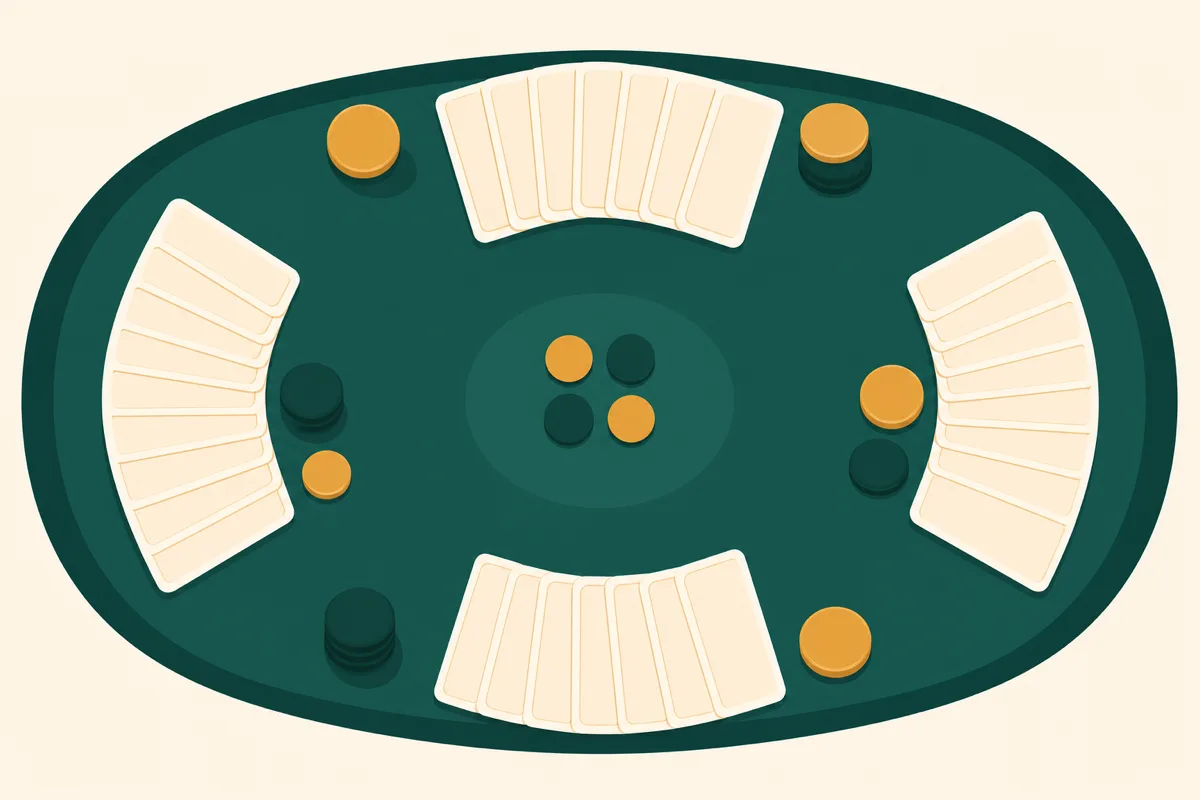
Deal the full 52-card deck out evenly, 13 cards to each of the 4 players, with partners seated across the table from each other rather than side by side. There's no widow or kitty in Bridge. Every card ends up in someone's hand before play even begins.
Two terms are worth knowing before the bidding starts. A "trick" is one round of play, everyone contributing a single card. "Book" refers to the first 6 tricks a side needs before any bid number even starts counting: a bid of 1 means "7 tricks total" (the 6-trick book plus 1 more), a bid of 7 means all 13 tricks in the hand.
Gameplay
The bidding auction
Starting to the dealer's left, players take turns either bidding or passing. A bid names a number, 1 through 7, plus a trump suit or "no-trump." Each new bid has to outrank the last one, either by number or, at the same number, by suit. The suit ranking runs low to high: clubs, diamonds, hearts, spades, then no-trump sitting above all four suits. So a bid of 2 hearts outranks 2 clubs, but a bid of 1 no-trump outranks 1 spades even though the number is the same.
The auction ends the moment three players in a row pass after the last bid. Whatever that final bid was becomes the contract, and the suit named in it (or no-trump) becomes trump for the rest of the hand.
Declarer and dummy
Whichever player on the winning side first named the contract's final suit during the bidding becomes declarer. Declarer's partner becomes the dummy. Once the player to declarer's left makes the opening lead, dummy lays their entire hand face-up on the table and takes no further active role, except playing whichever card declarer instructs from that exposed hand.
Playing the tricks
Play works through all 13 tricks one at a time. Each player has to follow the suit that was led if they can. A player with none of that suit left may play any card, including trump, and the highest trump played on a trick beats every other card, trump or not. Whoever wins a trick leads the next one. Bridge shares this same follow-suit, trump-beats-all structure with another trick-taking partnership game, Spades, even though the two games get to their contract in very different ways.
Scoring
Bridge scoring rewards a side for meeting or beating its contract, and penalizes the bidding side for falling short. A full scoring table with vulnerability, doubling and rubber-versus-duplicate variations is a much bigger topic than this page covers. What follows is the base structure every scoring format builds on.
| Contract suit | Points per trick bid and made (above the book of 6) |
|---|---|
| Clubs or diamonds (minor suits) | 20 |
| Hearts or spades (major suits) | 30 |
| No-trump | 40 for the first trick, 30 for each additional trick |
Reach 100 or more of these trick points across one or more hands, and the side earns "game," a milestone worth its own bonus on top of the trick points themselves. Bidding and making all 13 tricks (a grand slam) or all but one (a small slam) earns a much larger bonus again, with the exact figure depending on the scoring format and whether the side is vulnerable, a status that raises both the stakes and the rewards once a side has already won a game. If the bidding side falls short of its contract, the tricks it's short by cost the defending side penalty points instead, with the exact per-trick penalty also shifting depending on vulnerability.
Variations and house rules
Most home games play rubber bridge: an informal running score across as many hands as it takes to win two games, with no fixed board of pre-dealt hands. Tournament play almost always uses duplicate bridge instead, where the same pre-dealt hands get replayed at multiple tables so every partnership's results can be compared against every other partnership holding the identical cards. The core rules of bidding and play are the same either way. What changes is how the final score gets compared across the room rather than just across one table.
FAQ
How many cards does each player get in Bridge?
Each of the 4 players receives 13 cards from a standard 52-card deck, dealt out evenly with nothing left over. That's how you play bridge card game basics: no widow, no kitty, every card lands in someone's hand.
What does it mean to be the "dummy" in Bridge?
The dummy is declarer's partner. Once the opening lead is played, the dummy lays their whole hand face-up on the table and stops actively playing. Declarer plays cards from the dummy's hand by naming which one, and the dummy has no further decisions to make for the rest of that hand.
How does the bidding auction end?
The auction ends the instant three players in a row pass after the most recent bid. That bid becomes the contract, and its named suit (or no-trump) becomes trump for the hand.
What's the difference between rubber bridge and duplicate bridge?
Rubber bridge is the informal home-game format, scored on a running tally across hands until a side wins two games. Duplicate bridge is the tournament format, where identical pre-dealt hands are replayed at several tables so scores can be compared directly against other partnerships holding the same cards.
Do I need to learn bidding conventions to play Bridge?
Not for a casual home game. The bidding rules on this page (bid a number and a suit, higher bids outrank lower ones, three passes end the auction) are enough to play a full hand. Competitive and club-level Bridge leans heavily on named bidding conventions like Stayman or Blackwood to communicate hand strength more precisely, but that's a separate, much larger topic outside what a beginner needs to start playing.