Hearts rules: how to play and avoid taking points
* Difficulty is our editorial read on how hard the game is to pick up — not an official rating. Player counts and deck sizes come from the game's rulebook.
Hearts is a trick-taking card game for four players, played with a standard 52-card deck. Each player gets 13 cards, then passes 3 cards to another player before play starts. The goal is the opposite of most trick-taking games: avoid taking tricks that contain Hearts (1 point each) or the Queen of Spades (13 points). Once a player's cumulative score reaches 100 points, the player with the lowest score wins.
Setup
Deal all 52 cards, 13 to each of the 4 players. No cards are set aside and no trump suit is chosen, since Hearts has no trump at all.
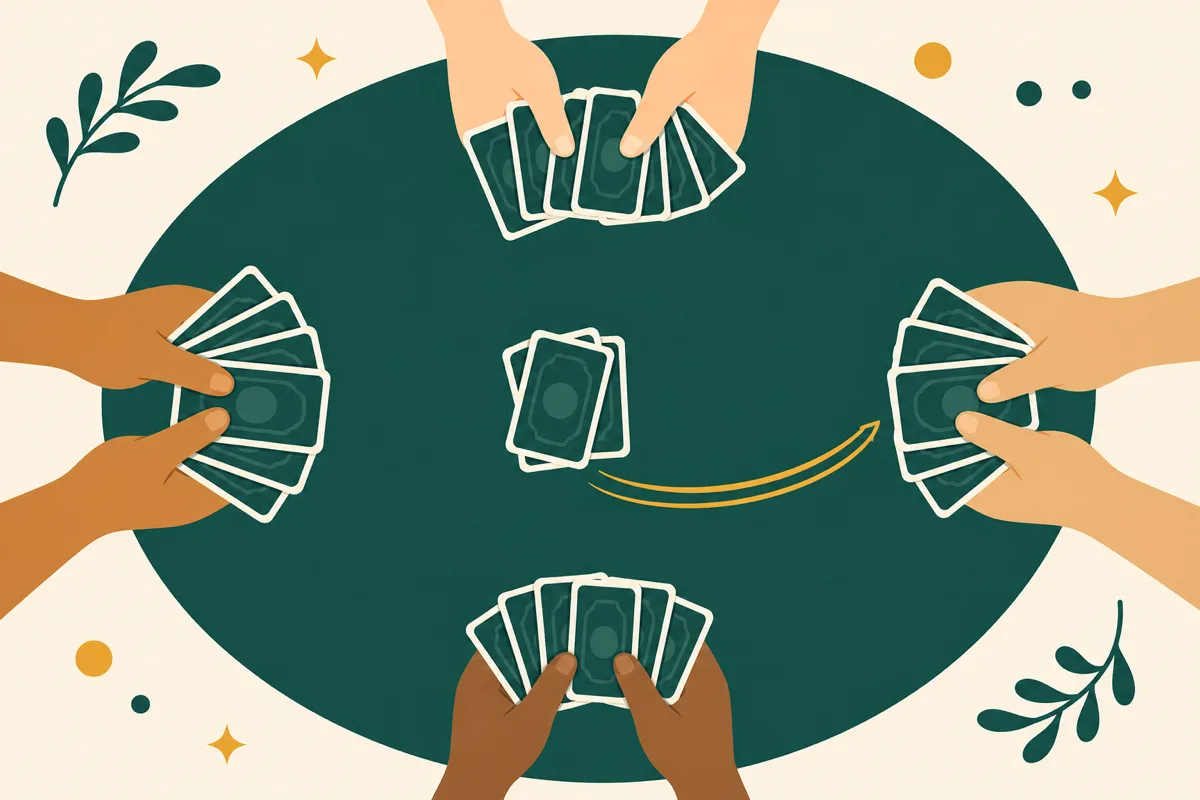
Before play begins, every hand includes a passing phase: each player chooses 3 cards from their hand and passes them, all at once, to a neighboring player. The direction rotates hand to hand rather than staying fixed, following a commonly cited 4-hand cycle: pass left on the first hand, right on the second, across the table on the third, and skip passing entirely on the fourth, before the cycle repeats. This rotation is widely used but isn't locked down by any single governing rulebook the way a Hasbro or Mattel product would be, so some groups adjust it, particularly the exact point where the "no pass" hand falls in the cycle.
Whoever holds the 2 of clubs leads the very first trick of the game, a convention that's close to universal across the sources checked for this page.
Gameplay
Passing cards
Passing happens before a single trick is played, and it's the one moment in the whole hand where you can shape what ends up in your own hand rather than just reacting to what's dealt. Most players use it to offload their highest hearts or the Queen of Spades if they're holding it, though some players pass it deliberately to a specific neighbor as a setup move, hoping to control who ends up stuck with it.
Following suit
Play proceeds trick by trick. Whoever leads a trick sets the suit, and every other player has to follow that suit if they have a card in it. A player with none of the led suit can play anything from their hand, including a heart or the Queen of Spades. Whoever plays the highest card of the suit that was led wins the trick and leads the next one.
When hearts can be led
Hearts can't be led to start a trick until they've been "broken," meaning a heart has already been played on some earlier trick, either because a player had no cards left in the suit that was led or chose to play a heart to avoid winning with something else. Until that first heart lands on the table, players leading a trick have to choose a non-heart card even if hearts are the bulk of what's left in their hand. The Queen of Spades has no equivalent restriction. It can be played the moment a spade is led, whether hearts have been broken yet or not.
Scoring
Every heart taken in a trick costs the player who won that trick 1 point, and the Queen of Spades costs whoever takes her 13 points on top of whatever hearts were also in that trick.
| Card taken | Points |
|---|---|
| Any card of the Hearts suit | 1 point each |
| Queen of Spades | 13 points |
| Every other card | 0 points |
That gives a maximum of 26 "point cards" available in any single hand, 13 hearts plus the Queen of Spades. Lower is better in Hearts, so the strategy is entirely about ducking tricks that contain those cards, not winning as many tricks as possible.
Shooting the moon
Shooting the moon flips the entire scoring model for one hand. If a single player manages to take every heart and the Queen of Spades themselves, all 26 points, they can choose to score 0 for that hand instead of 26, and every other player takes 26 points added to their own total instead. It's a genuine risk-reward gamble: going for the moon and falling one point card short means eating the full 26-point penalty yourself with nothing to show for it, so most players only attempt it when they can see a real path to sweeping every point card in the hand.
Variations and house rules
| Variant | What changes |
|---|---|
| 3-player Hearts | Remove the 2 of diamonds from the deck, deal 17 cards to each of the 3 players instead of 13 |
| 5-player Hearts | Remove the 2 of diamonds and the 2 of clubs, deal 10 cards to each of the 5 players |
| Jack of Diamonds bonus | A regional house rule worth minus 10 points to whoever takes that specific card, on top of the standard scoring — not a universal rule, flag it as a table agreement before playing with it |
| No-pass every hand | A simplified house rule that skips the passing phase entirely, playing every hand exactly as dealt |
FAQ
How do you avoid taking points in Hearts?
Watch which suits are running low in your hand and try not to be forced to win a trick that has a heart or the Queen of Spades in it. Ducking under the highest card played so far, rather than trying to win every trick, is the core defensive skill in Hearts, since winning tricks is only good for you if the trick is free of point cards.
What does shooting the moon mean?
Shooting the moon means one player takes every single point card in a hand, all 13 hearts plus the Queen of Spades, 26 points total. Instead of taking the normal 26-point hit, that player scores 0 for the hand and every other player takes 26 points added to their score instead, completely reversing who gets penalized.
Who leads the first trick in Hearts?
Whoever holds the 2 of clubs leads the very first trick of the game, a convention that's close to universal across the sources checked for this page. On every trick after that, whoever won the previous trick leads the next one.
Can you play Hearts with 3 or 5 players?
Yes, with adjustments to the deck. For 3 players, remove the 2 of diamonds and deal 17 cards to each player. For 5 players, remove both the 2 of diamonds and the 2 of clubs and deal 10 cards to each player. Both adjustments keep the deck dividing evenly, which is the whole reason specific low cards get pulled rather than random ones.
What's the difference between Hearts and Spades?
Both are trick-taking games with no deal-and-build phase, but the goals point in opposite directions. Hearts is a point-avoidance game with no trump suit and no fixed partnerships, where you're actively trying not to win tricks that carry hearts or the Queen of Spades. Spades, on the other hand, is another trick-taking card game built around bidding and fixed 2-player partnerships, where spades are always trump and each side commits up front to a specific number of tricks they intend to win. If you already know one, expect the other to feel structurally familiar but strategically almost backwards.
- Spades rules — another trick-taking card game, this one built around bidding and fixed partnerships
- Euchre rules — a faster-paced trick-taking game with a short 24-card deck
- Rummy rules — a meld-and-run-building game, a useful contrast to Hearts' trick-taking structure
- Classic Card Games hub — the category hub for trick-taking and traditional card games on this site
- Best Family Board Games — quick dice and tile games alongside classic family staples