Kings Corner rules: how to play and win
* Difficulty is our editorial read on how hard the game is to pick up — not an official rating. Player counts and deck sizes come from the game's rulebook.
Kings Corner is a card game for 2 to 4 players using a standard 52-card deck. Cards start in a cross layout of 4 piles around a central draw pile, and players build downward in alternating colors on any of those piles. A King can only be played into one of the 4 empty corners around the cross, starting a brand new pile. The first player to play every card from their hand wins.
Setup
Deal 7 cards to each player, the most commonly cited starting hand size, though a few sources describe a faster-paced variant using 4 or 5 cards, especially for a quicker 2-player game.
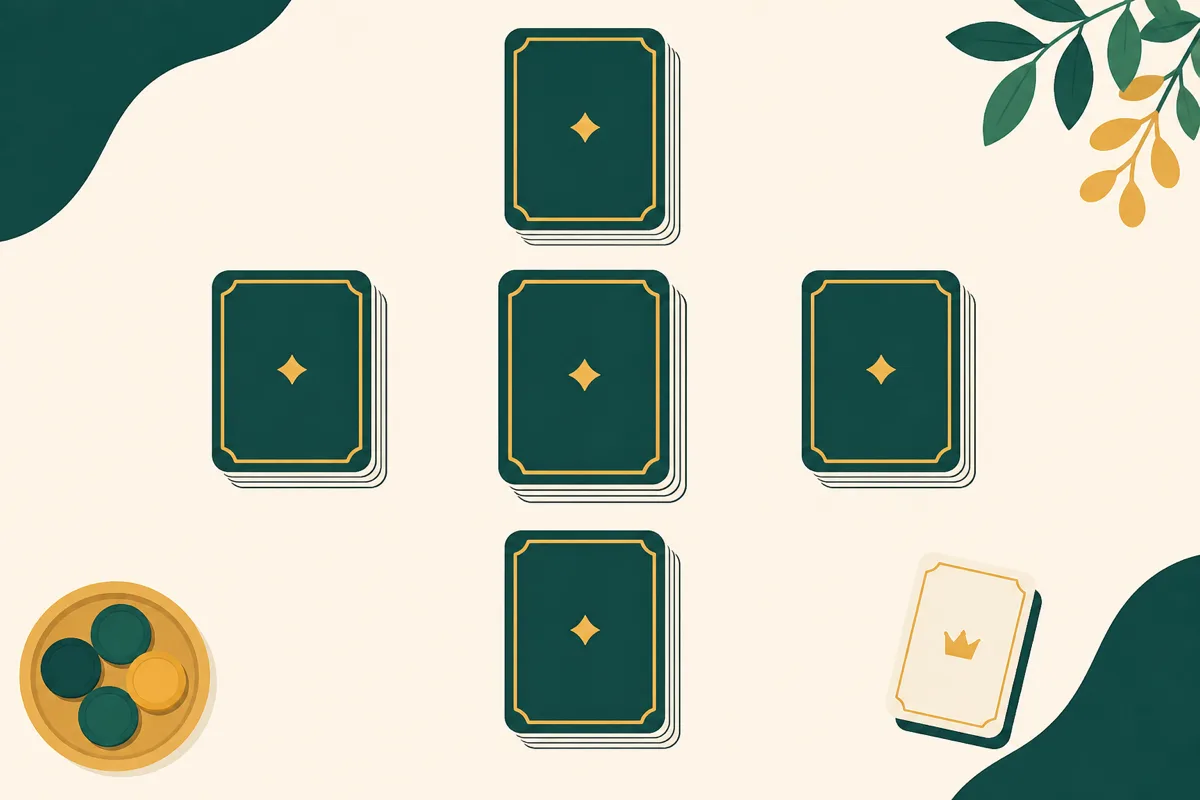
Place the rest of the deck face-down in the center of the table as the draw pile. Turn up the top 4 cards and arrange them in a cross around it, one to the north, south, east, and west. These 4 face-up cards are the foundation piles everyone builds on. The 4 diagonal corner spaces around the cross stay empty at the start, reserved for Kings.
Kings Corner shares its tableau-building logic with single-player Solitaire, cards descend in alternating colors, but it's a genuine multiplayer race rather than a solo puzzle. If you already know Solitaire's building rule, that part will feel immediately familiar even though the rest of the game plays very differently.
Gameplay
Building on a center pile
On your turn, you can play any card from your hand onto the top of any of the 4 center piles, as long as it's one rank lower than that pile's top card and the opposite color, a red 6 onto a black 7, for example. You can play as many legal cards as you have and want to, one after another, in a single turn.
You can also move an already-built partial sequence from one pile onto another, as long as the bottom card of the sequence you're moving still fits the descending, alternating-color rule against the top card of the pile you're moving it to.
Starting a new pile with a King
Kings are the only cards that can start a fresh pile, and they can only go into one of the 4 empty corner spaces around the original cross. Once a King is down, the next card played on it has to be a Queen of the opposite color, following the same building rule as every other pile from there on.
Drawing to end your turn
However many cards you played, or even if you played none at all, your turn always ends the same way: draw exactly 1 card from the center draw pile and add it to your hand. You don't draw back up to a fixed hand size, it's always just the one card, regardless of how much you managed to play.
Scoring
Kings Corner doesn't use a point-scoring system in its basic form. The first player to play every card out of their hand simply wins that hand outright.
Variations and house rules
| Variant | What changes |
|---|---|
| Multi-round scoring | Instead of playing a single hand, tally the point value of cards left in each losing player's hand at the end of a round and add it to a running total, lower is better, playing to an agreed target across several hands |
| Faster 2-player deal | Some tables deal only 4 or 5 cards to each player instead of 7 for a shorter, quicker 2-player game |
If building toward a win one placement at a time sounds appealing, Sequence, another game built around placing cards toward a win condition, plays out on a printed board instead of a plain tableau, using chips and matching cards rather than piles alone.
FAQ
How many cards do you deal in Kings Corner?
7 cards to each player is the most commonly cited standard, though some sources describe a faster 4- or 5-card deal, especially for a quicker 2-player game.
What's special about the corner spaces?
The 4 diagonal corners around the central cross are the only spots where a brand new pile can start, and only a King can be played there. Every other card has to build onto one of the 4 existing center piles instead.
Can you build on more than one pile in a turn?
Yes. You can play as many legal cards as you have in a single turn, spread across any of the piles, as long as each individual placement follows the descending, alternating-color rule.
Is Kings Corner the same as Solitaire?
The tableau-building rule is identical, descending sequences in alternating colors, but Kings Corner is a real multiplayer race between 2 to 4 players, not a single-player puzzle. There's no solo version of Kings Corner the way there's a solo version of Solitaire.
How do you win Kings Corner?
Be the first player to play every card out of your hand. In the basic version, that's the entire win condition, there's no separate point total to track unless your group is using a multi-round scoring variant.
- Sequence rules — another game built around placing cards toward a win condition
- Solitaire rules — the single-player game that shares Kings Corner's tableau-building rule
- Best card games for adults — down-funnel listicle featuring this and other strategy-friendly picks
- Rummy rules — another meld-and-sequence game, this one built around matching sets and runs
- Best Family Board Games — quick dice and tile games alongside classic family staples