3 player cribbage rules: how three-handed cribbage works
* Difficulty is our editorial read on how hard the game is to pick up — not an official rating. Player counts and deck sizes come from the game's rulebook.
Three-handed cribbage uses the normal two-player rules with a smaller deal: each player gets 5 cards, throws 1 into the dealer's crib, and one card from the deck tops the crib up to 4. Everyone plays for themselves, and the first to 121 wins.
- Deal 5 cards each, one at a time, starting with the player on the dealer's left.
- Each player discards 1 card to the crib; 1 card from the deck makes it 4 cards.
- Everyone keeps 4 cards in hand, same as the two-player game.
- Play and pegging go clockwise, starting left of the dealer.
- Hands are counted in the same clockwise order, dealer last, then the crib.
- Game is 121 points, usually pegged on a 3-track board.
Setup
You need a standard 52-card deck and either a 3-track cribbage board or a pencil and paper. Cut for the first deal; after every hand the deal passes one seat to the left. The American Cribbage Congress rulebook says three- and four-handed cribbage use essentially the same rules as the two-player game. What changes is the deal.
The dealer shuffles and offers the deck to the player on their right for a cut before dealing. Then the dealer deals clockwise one card at a time, starting with the player on their left. Each player ends up with 5 cards, and during the deal one extra card goes face down from the deck into the crib. Each player looks at their 5 cards and throws 1 into the crib. The crib now holds 4 cards and belongs to the dealer, just as it does with two players.
The table below shows how the deal changes as more people sit down.
| Players | Cards dealt to each player | Discards to the crib | Cards kept in hand |
|---|---|---|---|
| 2 | 6 | 2 each | 4 |
| 3 | 5 | 1 each, plus 1 card from the deck | 4 |
| 4 (two teams of 2) | 5 | 1 each | 4 |
| 6 (two teams of 3, one published version) | 5 to four players, 4 to the dealer and the player on the dealer's right | 1 from each player who received 5 | 4 |
Every format ends with a 4-card hand and a 4-card crib, which is why the counting rules never change.
After the discards there is a second cut, this time for the starter. The player on the dealer's left cuts the deck, and the dealer turns the top card of the lower stack face up. If the starter is a jack, the dealer pegs 2 points right away ("his heels").
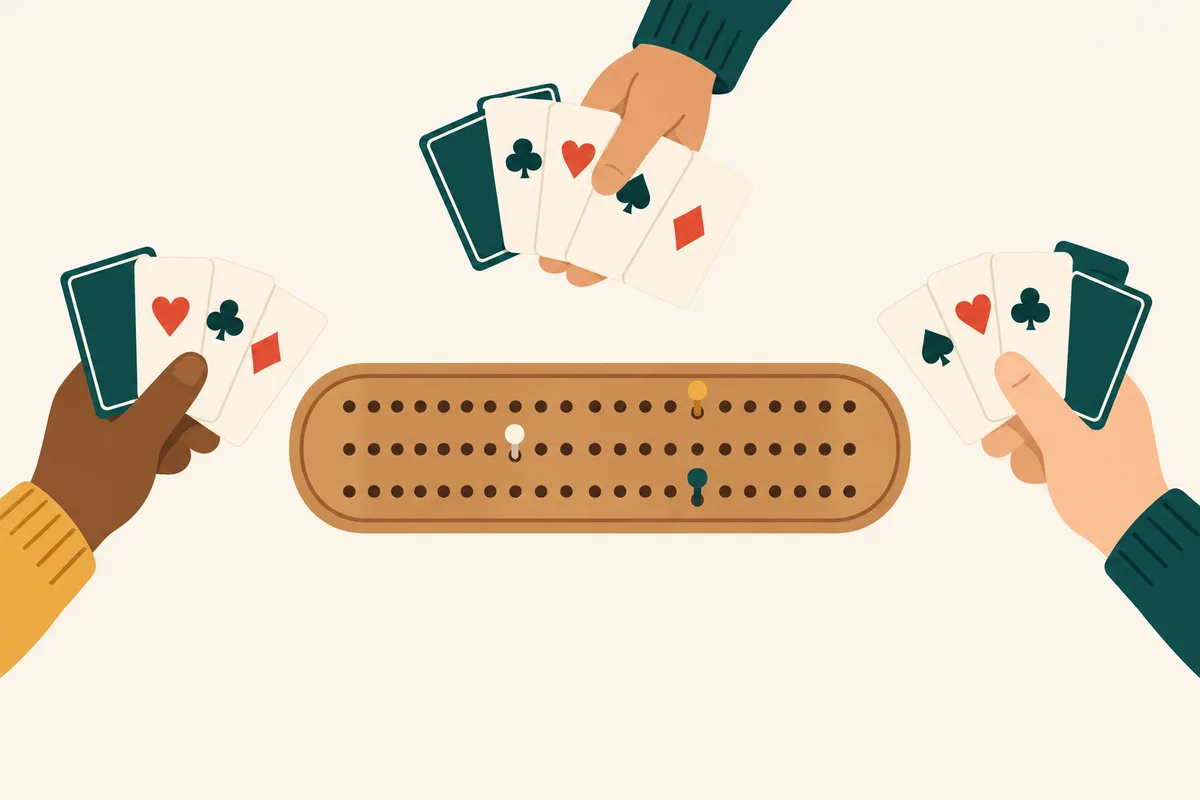
Gameplay: pegging with three players
The player on the dealer's left plays first, laying a card face up and calling the running count. Play then moves clockwise. Each player adds one card at a time, the count can never go past 31, and you must play a card if you have one that fits.
Pegging scores the same way as in the two-player game: 2 for making the count exactly 15, 2 for a pair, 6 for three of a kind in a row, 12 for four, 1 point per card in a run of 3 or more, and 2 for hitting exactly 31. Combinations count across all three players' cards. If the player before you laid a 7 and you lay another 7, you peg 2 for the pair. If the third player follows with a 7 too, that player pegs 6.
How go works with three people
When you can't play without going over 31, you say "go" and the turn passes to the next player on your left. That player keeps playing if they can. The count only stops when nobody at the table can add a card. Whoever laid the last card pegs 1 point, or 2 if that card made exactly 31 (you never get both).
A single go doesn't wipe out a pair or run in progress. Only the reset does. Once the count is stopped, it starts again from zero, and the next count is led by the player to the left of whoever laid the last card. Play continues until everyone's 4 cards are gone, and the very last card of the hand earns its 1 point (or 2 at 31) like any other.
A three-player pegging example
Cal deals, so Ann (on Cal's left) leads, then Ben, then Cal.
- Ann plays a 7. Count: 7.
- Ben plays an 8. Count: 15. Ben pegs 2 for fifteen.
- Cal plays a 6. Count: 21. The 6, 7 and 8 form a run, so Cal pegs 3.
- Ann plays a 9. Count: 30. Now 6-7-8-9 is a run of four, and Ann pegs 4.
- Nobody holds an ace, so Ben says go, Cal says go, and Ann can't play either. Ann laid the last card, so she pegs 1.
The count resets to zero, and Ben, the player on Ann's left, leads the next count.
Scoring: counting hands and the crib
When all cards are played, each hand is counted together with the starter. The order starts on the dealer's left and runs clockwise: first the player left of the dealer, then the next player, then the dealer's own hand, and finally the dealer's crib. Hand scoring is unchanged from the two-player game: fifteens, pairs, runs, flushes and nobs, with 29 still the highest possible hand. For any hand you're unsure about, the Cribbage score calculator will count it for you.
The game ends the moment someone reaches 121, whether that happens during pegging or partway through the count. Counting order matters here. The player on the dealer's left counts first, so in a tight finish they can win before the dealer ever gets to score their hand or the crib.
Keeping score on the board
Three-track cribbage boards are made for this game, with one lane and two pegs per player. Each player moves their back peg ahead of their front peg by the points scored, so the gap between pegs always shows the last score. If your board only has two tracks, keep the third player on paper, or put two boards side by side.
Three-handed strategy notes
With only one card to throw, the discard is simpler than in the two-player game, but the crib math changes. Two of the three players are always throwing into someone else's crib, so for most hands you want to avoid giving away 5s, pairs or cards that sit close together in rank. When it's your own crib, throw the card that's most likely to combine with others, and a 5 is the classic choice. In the play, remember that you're facing two opponents. The card you lay can set up a fifteen or a pair for either of them.
Cribbage with 4 and 6 players
4 players: partnership cribbage
Four-handed cribbage is played in two teams of two, with partners sitting across from each other. Each player gets 5 cards and throws 1 into the crib, so the crib still ends up with 4 cards and belongs to the dealer's team. Play runs clockwise from the dealer's left, with partners' points combined on one shared track. Each player counts their own hand in turn, and the dealer counts the crib last. Game is 121.
6 players: teams of three
Six-handed cribbage is the least standardized format, and groups set it up in different ways. One published version uses two teams of three, seated so that every other player is a partner. Four players get 5 cards and the dealer and the player on the dealer's right get 4. The four players holding 5 cards each throw 1 into the crib. Each team keeps one score on the board. If your group plays it differently, agree on the deal before the first hand.
Variations and house rules
| Variation | What changes |
|---|---|
| Short game to 61 | One lap of the board instead of two. Good when a three-handed game to 121 would run too long |
| Skunk lines | Some tables award an extra game if a loser is below 91 when the winner reaches 121. Agree on it before the deal, since it isn't part of every group's rules |
| Muggins | Points a player misses while counting can be claimed by another player. With three people at the table, two pairs of eyes are watching each count |
| Lead after a go | Most published rules give the next lead to the player left of whoever laid the last card. A few rule sheets give it to the first player who said go instead. Settle it before the first hand |
FAQ
How many cards do you deal in 3 player cribbage?
Five cards to each player, one at a time, starting on the dealer's left. One extra card from the deck goes face down into the crib during the deal. After each player throws 1 card in, the crib holds 4 cards and every hand holds 4.
Who plays first in three-handed cribbage?
The player on the dealer's left. They lead the first card of the play, and they also count their hand first after the play. The deal moves one seat to the left after every hand, so the first-to-play seat rotates too.
Who gets the go in 3 player cribbage?
The player who lays the last card once nobody else can play. If one player says go, the next player on the left keeps going, and so on around the table. The last card scores 1 point, or 2 if it brings the count to exactly 31.
Who leads after 31 or a go with three players?
The player to the left of whoever laid the last card. The count starts again from zero, and any pair or run from the previous count is over. Some groups let the first player who said go lead instead, so check which way your table plays.
Does 3 player cribbage still go to 121?
Yes, 121 is the standard target, pegged on a 3-track board. Some groups play a shorter game to 61, once around the board, which suits a weeknight game with three people.
Can you play cribbage with 4 or 6 players?
Yes. Four players play two teams of two, 5 cards each, 1 card each to the crib. Six-handed cribbage is less standard. One published version uses two teams of three, with a 4-card crib built from the four players dealt 5 cards.