Rummy rules: how to play, plus the Rummy 500 variant
* Difficulty is our editorial read on how hard the game is to pick up — not an official rating. Player counts and deck sizes come from the game's rulebook.
Rummy is a card game for 2 to 6 players using a standard deck. Each turn, a player draws one card, then discards one, trying to build sets (same rank) and runs (same suit, in sequence). The first player to arrange their entire hand into melds, with nothing left over, wins the round.
Setup
Rummy needs nothing more than a standard 52-card deck and a flat surface to deal on. Pick a first dealer any way the group likes, a cut of the deck or a simple draw for high card both work fine, and rotate the deal clockwise after each round.
How many cards each player gets depends on how many people are at the table. Rummy tightens the hand as the group grows, since a bigger table already has more cards in circulation between all the melds on offer.
| Players | Cards dealt to each player |
|---|---|
| 2 | 10 |
| 3–4 | 7 |
| 5–6 | 6 |
Worth flagging up front: Rummy is a folk-game family, not a single game with one publisher-issued rulebook the way Uno or Phase 10 are. Card counts above are the version most widely cited across current published rule guides, but you'll occasionally see a table quote different numbers for the 3-player game specifically. Agree on the deal before you start if you're playing with a group that's used a different house version before.
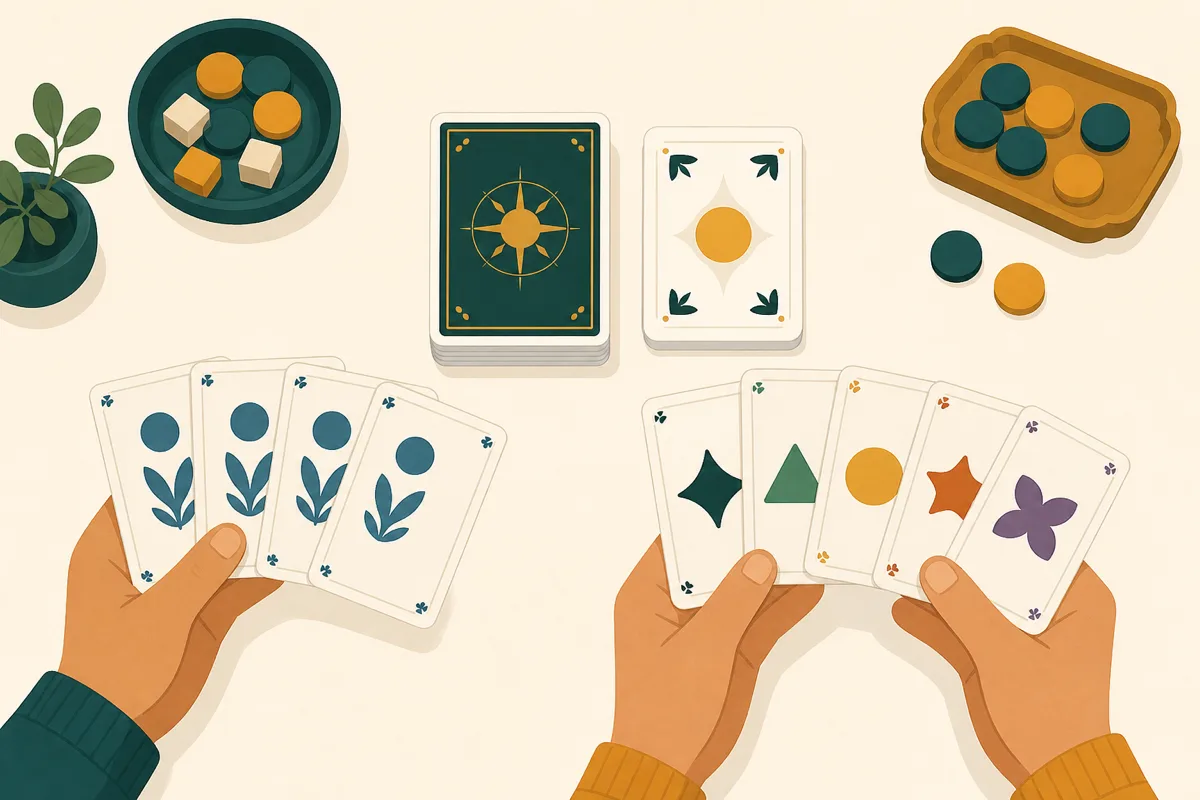
After the deal, place the remaining cards face-down as the stock pile in the middle of the table. Turn the top card of what's left face-up beside it to start the discard pile. That's the whole setup: one stock pile, one discard pile, and everyone's hand held close.
Gameplay
Drawing and discarding
Every turn follows the same two-step rhythm: draw one card, then discard one. You can draw from either the face-down stock pile or the face-up top card of the discard pile, your choice, though picking from the discard pile tells the whole table what you might be collecting, so it's rarely free information. After drawing, you discard exactly one card from your hand face-up onto the discard pile, and play passes to your left.
Building your first meld
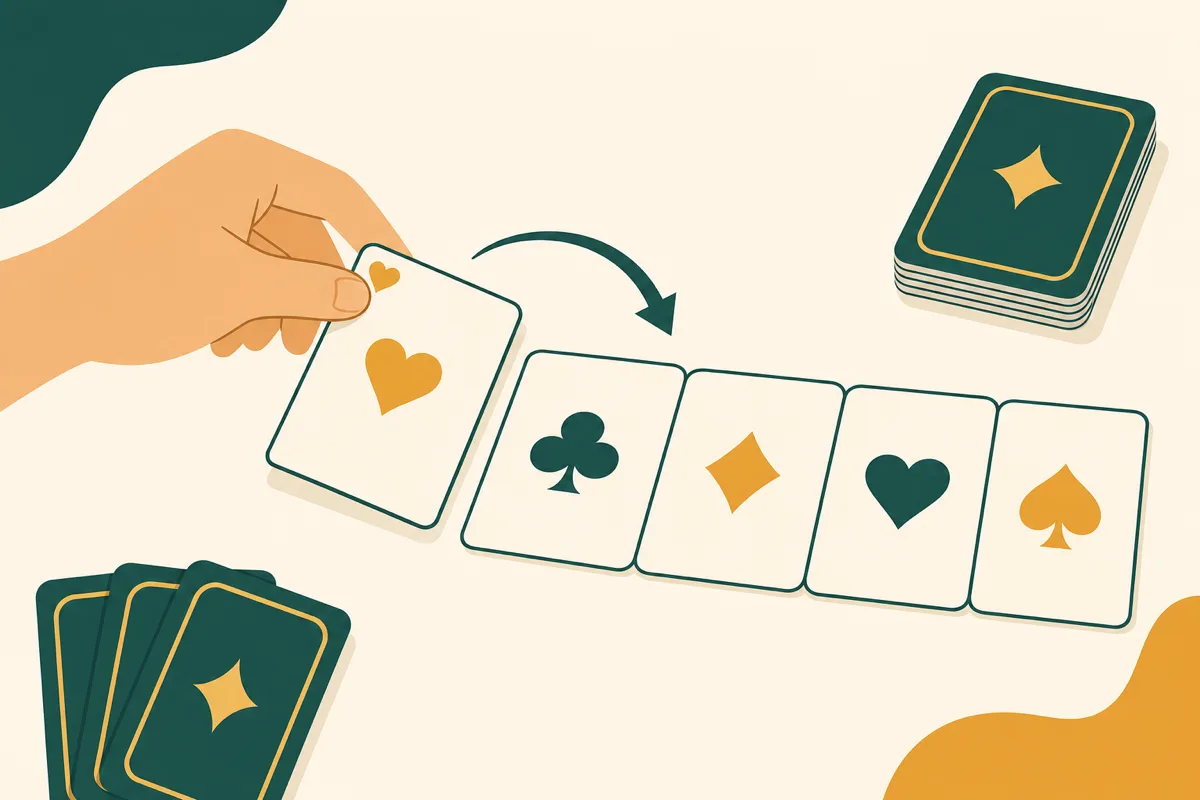
A meld is either a set, three or four cards sharing the same rank, like three 8s, or a run, three or more consecutive cards in the same suit, like 5-6-7 of hearts. Cards sitting in your hand that don't belong to a completed meld yet are simply cards you're holding onto, waiting for the right draw. Most tables allow melds to go down onto the table only once you have a full one in hand, so there's no partial credit for two cards of a pair sitting unplayed.
Once you've laid a meld on the table, you can usually add extra matching cards to it on later turns, a move often called laying off. If your 8-8-8 meld is already down and you draw a fourth 8, you can drop it onto your own meld instead of holding it. Some tables extend this to laying off onto a run too, adding a 4 of hearts to your own existing 5-6-7 sequence, stretching it further in either direction.
Going out
A round ends the moment a player melds their entire hand with nothing left over, sometimes called going out. Depending on the house rules a table has agreed on, that final card might need to be discarded rather than melded, so check before the first round if it matters to your group. Everyone else's hand gets scored based on what they're still holding, which is where the deadwood penalty comes in, covered in the Scoring section below.
Rummy 500: how it's different
Rummy 500 keeps the same basic goal, meld your hand and score more points than the table, but it changes two structural things that turn a fairly casual game into a sharper, more strategic one.
The first change is where you can meld. In basic Rummy, you generally only build onto your own melds sitting on the table. In Rummy 500, any player can meld directly onto any other player's exposed melds during their own turn, not just their own. If your opponent has a run of 4-5-6 of clubs on the table, you can play a 7 of clubs onto it on your turn even though you didn't start that run yourself. This turns the whole table into shared building material instead of four separate private projects, and it rewards paying close attention to what's already down, not just what's in your own hand.
The second change is how the game scores. Basic Rummy generally scores the losers on the deadwood, the point value of cards still stuck in their hand when someone goes out. Rummy 500 instead scores every card a player successfully melds, whether it's their own meld or a card laid onto someone else's, adding those points to a running cumulative total. Cards left unmelded in hand at the end of a round count against that player instead of for them. First to reach 500 cumulative points across however many hands it takes wins the game, which is where the variant's name comes from.
This is the exact comparison worth having on hand if you already know one of these three games and want to know how the others differ.
| Rummy | Rummy 500 | Gin Rummy | |
|---|---|---|---|
| Players | 2–6 | 2–6 (commonly 2–4) | 2 only |
| Hand size | 10/7/6 by player count | Same as Rummy, by player count | 10 cards, fixed |
| Melding onto others' cards | No, only your own melds | Yes, onto any player's exposed melds, any turn | Only at the knock stage, and only onto the knocker's own melds |
| Scoring basis | Deadwood left in losers' hands | Every melded card scores; unmelded cards count against you | Deadwood difference plus knock/gin/undercut bonuses |
| Win condition | Meld out first; sessions often run to an agreed number of rounds | First to 500 cumulative points across hands | First to 100 points across a match, with a box bonus per hand won |
Scoring
Basic Rummy usually keeps scoring simple: whoever goes out first wins the round outright, and everyone else adds up the deadwood, the point value of whatever's still sitting unmelded in their hand. Face cards commonly count 10 points each, aces count low at 1, and number cards count their face value. Groups that want to track a longer match often carry those deadwood totals forward round after round, with the lowest cumulative total after an agreed number of rounds declared the overall winner.
Rummy 500 scores in the opposite direction, in a sense, because points come from what you successfully meld rather than what you're stuck holding. Every card you meld, whether onto your own table or laid off onto someone else's, adds to your running total. Face cards and 10s are commonly worth 10 points, number cards their face value, and the ace's value depends on how it's used: worth 15 points when melded as part of a set, but only 1 point when it's played as the low card in a run like ace-2-3 of the same suit. Cards you're still holding when someone else goes out count against you at those same values, so there's real pressure not to sit on cards you can't place. Because Rummy has no single official rulebook, treat this as the widely used convention rather than an absolute standard, some tables simplify things further and count every card 2 through 9 flat at 5 points regardless of rank.
Variations and house rules
Rummy's folk-game roots mean nearly every group plays a slightly different version, and most of the differences are additions rather than contradictions of the base rules above.
| Variant | What changes |
|---|---|
| Joker wild | A handful of jokers get added to the deck (commonly 2 or 3) and act as a wild substitute for any card needed to complete a set or run |
| Buying the discard pile | A player who isn't next in turn can "buy" the top discard card out of turn by also taking a penalty card from the stock. That player can't meld, lay off, or discard on the buy itself, and still draws normally on their own turn later |
| Reach past the top discard | Some tables let a player take more than just the top discard card, reaching further down the pile, as long as they can immediately use the deeper card in a meld and take everything above it too |
Contract Rummy is a related but distinct game family worth knowing about if this style of play appeals to you, it adds a fixed sequence of required melds across several hands instead of Rummy's open-ended structure, and it's different enough to deserve its own separate treatment rather than a quick mention here.
FAQ
How do you play Rummy?
Deal each player a hand based on the player count, then take turns drawing one card and discarding one, working toward sets of matching rank or runs of consecutive same-suit cards. The first player to meld their entire hand wins the round, and everyone else scores based on what's left in their hand.
How many cards do you deal in Rummy?
It depends on the table size: 10 cards each for 2 players, 7 cards each for 3 or 4 players, and 6 cards each for 5 or 6 players. The remaining cards form the stock pile, with the top card turned face-up to start the discard pile.
What's the difference between Rummy and Rummy 500?
Rummy 500 lets players meld directly onto anyone's exposed cards on the table, not just their own, and it scores every melded card toward a running total rather than only penalizing the deadwood left in losers' hands. The target is 500 cumulative points across however many hands it takes.
What's the difference between Rummy and Gin Rummy?
Gin Rummy is strictly a 2-player game with a fixed 10-card hand and no melding onto the table during normal play, only a limited lay-off onto the knocker's melds when a hand ends. Basic Rummy allows 2 to 6 players and lets everyone build their own melds on the table freely each turn. For the exact scoring mechanics, see how Gin Rummy scoring differs, including the knock, gin, and undercut bonuses that don't exist in basic Rummy at all.
Can you play Rummy with 2 players?
Yes, and it's one of the most common table sizes. Each player gets 10 cards, the largest hand size across the standard player-count range, since there's less competition over what's available to meld.
What are common Rummy variations?
The most widely used adjustments are a joker-wild deck for extra flexibility, a "buying" house rule that lets a player grab a wanted discard out of turn at the cost of a penalty card, and reaching further down the discard pile when a meld calls for it. Contract Rummy is a related but separate game family for groups who want a more structured, multi-hand format.