Solitaire rules: how to play Klondike, step by step
* Difficulty is our editorial read on how hard the game is to pick up — not an official rating. Player counts and deck sizes come from the game's rulebook.
Solitaire, the game almost everyone means when they say "solitaire," is officially called Klondike. It's a one-player game played with a standard 52-card deck. Seven tableau columns hold 1 through 7 cards each, with only the top card face-up. Build the four foundation piles up by suit from Ace to King, moving cards between columns in alternating colors along the way, and you win once every card sits on a foundation.
Setup
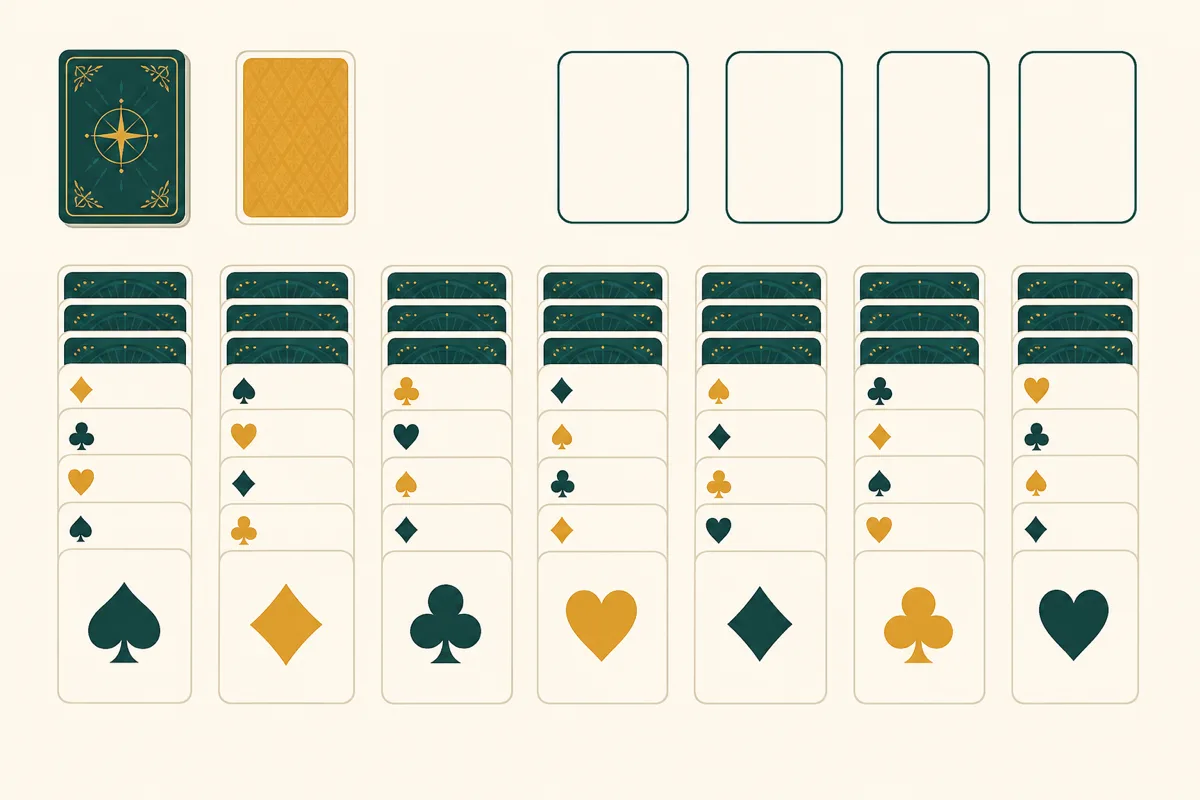
Klondike uses one standard 52-card deck, no jokers. Deal cards into seven columns, called the tableau, dealing one column at a time from left to right and adding one more card to each column as you go.
| Column | Cards dealt | Face-up count |
|---|---|---|
| 1 | 1 card | 1 (the only card) |
| 2 | 2 cards | 1 (top card only) |
| 3 | 3 cards | 1 (top card only) |
| 4 | 4 cards | 1 (top card only) |
| 5 | 5 cards | 1 (top card only) |
| 6 | 6 cards | 1 (top card only) |
| 7 | 7 cards | 1 (top card only) |
That's 28 cards dealt across the tableau. The remaining 24 cards form the stock, held face-down and set to one side. Above the tableau, leave room for four empty foundation piles, one per suit, which stay empty until an Ace of that suit turns up somewhere in play.
Every column's bottom cards start face-down and only get flipped over as the cards on top of them are cleared away, so a big part of early solitaire play is simply working down through each column to see what's hiding underneath. Longer columns, especially column 7 with its six buried cards, tend to decide whether a deal opens up quickly or stays cramped for most of the game.
One small setup detail that trips up new players: the tableau deal and the foundations are two completely separate areas of the table. Nothing gets placed on a foundation during the deal itself, no matter how tempting it is to move an exposed Ace there right away before you've had a chance to see what else the deal reveals underneath it.
Gameplay
Building the tableau
Cards in the tableau build downward in alternating colors: a red 6 can hold a black 5, which can hold a red 4, and so on, switching color every step down. You can move a single card, or an entire valid run of alternating-color cards already stacked in sequence, from one column onto another as long as the move keeps that alternating pattern intact at the point where the two groups meet. Once a face-down card becomes the top card of its column, because everything that was sitting on it has been cleared away, flip it face-up immediately and it becomes available to play.
Building the foundations
The four foundations sit above the tableau, one per suit, and each one builds up starting from that suit's Ace. Once a suit's Ace becomes available, whether it's sitting on top of a tableau column or has just been turned up from the stock, move it to its foundation, then add that suit's 2, 3, and every following rank in strict ascending order. Skipping a rank isn't allowed, even temporarily. Most rule sets also let you move a card back from a foundation to the tableau if doing so frees up a stuck play elsewhere, though a well-going game rarely needs it.
Working the stock pile
Whenever the tableau and foundations run out of legal moves using only what's currently visible, turn over cards from the stock into a separate waste pile next to it. Only the top card of the waste pile is playable at any given moment, so cards further down stay locked away until the ones on top of them are dealt with or played. Once the stock runs dry, some versions let you flip the entire waste pile back over and turn it into a fresh stock to cycle through again, while others cap how many times you're allowed to do that. It's worth agreeing on that detail before you start if you're keeping score or timing the game, since it materially changes how many chances you get to unstick a difficult deal.
Scoring
Most casual games of solitaire have no formal scoring at all. You either clear the entire tableau onto the foundations and win, or you eventually run out of legal moves and the game ends unfinished, and that binary result is the whole point for most players.
A separate scoring convention, commonly called Vegas scoring, does exist for players who want a running number attached to each game rather than a plain win or loss. Instead of charging anything during play, it treats the whole 52-card deck as a one-time buy-in, commonly cited at a dollar a card, so $52 to play a single deal, and pays back a larger amount for every card that reaches a foundation, commonly cited at $5 a card. That gap between the buy-in and the payout is the point: moving roughly 11 cards to the foundations covers the cost of the deck, and everything beyond that is profit. Some versions of Vegas scoring also limit play to a single pass through the stock rather than letting you cycle back through it, which raises the stakes on making each stock card count. Treat Vegas scoring as an optional add-on layered on top of the base rules rather than the default way solitaire is scored, since most people playing a casual home game never touch it.
Draw 1 vs. draw 3
The single biggest variable in how a Klondike game feels, and in how likely it is to be winnable at all, is how many stock cards you turn over at once. Both conventions below are widely documented as standard forms of the game, not one official version and one house variant.
| Draw 1 | Draw 3 | |
|---|---|---|
| Stock cards revealed per turn | 1 card at a time | 3 cards at a time, only the top one playable |
| Difficulty | Easier, meaningfully higher win rate | Harder, more of the stock stays buried behind cards you can't touch yet |
| Where it's common | Most casual and digital solitaire apps | Some scored and casino-style versions use this as their standard |
| Effect on stock cycling | Every card gets a turn face-up eventually, even if it takes multiple passes | Cards can stay stuck two or three deep depending on exactly what sits on top of them |
Digital solitaire apps often default to draw 1, since it's the friendlier version for a casual player working through a quick game, and it's the version most people picture when they picture solitaire at all. If a rulebook or a scored variant just says "solitaire" without specifying which stock convention it uses, draw 1 is the safer assumption, but draw 3 is common enough in scored and casino-style play that it's worth confirming before you deal, especially if points or money are riding on the outcome.
Variations and house rules
Beyond the draw 1 versus draw 3 choice, a handful of other table-agreement rules change how forgiving a game of solitaire feels, and none of them is more "official" than the others.
| Variant | What changes |
|---|---|
| Unlimited stock re-cycling | Once the stock runs out, flip the waste pile back over and keep going as many times as needed until the game is solved or truly stuck |
| Limited re-cycling | The stock can only be turned over a fixed number of times, often 1 or 3, forcing you to solve the deal before you run out of turns rather than grinding it out indefinitely |
| Kings-only empty column | Only a King, or a valid descending run starting with a King, can be moved into an empty tableau column, the strict standard rule |
| Any card to an empty column | A relaxed house rule that lets any card start a new pile in an empty column, making the game noticeably easier and opening up plays the strict rule would block |
Groups that play for fun rather than for a formal score tend to gravitate toward the more relaxed end of this table, unlimited re-cycling plus the any-card rule, since both changes cut down on the frustration of an early deal locking up before you've had much chance to work it.
FAQ
How do you set up a game of solitaire?
Deal one standard 52-card deck into seven tableau columns, giving column 1 a single face-up card and each following column one more card than the last, up through 7 cards in column 7, with only each column's top card face-up. The rest of the deck becomes the stock, and four empty spaces are left above the tableau for the foundations.
What's the difference between solitaire and Klondike?
There's no real difference. Klondike is the specific name of the game most people mean when they say "solitaire" in casual conversation, and it's the version described on this page. Other solo card games, like Spider Solitaire and FreeCell, are sometimes lumped under the broader "solitaire" label too, but they use different tableau layouts, different win conditions, and different rules from Klondike itself.
Can you move a card to an empty column in solitaire?
In the strict standard rule, only a King, or a valid descending run starting with a King, can move into an empty tableau column. Some players use a relaxed house rule that allows any card into an empty column instead, which makes the game meaningfully easier since it opens up more moves earlier, so it's worth agreeing on which version you're playing before you start.
What's the difference between draw 1 and draw 3 solitaire?
Draw 1 turns over one stock card at a time and gives every card a real chance to become playable eventually, which makes it easier overall and produces a higher win rate across a large sample of games. Draw 3 turns over three cards at once but only lets you play the top one, which buries more of the stock behind cards you can't reach yet. Both are widely used, not one official version and one lesser variant.
Is there a way to always win at solitaire?
No. Not every Klondike deal is mathematically winnable, even with perfect play, since some deals lock cards behind combinations that can never legally be unstuck no matter what order you try them in. That's a genuine, checkable difference from FreeCell, where nearly every standard deal has been shown to be solvable.
What are Spider Solitaire and FreeCell?
Spider Solitaire and FreeCell are both solo card games often grouped under the broader "solitaire" umbrella, but each uses its own tableau and win condition rather than Klondike's seven-column, four-foundation layout. Spider Solitaire uses two combined decks and ten columns with no traditional foundations at all, while FreeCell deals every card face-up from the very start and adds four free cells for temporary storage instead of hidden cards.
- Spider Solitaire rules — the two-deck, ten-column variant, with its own suit-count difficulty tiers
- FreeCell rules — the fully-visible variant where nearly every deal is solvable
- Best Family Board Games — where quick dice and tile games sit alongside classic family staples
- Yahtzee rules — another classic solo-friendly, family-night staple
- Best 2 player card games — includes a note on Double Solitaire, a 2-player spin on this page's rules