Pinochle rules: how to play, bid and count melds
* Difficulty is our editorial read on how hard the game is to pick up — not an official rating. Player counts and deck sizes come from the game's rulebook.
Pinochle is a trick-taking card game played with a 48-card deck holding two copies of each 9 through ace. The most common form seats 4 players in 2 partnerships, dealing 12 cards each. Players bid for the right to name trump, lay down melds for points, then play tricks, and the winning side needs their combined meld and trick points to reach the bid or lose that amount instead.
Setup
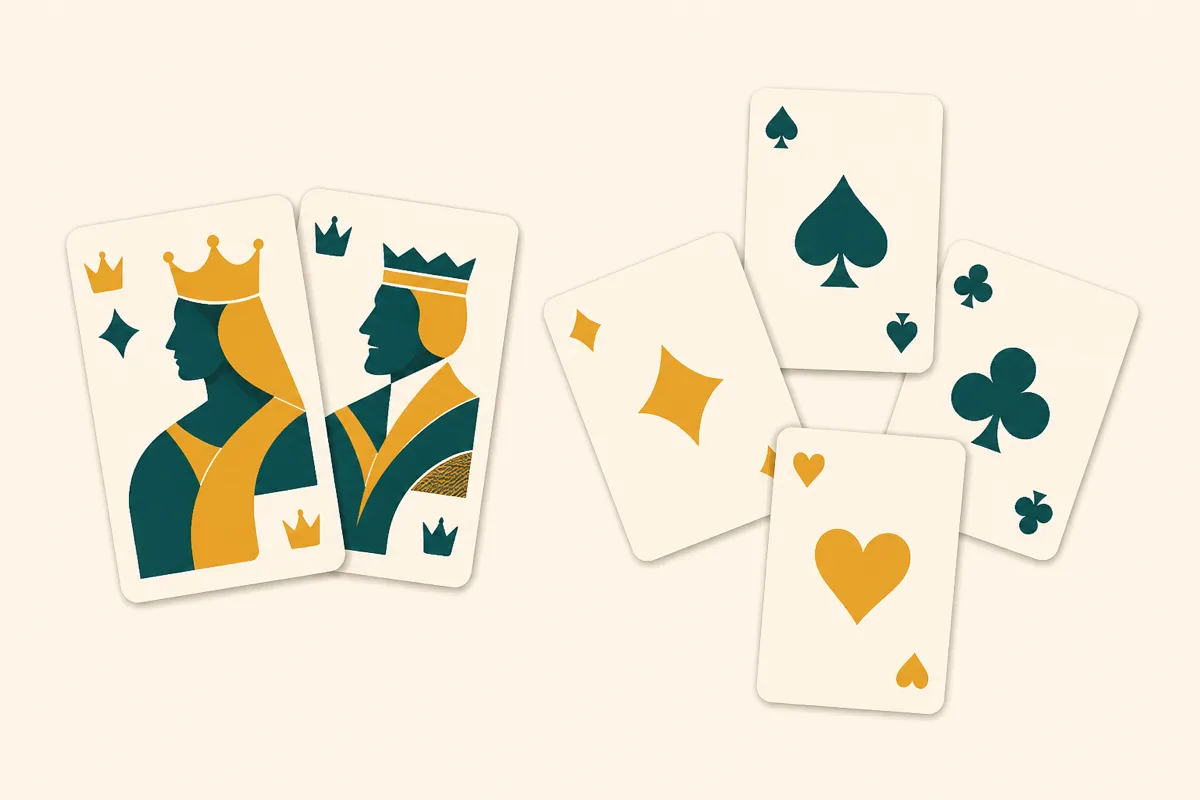
A Pinochle deck looks unusual to anyone used to a standard 52-card pack. It runs 9 through ace in each suit, with two copies of every rank, giving 48 cards total and no cards numbered 2 through 8 at all. The nines are the lowest-ranking card, which surprises a lot of new players expecting them to sit somewhere in the middle.
In the standard 4-player partnership game, the dealer gives each player 12 cards, using up the entire 48-card deck exactly. That even split means there's no widow or kitty in this form, every card in the deck ends up in someone's hand before the bidding starts. A widow does show up in some 2-player and 3-player versions of single-deck Pinochle, where the deal doesn't divide the deck evenly and the leftover cards form a small extra pile the winning bidder picks up. Confirm which form your table is playing before you deal, since the widow rule changes how the bidding and melding phase works.
Gameplay
Bidding for trump
Starting to the dealer's left, players take turns bidding a number of points or passing, with each new bid required to beat the last one. Bidding continues until every other player has passed, and the last bidder standing wins the right to name trump for the hand. That bid is also a promise: the bidder's side needs to reach at least that many combined points between melds and tricks, or the full bid amount is subtracted from their score instead. Bidding to win the right to name trump, rather than just having trump turned up automatically, is a mechanic Pinochle shares with another bidding-and-trump trick game, Euchre, even though the two games arrive at trump in very different ways.
Melding
Once trump is named, every player lays down whatever scoring combinations they're holding, face up on the table, before trick play starts. Melds are built from specific card combinations, a pair of kings and queens in the trump suit, a run of the top five trump cards, and so on, each worth a fixed point value covered in Scoring below. Only combinations shown at this stage count, so a hand full of near-misses that never get displayed on the table scores nothing.
Trick-taking and card values
After melding, players play out the hand one trick at a time, following suit when possible, with trump cards beating any non-trump card played. Only certain cards carry point value when they're won in a trick: ace is worth 11, ten is worth 10, king is worth 4, queen is worth 3, jack is worth 2, and nine is worth nothing at all. Whoever wins the very last trick of the hand also collects a 10-point bonus on top of whatever cards were in it, which is one detail newer players commonly miss when they're adding up the count.
Scoring
Between the fixed card values above and a fixed 10-point last-trick bonus, a full 48-card hand has exactly 250 points available during trick play. Meld points are added on top of that trick-play total. The table below covers every commonly recognized single-deck meld, from the smallest bonus, the nine of trump, up to the two rare "double" melds that pay far more than simply twice the base value.
| Meld | Points |
|---|---|
| Nine of trump ("dix"), if turned up as the trump card | 10 |
| Marriage (king + queen, non-trump suit) | 20 |
| Royal marriage (king + queen of trump) | 40 |
| Pinochle (queen of spades + jack of diamonds) | 40 |
| Jacks around (one jack of each suit) | 40 |
| Queens around (one queen of each suit) | 60 |
| Kings around (one king of each suit) | 80 |
| Aces around (one ace of each suit) | 100 |
| Trump run (ace, 10, king, queen, jack of trump) | 150 |
| Double pinochle (both pinochles in the same hand) | 300 |
| Double run (both trump runs in the same hand) | 1,500 |
Say a bidder's hand includes the king and queen of trump (a royal marriage, worth 40), the queen of spades and jack of diamonds (a pinochle, worth 40), and one jack from each of the four suits (jacks around, worth 40). Laid down together, that's 120 meld points on the table before a single trick is played, on top of whatever card points that hand's tricks bring in afterward.
Holding two separate, different melds, say a royal marriage in trump plus an ordinary marriage in another suit, just adds the two values together like any other pair of melds. The two "double" melds in the table above work differently: doubling every card in a pinochle or in a full trump run doesn't simply double the points, a double pinochle pays 300 rather than 80, and a double run pays 1,500 rather than 300, which is exactly why they're the two melds most worth building a hand around when the cards allow it.
After both melding and trick play are counted, the bidding side checks their combined total against their bid. Meet or beat it, and both the meld and trick points count as scored. Fall short, and the bid amount comes off their score instead, regardless of how many points they actually put on the board that hand.
Single-deck vs. double-deck comparison
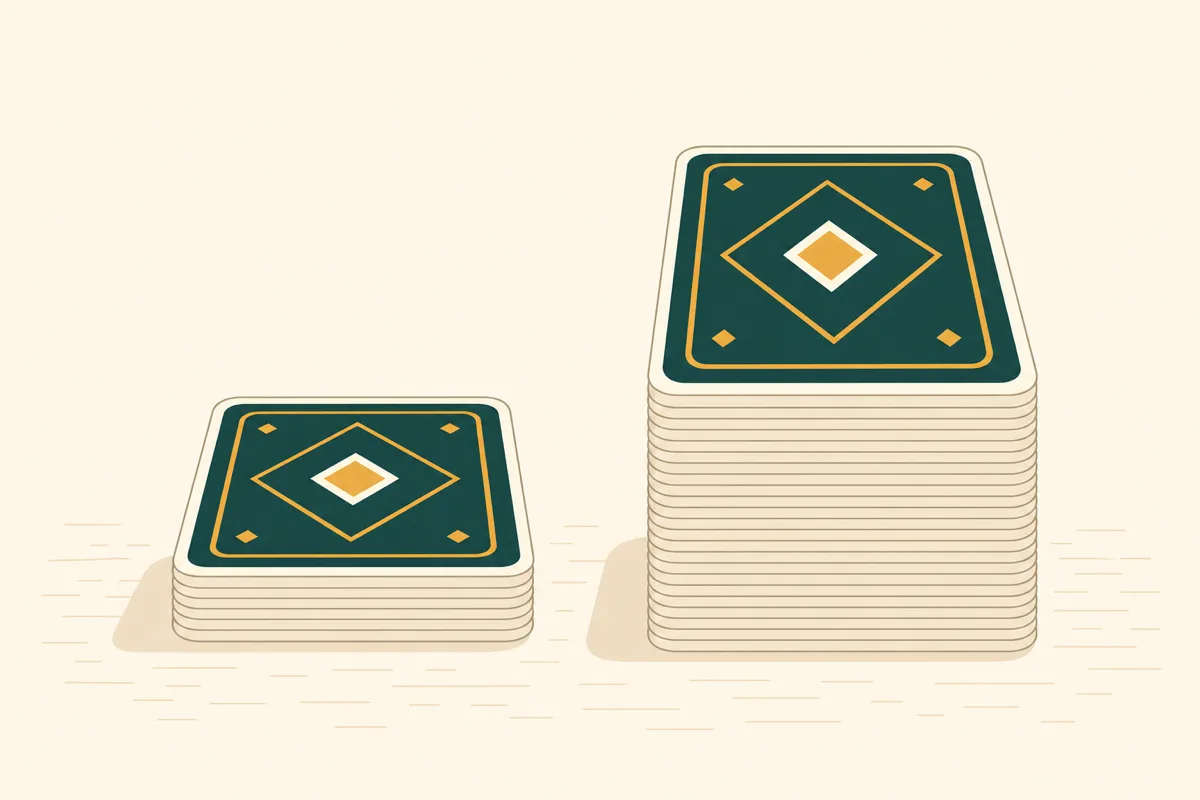
Double-deck Pinochle is built for a bigger table and changes more than just the card count. The version most commonly cited combines two Pinochle decks with the nines removed, landing on 80 cards total, though some tables play a 96-card version that keeps the nines in, so it's worth confirming which one a group is using before the first hand. Dealt out to the standard 4-player partnership arrangement, that's 20 cards each, another deal that divides the deck exactly and leaves no widow.
| Single-deck Pinochle | Double-deck Pinochle | |
|---|---|---|
| Card count | 48 cards | Commonly 80 cards (9s removed); some tables use 96 |
| Cards per player (4-player partnership) | 12 | 20 |
| Typical player count | 2 to 4 most common | Usually 4, in 2 partnerships |
| Minimum opening bid | Varies by table convention | Commonly 50 |
| Meld requirement to score | No fixed minimum widely cited | Commonly requires at least 20 meld points before any meld scores at all |
| Common game target | 500 (1,000 for longer matches) | Commonly 500 |
The bigger deck changes strategy more than it changes the rules on paper. With twice as many copies of every card in circulation, melds that would be rare in single-deck play, like a double pinochle, come up more often, and trump suits get contested more aggressively during bidding since there's more trump-suit material available for everyone at the table.
FAQ
How many cards are in a Pinochle deck?
A single Pinochle deck has 48 cards, two copies each of 9 through ace in every suit, with no cards ranked 2 through 8. Double-deck play commonly combines two of these decks with the nines removed, landing on 80 cards, though a 96-card version that keeps the nines exists too.
What is a Pinochle meld worth?
It depends on the combination. A marriage outside the trump suit is worth 20 points, while a royal marriage in trump or a plain pinochle is worth 40 points each. The four "around" melds range from 40 for jacks up to 100 for aces, and a full trump run is worth 150. The two rare "double" melds pay far more than twice their single value: a double pinochle is a 300-point bonus, and a double run of trump is worth 1,500.
What's different about double-deck Pinochle?
Double-deck Pinochle commonly uses an 80-card combined deck (with the nines removed) instead of a single 48-card deck, deals 20 cards to each of 4 players instead of 12, and typically requires a partnership to reach at least 20 meld points before any of their melds count toward the score.