Uno Flip rules
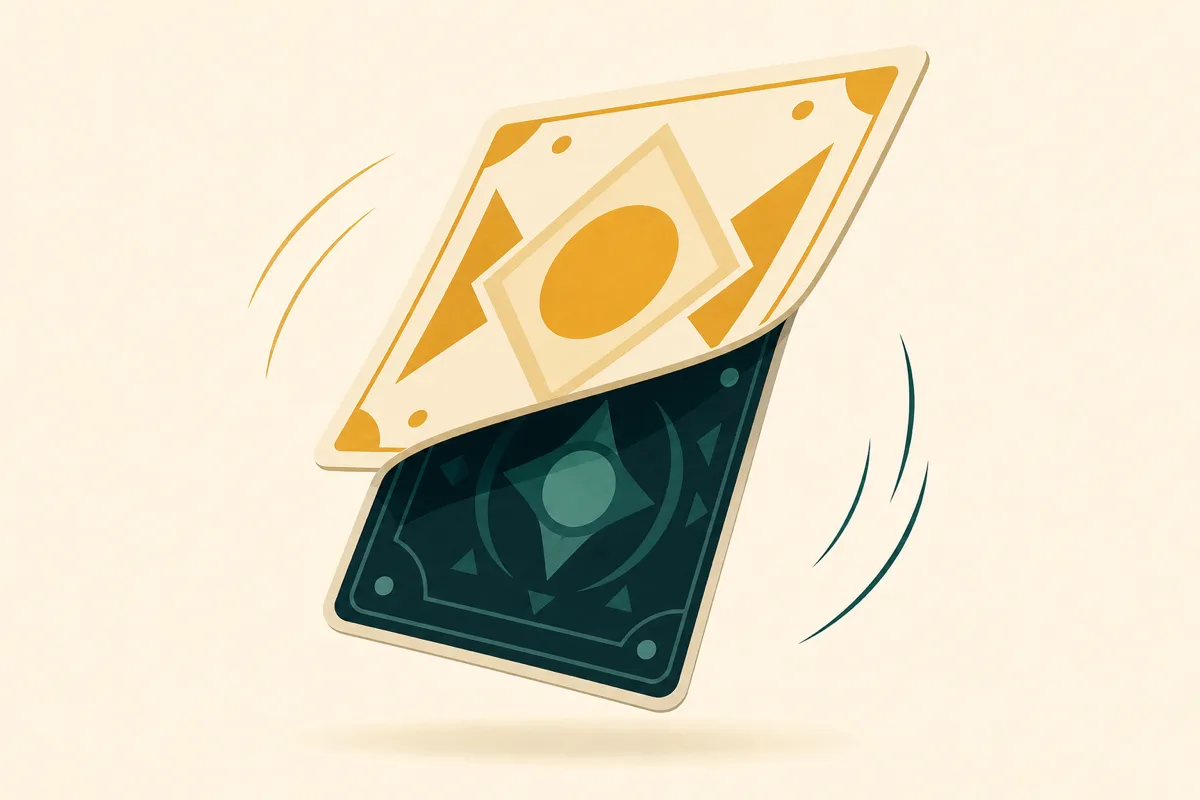
Uno Flip plays with a double-sided deck instead of a single-sided one. One side (light) works close to standard Uno; the other side (dark) uses harsher versions of the same cards. A Flip card turns the whole table over to the other side mid-game, and that side stays in play until someone flips it back.
How this differs from standard Uno
If you already know standard Uno rules, Flip will feel familiar within the first few turns. The core loop doesn't change: match by color or number, play action cards to mess with the next player, run out of cards first. What changes is the deck itself. Every card in an Uno Flip set is printed twice, once on each face, so the whole deck lives a second life the moment someone plays a Flip card.
Light side colors are the usual blue, green, yellow and red. Dark side colors are pink, teal, purple and orange, and every action card on that side hits harder than its light-side twin. Games start on the light side by default, then flip back and forth as players trigger the switch.
Gameplay: light side and dark side
Play begins on the light side with a normal-looking Uno hand. Numbers still range 0 through 9 in each color, and the deal, discard pile and turn order all work the way they would in a standard game.
The table only flips when someone plays a Flip card. When that happens, every card still in play, hands, draw pile, discard pile, turns over to reveal the opposite face. The player who played the Flip card chooses which side to switch to (if the game is on light, it goes to dark, and vice versa), and play continues from there until another Flip card shows up.
Once you're on the dark side, the deck's personality changes. Dark-side action cards are built to punish, which is the whole appeal of the variant for players who find standard Uno too tame.
| Light side card | What it does | Dark side counterpart | What it does |
|---|---|---|---|
| Skip | Next player loses their turn | Skip Everyone | Every other player loses their turn, you go again |
| Reverse | Reverses turn order | Reverse | Same effect, works identically on both sides |
| Draw One | Next player draws one card and is skipped | Draw Five | Next player draws five cards and is skipped |
| Wild | Play on any card, choose the new color | Wild | Same effect on the dark palette |
| Wild Draw Two | Choose a color, next player draws two and is skipped | Wild Draw Color | Choose a color, next player draws until they pull that color, then is skipped |
| Flip | Flips the whole game to the dark side | Flip | Flips the whole game back to the light side |
Notice that Wild Draw Color on the dark side has no fixed draw count. A player could pull two cards or ten before they finally hit the called color, which is exactly why groups who've tried both sides describe dark-side turns as riskier to sit through.
Variations and house rules
Because Flip is already a variant, most house rules people layer on top of it are small tweaks rather than full rewrites.
- Starting on the dark side. Some groups skip the light side entirely for a shorter, meaner game from card one. Nothing in the deck stops this, it's purely a table agreement.
- Combining two Flip sets. Larger groups sometimes merge two boxes to support more players or refill a draw pile that's running thin. Shuffle both decks together rather than alternating them, or the color distribution gets lopsided.
- Capping Wild Draw Color. Because that card has no built-in draw limit, some tables cap it at a fixed number, commonly six or eight cards, so one unlucky draw doesn't stall the game. This is a house adjustment, not part of the printed rules.
FAQ
How do you switch to the dark side in Uno Flip?
Someone plays a Flip card. The moment it lands, every card still in play turns over, hands included, and the game continues on whichever side the Flip card sent it to. It flips back the same way when a Flip card is played again.
What new cards does Uno Flip add?
The deck adds a Flip card (present on both sides) plus dark-side-only versions of the standard action cards: Skip Everyone, Draw Five and Wild Draw Color. Reverse and Wild work the same way on both sides, just with different artwork.
Can you mix Uno Flip cards with a regular Uno deck?
No. A Flip deck is built as a matched double-sided set, and its dark side has no equivalent in a standard Uno box. Mixing the two breaks the flip mechanic and makes card backs inconsistent, so keep the sets separate.
Is Uno Flip harder than regular Uno?
Most players find it harsher rather than harder in a strategic sense. The dark side's stronger draw cards mean hands can swing fast, so rounds tend to be shorter and less predictable than standard Uno, which is the point of the variant.
- Uno Rules — the full standard rulebook this variant builds on
- Uno Attack Rules — the launcher-based Uno variant
- Uno Special Cards Explained — card-by-card reference with dispute resolution
- Uno Spin-Offs Roundup — quick orientation on five other Uno variants
- Uno House Rules & Stacking — popular unofficial rule additions
- Best Family Board Games — quick dice and tile games alongside classic family staples