Uno special cards explained: every card and how it's disputed
This page is a card-by-card reference for every special card in Uno: what each one does, and the specific edge cases that come up when someone at the table disagrees about a ruling.
How this fits into standard Uno
This guide assumes you already know how a basic turn works: draw, match, discard, first to zero wins. If you need that groundwork first, start with the full Uno rulebook, which covers setup, turn order, and scoring from the beginning. What follows here goes deeper on the cards themselves, the ones that change turn order, force draws, or hand over control of the discard pile's color, along with the situations where players most often disagree about how they're supposed to work.
Card-by-card breakdown
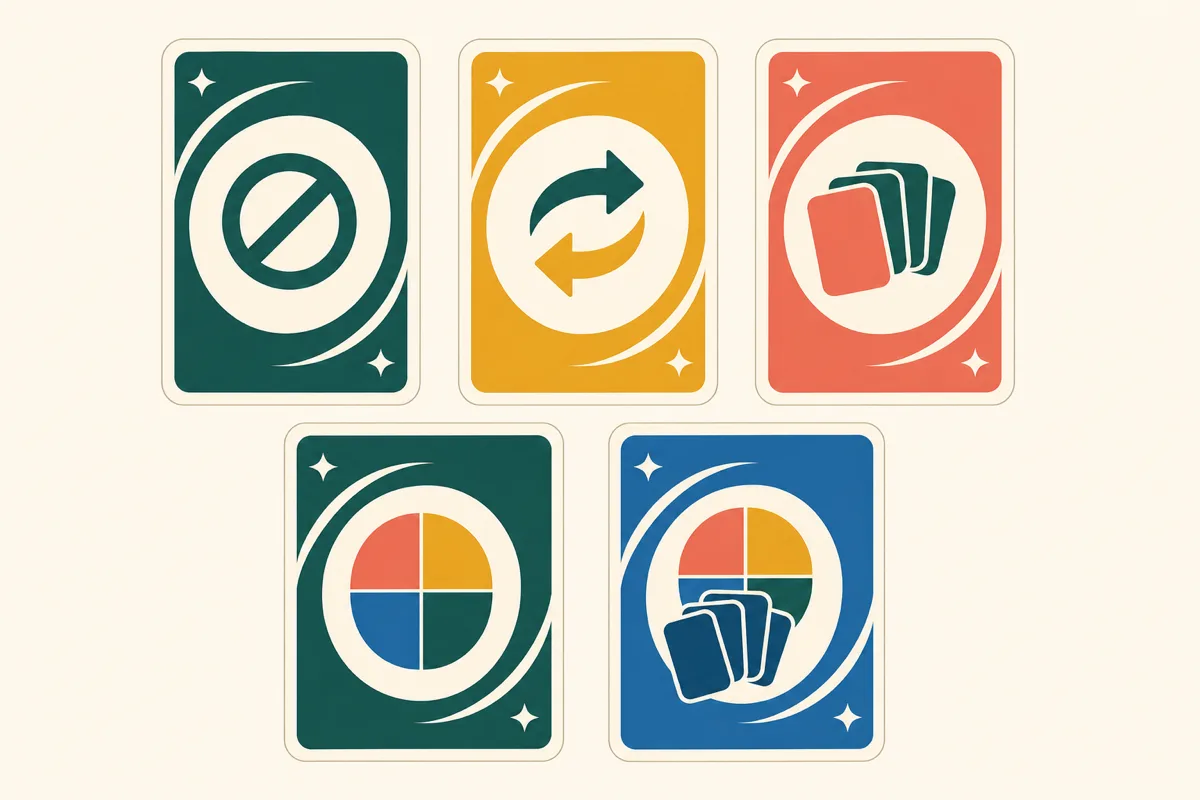
| Card | Effect | Common dispute |
|---|---|---|
| Skip | The next player in turn order loses their turn entirely | A Skip always targets whoever's next in line, never the player who played it. A point some new players get backward |
| Reverse | Turn direction flips, clockwise to counter-clockwise or back | In a 2-player game, a Reverse has nowhere else to send the turn, so it functions exactly like a Skip and knocks the other player out of their turn. This trips up players expecting it to do nothing with only two people at the table |
| Draw Two | The next player draws 2 cards and loses their turn | Whether that draw can be passed along to the following player instead of taken. The standard rulebook says no, the card has to be drawn; passing it along is a house rule, not a core one |
| Wild | Playable on any turn regardless of hand; the player names the color that continues play | Whether it can be played even when a legally matching card is sitting right there in hand. Yes, a Wild is always legal to play; there's no restriction tied to what else you're holding |
| Wild Draw Four | Same color choice as Wild, plus the next player draws 4 cards and loses their turn | It's only legal to play when you have no card in hand matching the current color. This restriction is exactly what the challenge rule below exists to enforce |
| Shuffle Hands | Every player's hand gets gathered, shuffled together, and redealt evenly starting with the player to the left of whoever played it; that player also names the next color | Whether it's a standard Uno card at all. It isn't part of every printing; it appears in a specific modern-production refresh of the deck alongside blank "Wild Customizable" cards, so older boxes and some editions won't have it |
Variations and edge cases
Beyond the table above, a few specific situations come up often enough to spell out on their own.
Stacking a Reverse on a Reverse works fine in games with three or more players. Direction just flips back again. In a 2-player game, though, since a single Reverse already functions as a Skip, playing a second Reverse right after the first effectively skips the same player twice over consecutive turns, which feels unfair to whoever's on the receiving end and is worth agreeing on before it happens rather than mid-game.
Challenging a Wild Draw Four is built into the standard rules, not a house rule addition. If you suspect the player who just played one actually had a card matching the current color in hand, you can challenge before you draw. They have to show you their hand. If they were holding a matching color card, the challenge succeeds and they draw 4 cards instead of you. If their hand turns out to be clean and the play was legal, the challenge fails and you draw 6 cards instead of the original 4, a real risk, so challenge only when you're fairly confident.
If the draw pile runs out mid-game, take the discard pile, set aside its top card to keep the game going, shuffle the rest, and use that as the new draw pile. Play continues without pausing the round.
Every ruling on this page, including the two dispute-prone ones above, was checked against Uno's current official rulebook rather than presented as one table's opinion, so you can settle an argument with a source behind it.
FAQ
What does the Reverse card do in Uno?
It flips the direction of play, from clockwise to counter-clockwise or the other way around. In a 2-player game, since there's no one else to pass the turn to, it acts exactly like a Skip and knocks the other player's turn out entirely.
What are the rules for the Wild card?
A Wild card can be played on any turn, no matter what else is in your hand, and the player who plays it names the color that continues play. It doesn't force anyone to draw; it's purely a color-change tool.
What does the Draw Four card do?
It forces the next player to draw 4 cards and lose their turn, and the player who plays it chooses the next color. It's only a legal play when the player has no card in hand matching the current color. If that's in doubt, it can be challenged.
What does "Shuffle Hands" mean in Uno?
Playing it gathers every player's hand, shuffles them together, and redeals the cards evenly starting with the player to the left of whoever played it. It's a real card, but it belongs to a specific modern-production version of the deck rather than every Uno box on the shelf, so don't be surprised if your copy doesn't have one.
How are Uno Flip's special cards different?
Uno Flip uses a double-sided deck where every card, including the special ones, has a second, harsher effect on its dark side. For the full light-side and dark-side breakdown, see our dedicated Uno Flip rules guide.