Dominoes rules: how to play Block and Draw
* Difficulty is our editorial read on how hard the game is to pick up — not an official rating. Player counts and deck sizes come from the game's rulebook.
Dominoes is normally played by 2 to 4 players with a standard double-six set of 28 tiles. Players match tiles end to end by pip count, extending a growing line across the table. The first player to play every tile in their hand wins the round outright, or, if nobody can play at all, the player holding the lowest total pip count wins instead.
Setup
This page covers the standard double-six domino set, 28 tiles total, one for every unique pairing of pip counts from 0 (a blank) through 6, including the six "doubles" (0-0, 1-1, and so on up to 6-6). Regional dominoes traditions vary meaningfully, so it's worth being explicit that this page describes one specific, widely played standard rather than the only version that exists.
The number of tiles each player gets depends on how many people are at the table.
| Players | Tiles dealt each |
|---|---|
| 2 | 7 |
| 3 | 5 |
| 4 | 5 |
What happens to the tiles left over after dealing depends on which of the two standard variants you're playing. In the Draw variant, the leftover tiles form a face-down "boneyard," and a player who can't play a tile from their hand draws from it, one at a time, until they either draw something playable or the boneyard runs dry. In the Block variant, there's no boneyard at all, every tile in the set is dealt out at the start, and a player who can't play simply passes their turn with no drawing option available.
That Draw-versus-Block distinction is the single most important structural fact on this page, since it changes what "being stuck" actually means for the rest of the game.
Gameplay
Playing a tile
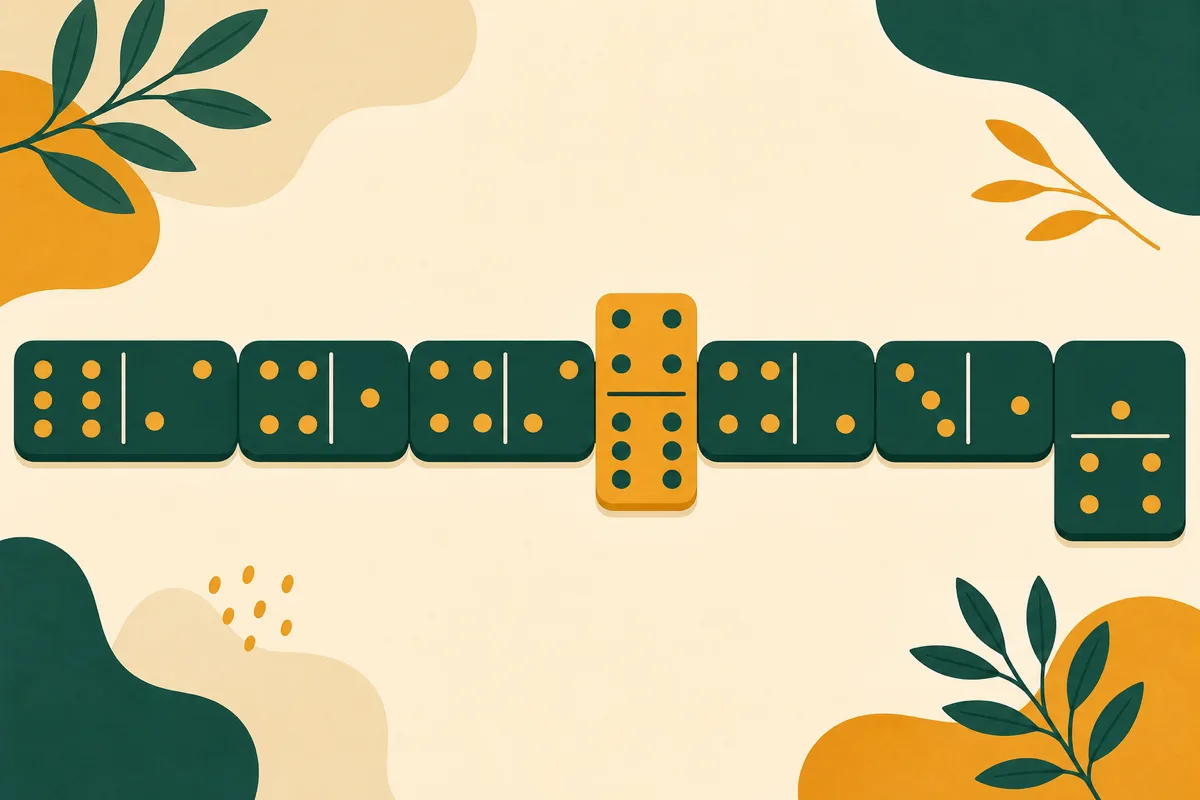
Tiles get played end to end, matching pip counts, extending the line in either direction from wherever it currently ends. If the open end of the line shows a 4, only a tile with a 4 on one of its halves can attach there, and once it's placed, whichever number was on the other half of that tile becomes the new open end.
Doubles
A double, where both halves show the same pip count, is commonly played turned crosswise rather than in line with the rest of the tiles, marking it visually as a pivot point. Depending on house convention, a double can allow the line to branch in a new direction from that point rather than only continuing straight, though not every group plays branching, some simply treat a crosswise double as a longer single tile with no branch at all.
Drawing (Draw variant only)
If it's your turn and you have no tile that matches either open end of the line, you draw one tile at a time from the boneyard. If that tile is playable, you can play it immediately; if not, you keep drawing until you get something playable or the boneyard is empty, at which point you simply pass.
Passing (Block variant only)
Since the Block variant deals out the entire set with nothing left over, there's no drawing option if you're stuck. A player with no playable tile just passes, and play moves to the next person.
Scoring
A round of dominoes ends one of two ways: a player plays their last tile and wins outright ("domino"), or every remaining player is unable to play at all and the round is "blocked." In a blocked round, whoever is holding the lowest total pip count across their remaining tiles wins that round instead, a detail some newer players don't expect since it means the game doesn't just stall out with no result.
| Outcome | How points are awarded |
|---|---|
| A player plays their last tile | That player wins the round. One commonly used convention awards them points equal to the total pip count remaining across every other player's hand |
| Round is blocked (nobody can play) | The player with the lowest total pip count in hand wins the round; scoring convention for the win varies by region, some tables round the total to the nearest 5 or 10 rather than using the exact figure |
Scoring conventions for dominoes vary meaningfully by region and by which named variant a group plays, more than almost any other game on this site. Treat the table above as one commonly used convention rather than the only correct way to tally points, and confirm with your table before a game starts if there's a running score across multiple rounds.
Variations and house rules
| Variant | What changes |
|---|---|
| Block vs. Draw | Both are fully standard forms of the base game, not one "official" version and one house tweak. Block removes the boneyard entirely by dealing out the whole set; Draw keeps a stock pile for players who get stuck to pull from |
| "Draw until you can play" | A stricter house version of the Draw variant's stock rule, requiring a stuck player to keep drawing until they get a playable tile, even if that means drawing most of the remaining boneyard |
| "Draw one and pass" | A looser house rule where a stuck player draws exactly one tile from the boneyard and, if it's not playable, passes their turn regardless of whether more of the boneyard remains |
| Larger sets (double-nine, double-twelve) | Bigger domino sets with higher pip counts per tile scale the same rules up for larger groups; the double-twelve set specifically is the standard set for Mexican Train, covered on its own page |
FAQ
How many dominoes do you start with?
With a standard double-six set, 2-player games deal 7 tiles to each player, while 3- and 4-player games deal 5 tiles to each player. Whatever's left over either forms a boneyard (Draw variant) or simply doesn't exist because the whole set was dealt out (Block variant).
What's the difference between Block and Draw dominoes?
Block deals out the entire 28-tile set at the start, so a player who can't play just passes with no drawing option at all. Draw leaves the undealt tiles as a face-down boneyard, and a stuck player draws from it until they get something playable or it runs out. Both are standard, fully documented forms of the game, not one official version and one variant.
How do you score dominoes?
The player who plays their last tile wins the round, commonly scoring points equal to the total pip count left in every other player's hand. If the round blocks instead, because nobody can play at all, the player with the lowest pip total in hand wins that round. Scoring conventions for the actual point tally vary by region, so treat any specific number as a commonly used convention rather than a fixed rule.
What happens if you can't play a domino?
It depends which variant you're playing. In Draw, you keep drawing tiles from the boneyard until you get one you can play or the boneyard empties out. In Block, there's no boneyard to draw from at all, so you simply pass your turn.
Can you download printable dominoes rules?
A one-page printable summary covering the tile-per-player table and the Block-versus-Draw comparison is planned as a companion to this page, described in the printable outline below.