Farkle rules: how to play and score every combination
* Difficulty is our editorial read on how hard the game is to pick up — not an official rating. Player counts and deck sizes come from the game's rulebook.
Farkle is a dice game for 2 or more players using 6 standard six-sided dice. On your turn, roll all 6 dice, set aside at least one scoring die or combination, then choose whether to bank your points or risk a re-roll on the remaining dice. Rolling with nothing that scores ends your turn immediately at zero points, a "Farkle." The first player to reach the target score, commonly 10,000, wins.
Setup
Farkle doesn't need a deck, a board, or a deal. All it takes is 6 standard dice and a way to track a running score, plain paper and a pen work fine, though plenty of regular players keep a dedicated scorepad handy. Any number of players from 2 upward can join, and there's no fixed upper limit in wide circulation, a table of 6 or more works just as well as a head-to-head game between two people.
Farkle has no single publisher and no official rulebook the way Yahtzee or Phase 10 does, so the figures on this page come from the version most widely cited across independent rule sources rather than from one company's printed sheet. That matters going in: if your household plays a slightly different point value for some combination, you're not doing it wrong, you're playing a documented and common variant, and the scoring section below flags exactly where that happens.
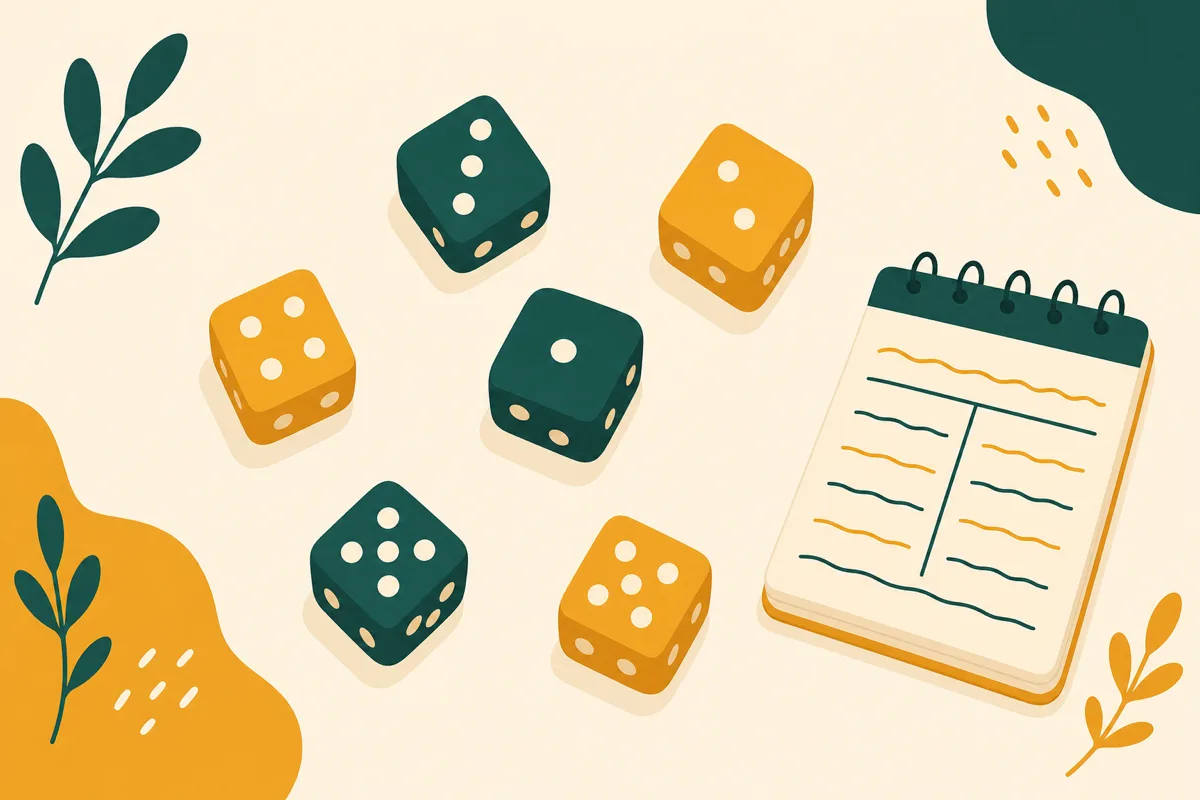
Play runs in a simple loop, moving clockwise around the table. On your turn, you roll all 6 dice at once, and from there the rest of the turn is a string of decisions rather than a fixed procedure, which is really where the game's appeal comes from: keep some dice, gamble the rest, and decide when you've pushed your luck far enough.
Gameplay
Rolling and setting aside
Every turn starts the same way: roll all 6 dice at once. Look over the result and pull out at least one die or combination that scores points, using the table in the next section. You don't have to set aside everything that scores on a given roll, but you do have to set aside something. If nothing on the table shows up at all, your turn ends right there at zero.
Banking or rolling again
Once you've set aside a scoring die or combination, you face a choice. Bank the points you've built up so far this turn and hand the dice to the next player, or push your luck and re-roll whatever dice you haven't already set aside. There's no middle ground, once you decide to re-roll, you're committed to whatever the dice show next.
This decision is the entire tension of Farkle. A bigger score is always sitting one more roll away, but so is the risk of rolling nothing at all and losing every point from that turn, even after building up several thousand.
What happens on a Farkle
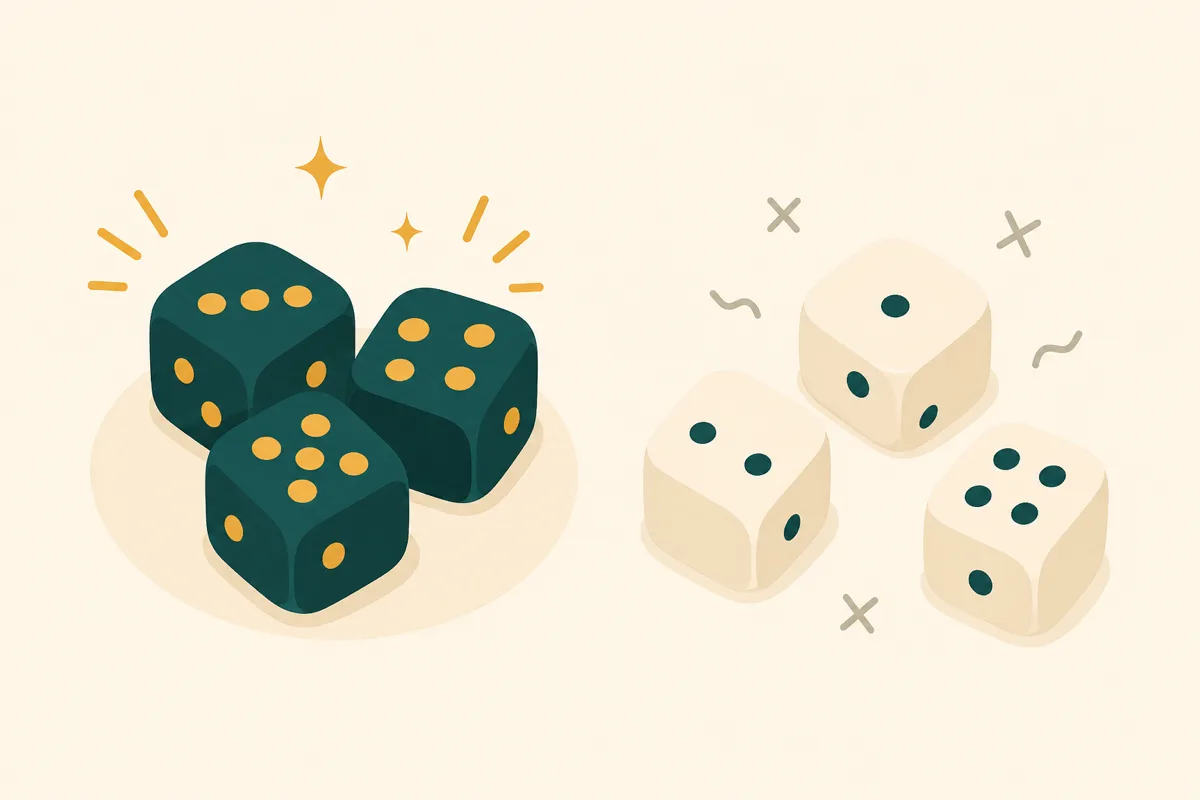
If you roll the dice you haven't set aside and nothing scores, no 1s, no 5s, no matching sets of any kind, that's a Farkle. Your turn ends on the spot, you score zero for the whole turn regardless of how much you'd mentally banked already, and play passes to the next person.
Hot dice
If every one of your 6 dice ends up part of a scoring combination during a single turn, whether that happens across two or three rolls or all at once, you've hit "hot dice." Instead of stopping, you pick up all 6 dice and roll again, adding whatever comes up to that same turn's running total rather than starting fresh. There's no cap on how many times hot dice can trigger in a row, which is why a strong turn in Farkle can occasionally snowball into a genuinely large score.
Scoring
This table is meant to work as a complete reference, not a shortened version. A lot of pages covering Farkle stop at the basic 1s, 5s and three-of-a-kind entries. The less common combinations below, three pairs, two triplets, and the three-1s exception, come up often enough in a real game that leaving them off makes the page incomplete.
| Roll | Points |
|---|---|
| Single 1 | 100 |
| Single 5 | 50 |
| Three 1s | 1,000 (a named exception, not the regular three-of-a-kind formula) |
| Three of a kind (any other number) | Face value × 100 (three 2s score 200, three 6s score 600, and so on) |
| Four of a kind | Commonly cited as double the matching three-of-a-kind value. A competing flat figure of 1,000 regardless of face also circulates widely (see the note below) |
| Five of a kind | Commonly cited as triple the three-of-a-kind value, with a competing flat figure of 2,000 also widely cited |
| Six of a kind | Commonly cited as quadruple the three-of-a-kind value, with a competing flat figure of 3,000 also widely cited |
| Straight, 1 through 6 | 1,500 |
| Three pairs | 1,500 |
| Two triplets | 2,500. Some published rule sheets skip this combination entirely, so confirm it's part of your table's ruleset before treating it as a given |
That four/five/six-of-a-kind row is worth a plain explanation, since it's the single most inconsistent part of Farkle's scoring across published sources. One widely cited convention scales the matching three-of-a-kind value, so four 2s would be 400 (double the 200 that three 2s score). A separate, equally well-established convention uses flat figures no matter which number shows, four of a kind worth 1,000, five worth 2,000, six worth 3,000, regardless of face value. Both conventions appear on well-established rules sites, and neither has a stronger claim to being the "real" one, since Farkle doesn't have a single company's rulebook to settle the question. The honest move is to agree on one before your game starts rather than assume everyone at the table is using the same figures.
Want to skip doing the math by hand mid-game? The Farkle scoring calculator works through every combination for you and returns an instant breakdown.
Variations and house rules
| Variant | What changes |
|---|---|
| Minimum entry score | Many groups require a player to bank at least a set amount, commonly cited anywhere from 300 to 1,000, in a single turn before any of their points count toward the game total at all. No single figure is agreed on across sources, so it's worth setting before the first roll |
| Alternate win target | 10,000 points is the most commonly cited target, though a shorter 5,000-point game is a widely used variant for a quicker session |
| "Must bank before the next Farkle" house rule | Some tables agree that a player who's built up a large unbanked total for the round loses it not just on their own Farkle, but if a specific triggering event happens first. Groups differ meaningfully on exactly when this applies, which is why it's treated here as a genuine house rule rather than a standard one |
FAQ
How do you win Farkle?
Be the first player to reach the game's target score, commonly 10,000 points, at the end of your own turn. Once someone hits that target, most groups give every other player one final turn to try to beat the total before the game ends.
What counts as a Farkle?
A Farkle happens when you roll the dice you haven't set aside and none of them, alone or in combination, score any points at all. Your turn ends immediately, and you score zero for the entire turn, even if you'd built up a large total earlier in that same turn.
What are hot dice in Farkle?
Hot dice happens when every one of your 6 dice has been set aside as part of a scoring combination during your turn. Instead of stopping there, you pick up all 6 dice and roll again, adding to the same turn's running total rather than starting a fresh one. There's no cap on how many times hot dice can trigger during a single turn.
How many points is three of a kind in Farkle?
It depends on the number showing. Three of any number besides 1 scores that number times 100, so three 4s score 400. Three 1s are a named exception and score 1,000 flat instead of following that formula.
Do you need a minimum score to start scoring in Farkle?
Many groups play with a minimum entry score, a set number of points you need to bank in one turn before any of your points count toward your running total. The exact figure varies by table, commonly cited anywhere from 300 to 1,000, so it's worth agreeing on one before play starts rather than assuming everyone at the table uses the same number.
Can you download printable Farkle rules?
A one-page printable summary is planned as a companion to this page, covering the full scoring table and turn structure at a glance, described in the printable outline below rather than embedded directly on this page.