Mexican Train rules: how to play this dominoes variant
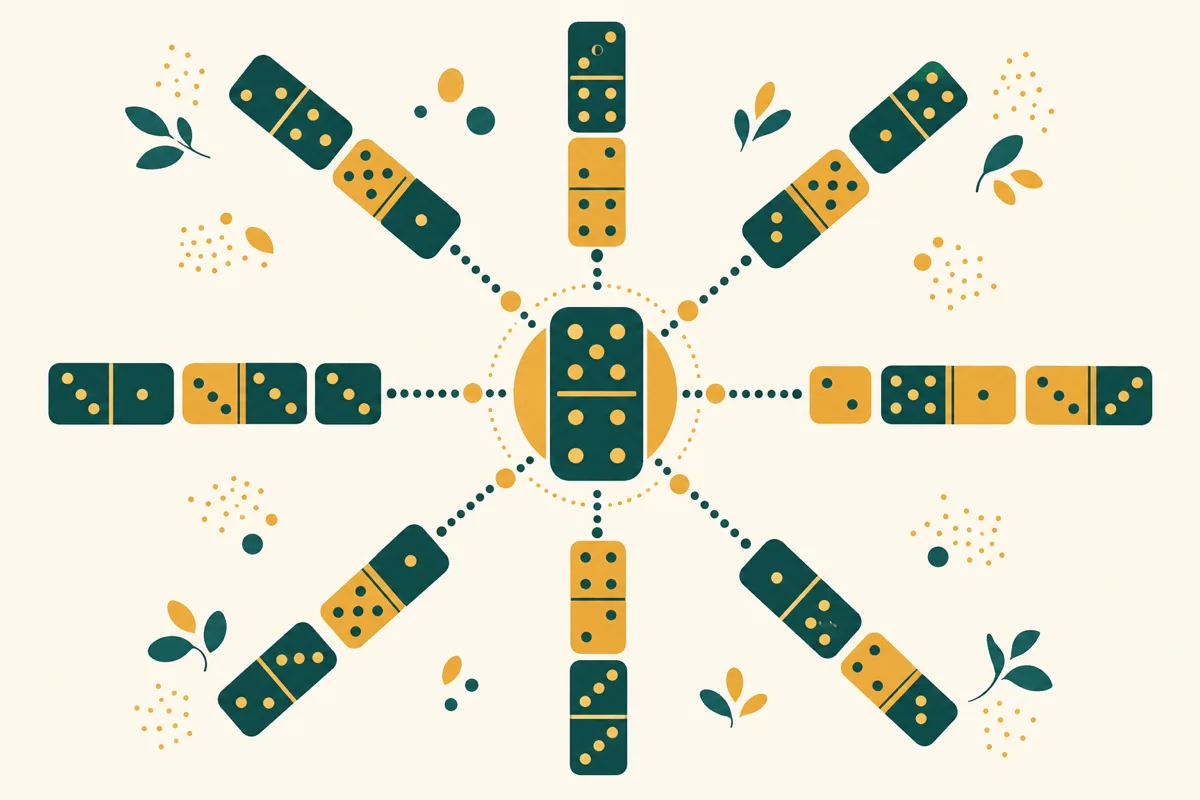
Mexican Train is commonly played by 2 to 8 players with a double-12 domino set. Each player builds a personal "train" branching out from a shared center tile, while a communal "Mexican Train" is also open for anyone to play on. Rounds run from the highest double down to the double-0, and the lowest cumulative pip score across all rounds wins the game.
Setup
This page assumes the double-12 set, the most commonly cited standard for Mexican Train, 91 tiles total, one for every unique pairing of pip counts from 0 through 12 on each half. Smaller groups sometimes use a double-9 set instead, a named, explicit alternative rather than a silent substitution, since it changes the tile count and the range of doubles available.
How many tiles each player draws depends on how many people are playing.
| Players | Tiles drawn each (double-12 set) |
|---|---|
| 2 | 15 (a couple of sources cite 16 instead for exactly 2 players; this page uses the figure given by the source that breaks the deal down by exact set size, but treat this specific number as the least settled one on the whole table) |
| 3 | 15 |
| 4 | 14 |
| 5 | 12 |
| 6 | 11 |
| 7 | 10 |
| 8 | 9 |
The 4-through-8-player figures above are consistent across every source checked for this page. The 2-player figure is the one genuine exception, worth flagging rather than quietly picking a number: one commonly cited breakdown gives 15 tiles for 2 players, another gives 16, and no single source settles it. If your box insert or another rules site tells you something different for exactly two players, that's not a mistake on either side, it's an unresolved gap between published sources.
Once tiles are drawn, whoever holds the highest double in the set (the double-12, in round 1) places it face-up in the center of the table as the "engine." Every player then builds a personal train branching out from that center tile, and a shared "Mexican Train" is also started from the same engine, open to any player at any time. Whatever tiles are left after dealing form the boneyard, a face-down stock pile players draw from when they can't play.
Gameplay
Starting a train
Once the engine is placed, each player has their own private train, and the shared Mexican Train sits alongside it. On your turn, you can extend your own train, play on the Mexican Train, or, if it's been marked open (see below), play on someone else's train instead.
Playing on the Mexican Train
The Mexican Train is available to every player on every turn, regardless of whose turn it is, which makes it the one place tiles can always go if nothing else works. Playing on it follows the same end-matching rule as standard dominoes, matching pip counts at the open end of the line.
Doubles
Playing a double comes with an extra requirement: the same player who played it must immediately play a second tile matching the double, either on the double itself or elsewhere. If they can't, the double is marked as "open," meaning any player, on any subsequent turn, including the one who played it, must try to satisfy it before doing anything else, or draw from the boneyard and mark their own train instead. This chain keeps going, turn after turn, until someone successfully plays on the open double or the boneyard runs out.
Marking an open train
If you can't extend your own train on your turn, even after drawing from the boneyard, you mark it with a token. A marked train stays open to every other player until you close it again by playing a tile there yourself. This is the mechanic that most distinguishes Mexican Train from ordinary dominoes: a struggling player's train doesn't just sit locked and untouched, it becomes fair game for everyone else at the table.
Scoring
Each round ends when a player plays every tile in their hand, or when nobody at the table can play at all. Every remaining player then totals the pip count of the tiles still in their hand, and that total is added to their running cumulative score across the game, lower is better throughout.
| Round | Starting double |
|---|---|
| Round 1 | Highest double in the set (double-12) |
| Each following round | The next double down in sequence |
| Final round | Double-0 |
The player with the lowest cumulative pip total once every round from the highest double down to double-0 has been played wins the whole game. There's no single fixed target score to reach, the game simply runs its full sequence of rounds and totals everything at the end.
FAQ
How many dominoes do you need for Mexican Train?
The most commonly cited standard is a double-12 set, 91 tiles total. Smaller groups sometimes use a double-9 set instead, which has fewer tiles and a lower range of doubles, named here as an explicit alternative rather than folded silently into the main rules.
What does marking your train mean?
If you can't extend your own train on your turn, you place a marker at its open end. That marker signals to everyone else at the table that your train is open to play on, and it stays that way until you close it again by playing a tile there yourself on a future turn.
How do doubles work in Mexican Train?
Playing a double requires you to immediately play a second tile as well, either on the double or elsewhere. If you can't, the double stays "open," and every player, including you, has to try to satisfy it on their next turn before doing anything else, or draw and mark their own train instead, until someone finally covers it.
Is Mexican Train the same as regular dominoes?
No. It shares the basic end-matching mechanic with standard dominoes rules, but the personal-train-plus-shared-Mexican-Train structure, the marking mechanic, and the round-by-round starting-double sequence are all specific to this variant and don't exist in the base Block or Draw game.