Yahtzee rules: how to play and score all 13 categories
* Difficulty is our editorial read on how hard the game is to pick up — not an official rating. Player counts and deck sizes come from the game's rulebook.
Yahtzee is a dice game that works with any number of players, though it plays fastest with 2 to 6. Each player rolls 5 dice up to 3 times per turn, keeping whichever dice they want between rolls, then records that turn's result in one of 13 scoring boxes on their card. Once every box is filled by every player, whoever has the highest total wins.
Setup
Each player needs 5 standard six-sided dice and a scorecard with 13 boxes, plus a small cup for shaking and rolling if you're playing informally without a dice tray. Turn order can be decided however the group prefers, a single die roll or just going around the table works fine, since nothing about the game itself depends on turn order beyond keeping things moving.
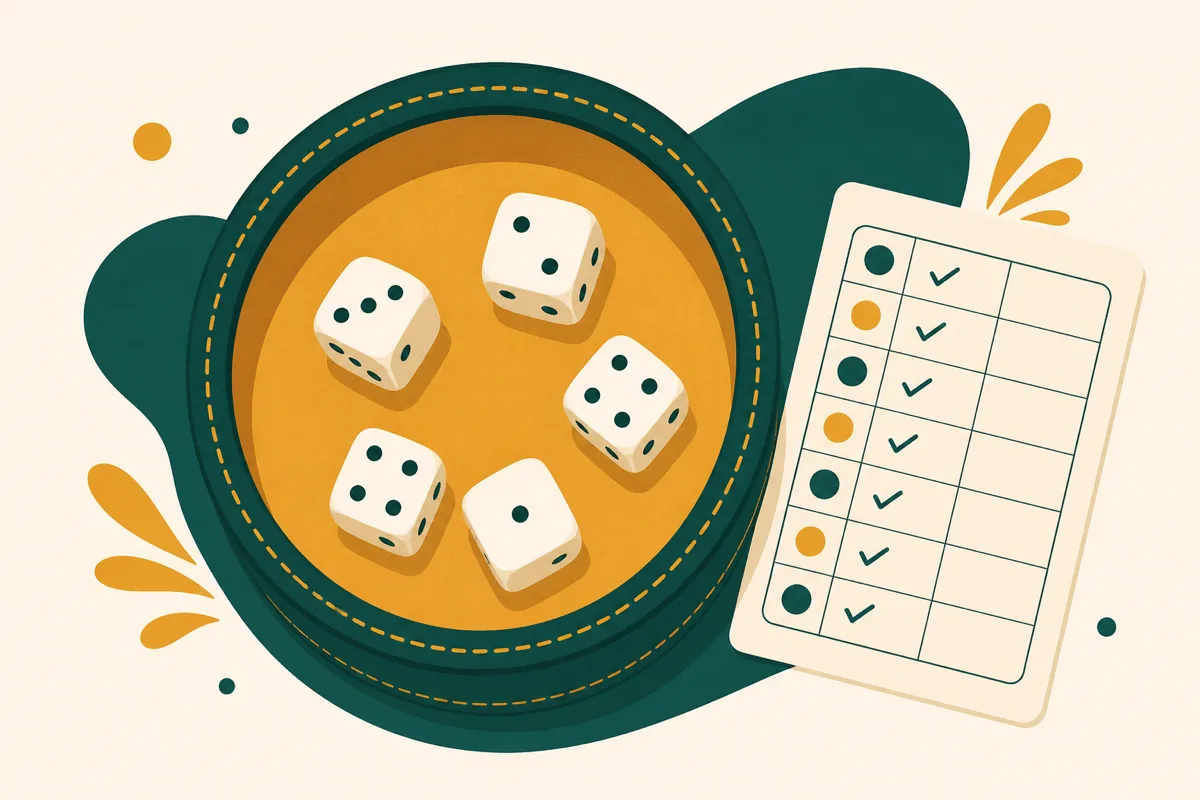
Every turn follows the same 3-roll shape. A player rolls all 5 dice, looks at the result, and decides which dice to keep and which to roll again. They can re-roll up to two more times, for a maximum of 3 rolls total per turn, setting aside any dice they like between each one. Once the third roll happens, or the player chooses to stop earlier, the turn is over and the result has to go somewhere on the scorecard.
Gameplay
The three rolls
A turn starts with rolling all 5 dice. After that first roll, the active player chooses which dice, if any, to set aside, then rolls the rest again. They get one more chance after that, for up to 3 rolls in total. A player can also stop after the first or second roll if they're happy with the result and don't want to risk changing it.
Choosing which dice to keep
Between rolls, a player can keep any subset of their dice, all five, none of them, or anything in between, and re-roll the rest. There's no requirement to keep dice that are working toward one particular category; players regularly change their mind mid-turn if the dice suggest a better opportunity than the one they started chasing.
Filling a category
At the end of the turn, whether that's after the third roll or an earlier stop, the player must record a result in exactly one of the 13 scoring boxes. Each box can only be used once across the whole game, and once it's filled, it's locked in for good. If nothing about the final roll fits a box the player wants to use, they still have to put something somewhere, recording a zero in an otherwise-unused box is entirely legal and sometimes the only option left.
Scoring
The scorecard has 13 categories split into two sections. The upper section rewards matching a single number across your dice, the lower section covers specific dice patterns.
| Category | How it scores | Example |
|---|---|---|
| Ones through Sixes (upper section, 6 boxes) | Add up only the dice showing that box's number; other dice don't count toward it | Rolling 4-4-4-2-6 in the "Fours" box scores 12 (three matching 4s), ignoring the 2 and the 6 |
| Three of a kind | Sum of all 5 dice, if at least 3 of them share a number | 3-3-3-5-6 scores 20 (every die counts, not just the matching three) |
| Four of a kind | Sum of all 5 dice, if at least 4 of them share a number | 2-2-2-2-6 scores 14 |
| Full house | A flat 25 points, for 3 dice of one number plus 2 of another | 3-3-3-6-6 scores 25 regardless of the actual numbers involved |
| Small straight | A flat 30 points, for 4 dice in an unbroken run of consecutive numbers | 2-3-4-5 (plus any fifth die) scores 30 |
| Large straight | A flat 40 points, for all 5 dice in one unbroken run | 1-2-3-4-5 or 2-3-4-5-6 both score 40 |
| Yahtzee | A flat 50 points, for all 5 dice showing the same number | 6-6-6-6-6 scores 50 |
| Chance | Sum of all 5 dice, no combination needed at all | 1-2-3-4-5 scores 15, useful as a fallback box for a roll that doesn't fit anywhere else |
Two bonus rules sit on top of this table and both are common sources of confusion, worth treating with the same care as the base categories rather than as an afterthought.
The upper section carries a bonus of 35 points if the six upper boxes (Ones through Sixes) add up to 63 or more once all six are filled. That 63-point line roughly corresponds to averaging three of each number across those six boxes, though there's no requirement to hit that exact pattern, any combination of upper-section results that totals 63 or higher earns the bonus.
Rolling a second (or third, or later) Yahtzee after the Yahtzee box is already filled with a nonzero score triggers a separate bonus, commonly cited at 100 points each, on top of whatever category the roll ends up recorded in. To actually use that extra Yahtzee roll, the player must first try to fill the matching upper-section box (if a player rolls a second five-of-a-kind on 4s, and the Fours box is still open, that box has to be used, scoring 20). Only once the matching upper-section box is already filled does the player get to choose a lower-section category instead, following its own scoring rule as normal, or take a zero in whichever section still has room if nothing else fits. This "which box has to be used first" sequencing is exactly the kind of detail most competitor pages skip past.
Embedded scorecard reference
A quick tally reference for the 13 categories, useful for checking your card at a glance without flipping back to the full table above.
| Section | Categories |
|---|---|
| Upper (6 boxes) | Ones, Twos, Threes, Fours, Fives, Sixes, plus a 35-point bonus if this section totals 63+ |
| Lower (7 boxes) | Three of a kind, Four of a kind, Full house (25), Small straight (30), Large straight (40), Yahtzee (50), Chance |
Prefer not to tally by hand at all? The Yahtzee scoring calculator scores every category instantly from your roll, and keeps a running scorecard that tracks the upper-section bonus and the extra-Yahtzee joker rule automatically across a full game.
Variations and house rules
| Variant | What changes |
|---|---|
| Fixed round count | Some groups agree to a set number of rounds rather than playing until every box on every card is filled, useful for a shorter session with a large group |
| House Yahtzee bonus value | The 100-point extra-Yahtzee bonus is sometimes replaced with a different agreed number at some tables, treated here as a named house adjustment rather than a universal figure |
FAQ
How many times can you roll in Yahtzee?
Up to 3 times per turn: the first roll of all 5 dice, plus up to 2 more re-rolls of whichever dice you choose to set aside. A player can also stop earlier if they're satisfied with the result after the first or second roll.
What is the upper-section bonus in Yahtzee?
If your six upper-section boxes (Ones through Sixes) add up to 63 points or more once all six are filled, you get an extra 35 points added to your total. There's no requirement to hit that total in any particular pattern, any mix of results across those six boxes that reaches 63 or higher earns the bonus.
What happens if you roll a second Yahtzee?
If you already have a nonzero score recorded in your Yahtzee box and roll another five-of-a-kind later in the game, you typically get a bonus, commonly cited at 100 points, on top of using that roll to fill another category. You have to try the matching upper-section box first if it's still open, and only move to a lower-section category once that box is already filled.
Can you download Yahtzee rules as a PDF?
Yes. The download link near the top of this page gives you a one-page printable summary covering the full scoring table, the two bonus rules, and a blank scorecard for up to 4 players.
What's the highest possible Yahtzee score?
This isn't independently confirmed in this pass. The exact ceiling depends on how many extra Yahtzees a single game allows for and exactly how the joker rule interacts with a fully filled scorecard, both of which vary enough between published rule summaries that this page doesn't state one number as settled fact.