Go Fish rules: how to play and win
* Difficulty is our editorial read on how hard the game is to pick up — not an official rating. Player counts and deck sizes come from the game's rulebook.
Go Fish is a card game for 2 to 6 players using a standard 52-card deck. On your turn, ask one opponent for a card rank you already hold at least one of. If they have it, they hand over every card of that rank and you go again. If not, you "go fish," drawing a card from the pond instead. Collecting all four cards of one rank makes a "book." Whoever holds the most books when the deck runs out wins.
Setup
Go Fish doesn't have a single publisher or an official rulebook, so the numbers below come from the version most widely cited across independent rule sources rather than one company's printed sheet. How many cards each player starts with depends on how many people are playing.
| Players | Cards dealt to each player |
|---|---|
| 2 | 7 |
| 3 | 7 |
| 4 | 5 |
| 5 | 5 |
| 6 | 5 |
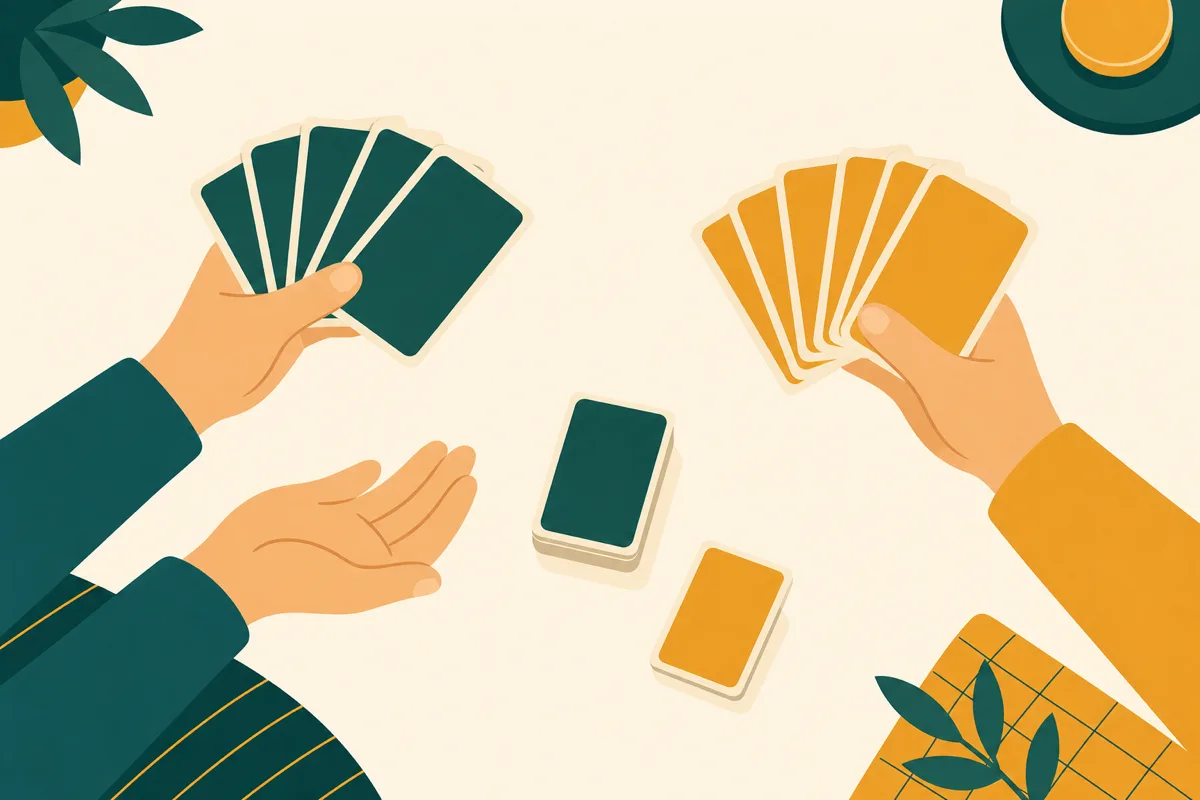
Once every player has their hand, the rest of the deck is left face-down in the middle of the table. This leftover stock is usually called the "pond" or "ocean," and it's what you draw from whenever an opponent doesn't have the card you asked for.
Gameplay
Asking for a card
On your turn, pick one opponent and ask them for a specific rank, such as "Do you have any 8s?" The catch is you can only ask for a rank you already hold at least one card of yourself. You can't fish blind for something you don't already have a piece of.
Going fish
If the player you asked has one or more cards of that rank, they have to hand over every one of them, no partial answers allowed. You add those cards to your hand and take another turn, asking anyone for any rank you now hold.
If they don't have it, they say "Go fish," and you draw the top card from the pond. Most commonly cited rule sets give you another turn if the card you draw happens to be the exact rank you just asked for, treating it the same as a successful ask. If it isn't, your turn simply ends and play passes to the next person.
Making a book
Once you're holding all four cards of a single rank, that's a "book." Set it down in front of you, face-up or face-down depending on your group's preference, and it's out of play for the rest of the game. Completing a book doesn't grant an extra turn on its own. Whether you go again depends only on how you got that last card, through a successful ask or a lucky fish, not on the book itself.
Scoring
Go Fish doesn't keep a running point total; what matters is books. A book is any four cards that share a rank, regardless of suit, and the player with the most books at the end wins.
Sources genuinely disagree on the exact moment the game ends, and this page states both rather than picking one. The most commonly cited version ends the game once all 13 possible books have been claimed between all players, even if the pond empties before that happens and players keep asking each other directly. Some groups instead end things the moment the pond runs dry, tallying books at that point even if a few ranks never got completed. A few house variants end the round the instant any single player empties their hand first. Agree on which one your table is using before you deal.
Variations and house rules
| Variant | What changes |
|---|---|
| Pairs instead of books | A simplified version for young children: matching just 2 cards of a rank counts as a completed set, instead of collecting all 4 |
| Go Fish for jokers | Some family rule sheets add 2 jokers to the deck, either as wild cards that complete any book or as their own separate matched pair |
| Two combined decks | For larger groups beyond 6 players, some households shuffle two 52-card decks together and deal accordingly |
Go Fish is genuinely one of the simplest games covered on this site, and it pairs naturally with two more simple card games for family game night if you're planning a longer session with mixed ages at the table.
FAQ
How many cards do you deal in Go Fish?
Deal 7 cards to each player if there are 2 or 3 people playing, and 5 cards each if there are 4 or more. Whatever's left over becomes the face-down pond in the middle of the table.
What happens if the person you ask doesn't have the card?
They say "Go fish," and you draw the top card from the pond. Your turn then ends, unless the card you drew happens to be the exact rank you asked for.
Do you get another turn if you catch the right card by fishing?
Yes, in the most commonly cited version of the rules. If the card you draw from the pond matches the rank you just asked for, you reveal it and take another turn, exactly as if your original ask had succeeded.
What's a "book" in Go Fish?
A book is all four cards of one rank, regardless of suit, such as all four Kings. Once you collect a full book, you set it down and it's out of play for the rest of the game.
How do you win Go Fish?
The player holding the most completed books when the game ends wins. Depending on which house rule your group uses, the game can end once all 13 possible books are claimed, once the pond is empty, or once a player's hand is empty first.
Is there a simpler version for young kids?
Yes. A common simplified variant swaps books for pairs, so matching just 2 cards of the same rank counts as a completed set instead of needing all 4. It shortens the game considerably and works well for very young players still learning the asking mechanic.
- War and Old Maid rules — two more simple card games for family game night
- Best card games for family game night — down-funnel listicle for simple, mixed-age games
- Uno rules — another easy-to-learn card game for mixed-age groups
- Skip-Bo rules — a simple sequencing game that plays well with kids and adults together
- Best Family Board Games — quick dice and tile games alongside classic family staples