War and Old Maid rules: two classic card games
War and Old Maid are two of the simplest card games most people learn as kids. War is pure chance, two players flip cards simultaneously and the higher card wins the pile, with ties triggering a dramatic mini-showdown called a "War." Old Maid is a memory-and-matching game, players draw blind from a neighbor's hand trying to pair off every card except one deliberately unmatched card, and whoever's stuck holding it at the end loses.
War
Setup
War uses a standard 52-card deck and is a 2-player game at its core, though multiplayer variants exist as a documented add-on rather than the base rules. Split the deck evenly, 26 cards to each player, dealt face-down and left completely unseen until they're played.
Gameplay
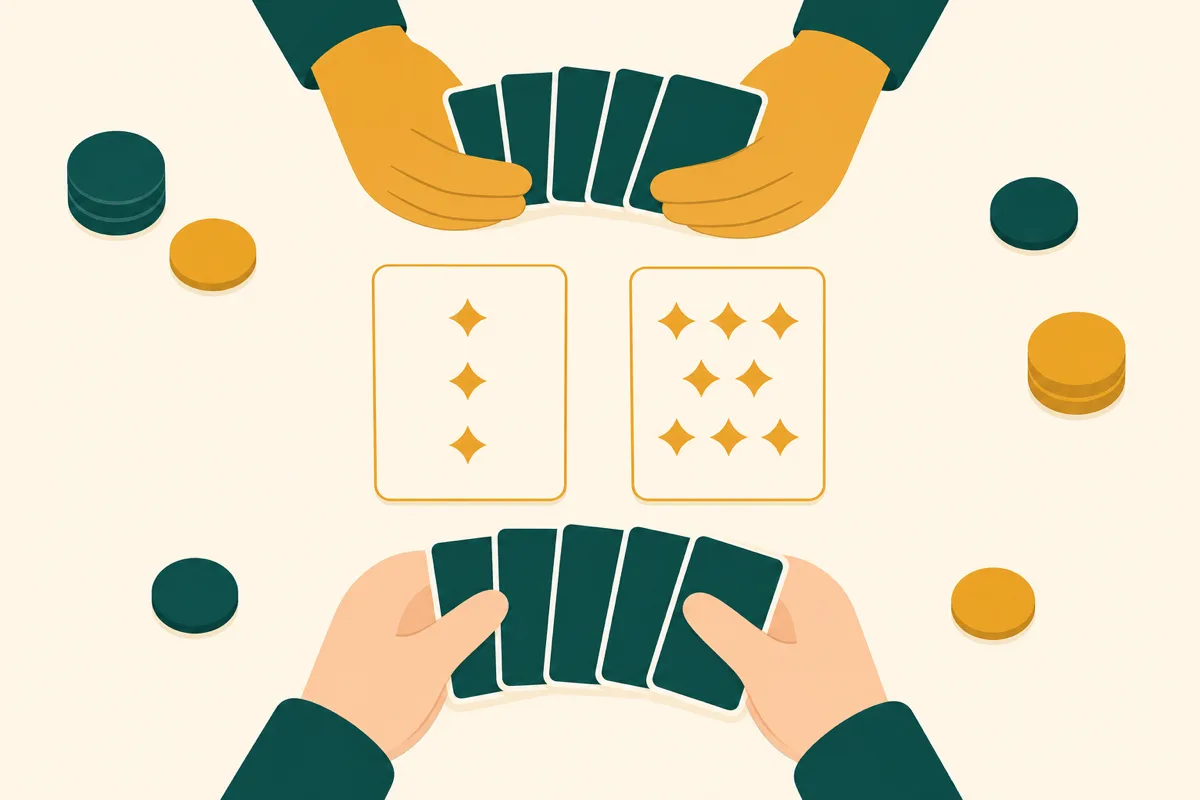
On each turn, both players simultaneously flip the top card of their own pile face-up. Whoever's card outranks the other's takes both cards and adds them to the bottom of their own pile. Play continues this way, card by card, until one player has collected the entire deck.
The standard ranking runs Ace high, then King down through 2. A low-Ace convention circulates in some regional rule sets, but it's the exception, not the common default, so most games you'll run into treat the Ace as the top card in the deck.
The War tie mechanic
A tie happens when both players flip a card of the same rank, and it's the single most distinctive moment in the whole game. When it happens, each player lays a set number of cards face-down on top of the tied pair, commonly cited at 3 cards, then a fourth card face-up. Whoever's face-up card ranks higher takes the entire accumulated pile, tied cards, face-down cards, and both face-up cards included.
If the two new face-up cards also tie, that triggers a "Double War," using the exact same procedure again on top of an even bigger pile. There's no theoretical limit to how many times this can chain.
Scoring and win condition
War has no scoring system at all. Cards are the only thing that change hands, and the player who eventually ends up holding the entire 52-card deck wins. Worth knowing going in: War has no guaranteed length. Since cards keep cycling between two piles, a game can in theory run for a very long time before it resolves, and no widely cited source states a fixed maximum round count or an official "declared a draw" rule for a game that drags on. Some households simply agree on a time limit or a round cap in advance rather than leaving it open-ended, and pair War with one more simple card game for family game night if the group wants a change of pace once a match wraps up.
Old Maid
Setup
Old Maid genuinely has two different, equally common ways to set up the deck, and this page states both rather than picking one as "correct."
| Deck convention | Total cards | How it's built |
|---|---|---|
| Queen removed | 51 | Take one Queen out of a standard 52-card deck, leaving 3. Whoever ends up alone holding an unpaired Queen at the end loses |
| Joker added | 53 | Add a single Joker to a full 52-card deck as a designated unmatched card from the start |
Some rule sheets go a step further on the removal side and take out three Queens instead of one, leaving only 49 cards and a single guaranteed unmatched Queen from the very start. It's a less common variant of the removal approach, but it circulates enough to be worth knowing if your deck comes up short.
Once the deck is set, deal the entire thing out evenly among all players. Some players may end up with one extra card depending on the exact player count, that's normal and doesn't affect play. Before the first turn, every player privately looks through their own hand and lays down any pairs they're already holding, face-up, removing them from play immediately.
Gameplay
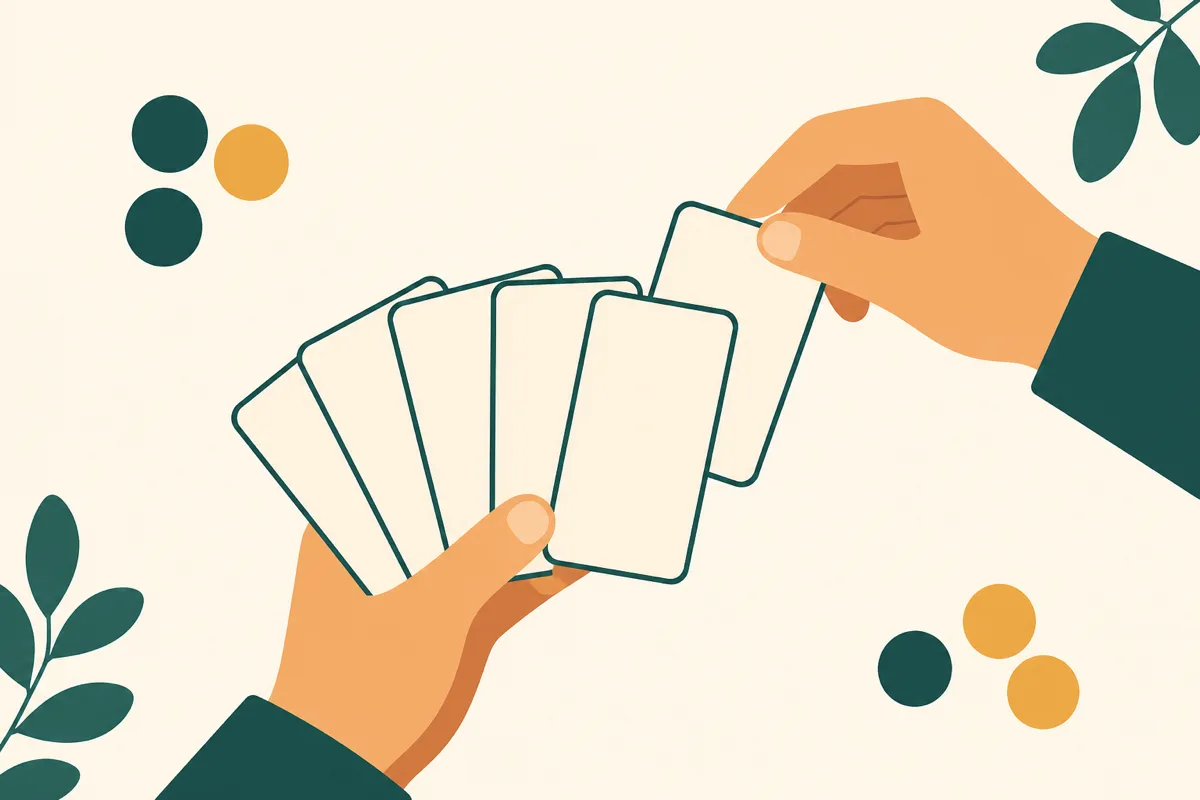
Players take turns drawing one unseen card from the fanned-out hand of the player next to them, commonly the player to their left, though some groups play to the right instead as a house convention. If the card you draw completes a pair with something already in your hand, discard the pair face-up right away. If it doesn't, it simply joins your hand, and play moves to the next player.
Play keeps going, hand by hand, as pairs keep getting discarded around the table. Eventually every card is paired off except the one designated odd card, whichever deck convention your group is using.
Scoring and win condition
Old Maid isn't about accumulating anything, it's about avoiding one specific outcome. Whichever player ends up holding the single unmatched card once every other card in the deck has been paired off and discarded loses the round. Everyone else, having successfully paired off their entire hand, is treated as a winner.
A note on the two setups
Neither deck convention above is more "official" than the other. Both circulate widely across independent rule sources, and the game plays identically either way, the only real difference is whether your odd card out is a leftover Queen or an added Joker. If you're teaching the game to someone new, it's worth just picking one before you shuffle and being upfront that the other version exists too.
FAQ
Is the Ace high or low in War?
High, in the standard version. Ace outranks King, and King outranks everything below it down to 2. A low-Ace convention shows up in a few regional rule sets, but it's not the common default.
What happens when there's a tie in War?
Each player lays a set number of cards face-down, commonly 3, then one more card face-up. Whoever's face-up card is higher takes the whole pile. If the face-up cards tie again, it repeats as a "Double War" on top of an even larger pile.
Do you use a Joker or remove a card for Old Maid?
Either works, and both are genuinely common. One version removes a single Queen from a standard 52-card deck, leaving 51 cards and 3 remaining Queens for someone to get stuck holding. The other keeps all 52 cards and adds a Joker as the designated unmatched card, for 53 total.
How do you draw cards in Old Maid?
You draw one unseen card at a time from a neighbor's fanned-out hand, usually the player to your left. If it completes a pair with a card you're already holding, you discard both face-up. If not, it just joins your hand.
Which game is better for younger kids, War or Old Maid?
Both work well for young players, since neither requires any strategy. War is entirely about the luck of the flip, which makes it accessible even to kids who can't read card ranks well yet, since it's really just "bigger number wins." Old Maid adds a small social element, since you're drawing blind from someone else's hand, which some younger kids find more engaging than War's more repetitive flip-and-compare rhythm.
- Go Fish rules — one more simple card game for family game night
- Best card games for family game night — down-funnel listicle for simple, mixed-age games
- Uno rules — another easy-to-learn card game for mixed-age groups
- Skip-Bo rules — a simple sequencing game that plays well with kids and adults together
- Best Family Board Games — quick dice and tile games alongside classic family staples