Old Maid card game rules: how to play with a regular or picture deck
* Difficulty is our editorial read on how hard the game is to pick up — not an official rating. Player counts and deck sizes come from the game's rulebook.
Old Maid is a card game for 2 or more players where everyone pairs off their cards by drawing blind from a neighbor's hand, and the player left holding the one card that can't be paired loses. You can play it with an ordinary deck of cards or with a special Old Maid picture deck.
- Regular deck: take one queen out of a standard 52-card deck, leaving 51 cards. The queen that ends up without a partner is the "old maid."
- Joker version: keep all 52 cards and add one joker as the odd card, for 53 cards.
- Picture deck: use it as it comes. Matching pictures make pairs, and the single Old Maid card has no partner.
- Each turn: draw one face-down card from your neighbor. If it makes a pair, put the pair down.
- End of the game: once every pair is down, whoever holds the odd card loses.
Setup
Old Maid needs a deck of cards and nothing else. There's no board or score pad, and nobody has to read anything, which is why it's often the first card game kids learn. It's also a folk game with no single publisher or official rulebook, so this page follows the version most printed rule sets use and names the main alternatives. The only decision before you deal is which deck you're using.
Playing with a regular 52-card deck
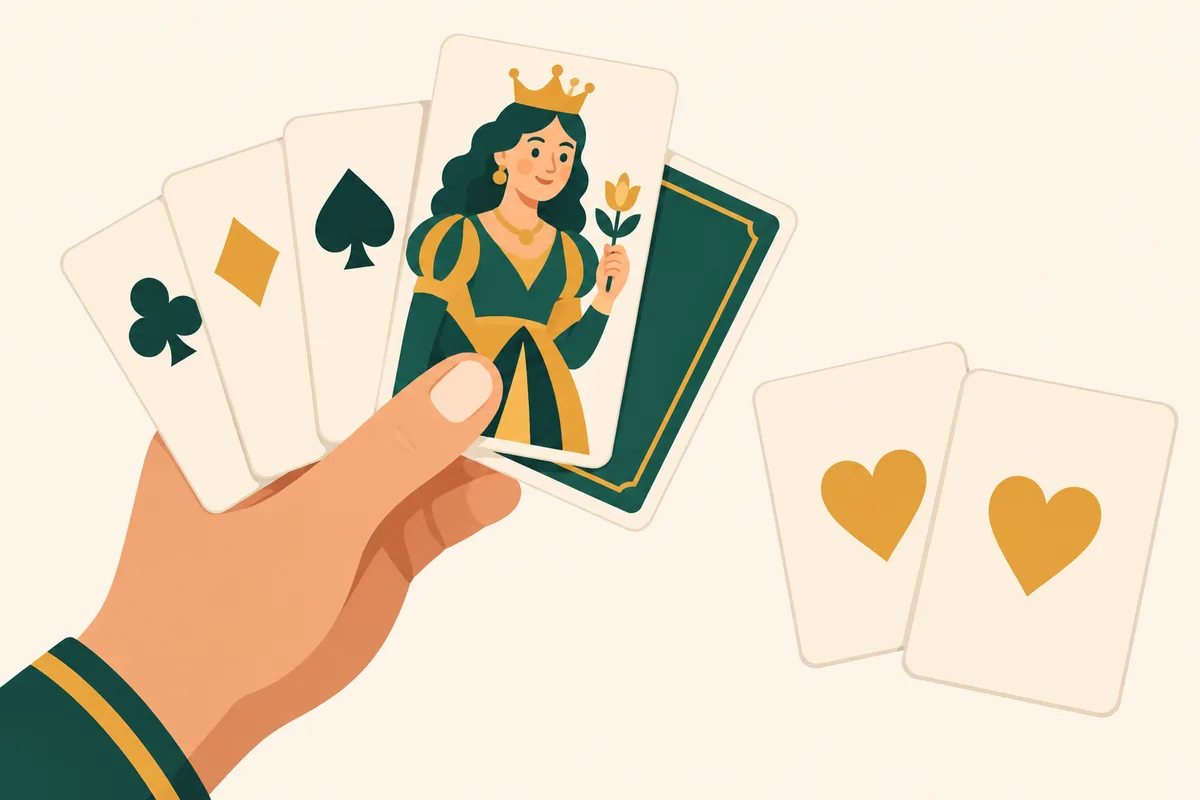
A standard deck has four cards of every rank, so every rank splits neatly into two pairs. Old Maid breaks that symmetry so that exactly one card can never be matched. There are three common ways to do it.
| Setup | Cards in play | The card nobody wants | Good to know |
|---|---|---|---|
| Remove one queen | 51 | Whichever queen is left unpaired | The most widely published version today. Pull the queen out without looking so no one knows its suit |
| Add one joker | 53 | The joker | All four queens pair normally. Easy for young kids, since the bad card looks different from everything else |
| Remove three queens | 49 | The one remaining queen | The oldest printed version, from Eliza Leslie's 1831 rules. Everyone knows from the first deal which card to dodge |
None of these is wrong. The game plays the same way with all three, so pick one before you shuffle and tell everyone which card they're avoiding.
Pairs in the standard game go by rank only. A 7 of hearts pairs with a 7 of spades, and a king pairs with any other king. Suits don't matter unless your group plays the color-matching variation described below.
Playing with a special Old Maid deck
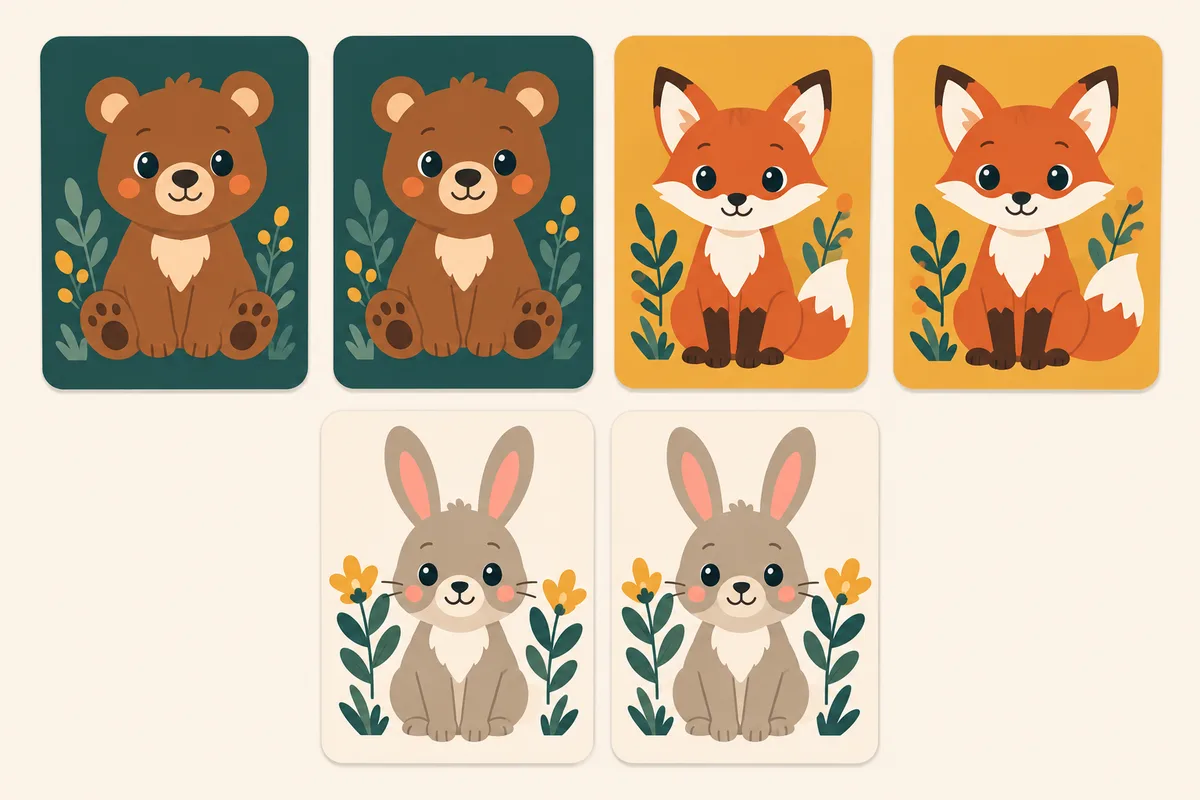
Old Maid picture decks are sold as their own boxed game. They hold illustrated characters printed in matching pairs, plus one Old Maid card with no twin. Decks like this have been printed since the 1800s.
With a picture deck there's nothing to remove or add. Shuffle and deal, then match identical pictures instead of ranks. Card counts differ by brand. If the box includes its own rule sheet and something differs from this page, go with the box.
Dealing and the first pairs
- Shuffle and deal the whole deck one card at a time, face down, going around the table until no cards are left.
- Don't worry about uneven hands. With 51 cards, some players get one more card than others.
- Everyone looks at their own hand privately and takes out any pairs they were dealt, placing them in a discard pile in the middle.
- Holding three of a kind? Put down two and keep the third. Holding four of a kind? Put down both pairs.
After this first clean-out, most hands shrink a lot, and the real game starts.
How to play Old Maid
Taking a turn
The dealer goes first by fanning their cards face down and holding them out to the player on their left. That player draws one card without seeing the faces. If the new card matches something already in their hand, they put the pair down right away. If it doesn't, it stays in their hand.
Then that player fans their own cards and offers them to the next person on their left, and so on around the table. In this standard direction, your cards travel left and you always draw from the player on your right. Some families run it the other way. Either direction works as long as the whole table sticks to it for the round.
One habit keeps the game fair: shuffle your hand before you offer it. Otherwise the next player may remember where you tucked the card they don't want.
When you run out of cards
Once you've paired off every card you hold, you're out of the round and safe. Play skips over you, and the player who would have drawn from you draws from the next person who still has cards.
A sample round
Say Maya, Leo and Grandpa are playing with the one-queen-removed deck. Near the end, Maya holds a 7, a king and a queen. She draws from Leo, gets the other 7, and puts the pair down. Grandpa then draws from Maya, pulls her king, and pairs it with the king he's been holding. Now each of the three players has a single queen. Two of those queens will eventually meet and pair up. Whoever still holds the third one when everyone else is out becomes the old maid.
How to win and who loses
Old Maid has no points and no score sheet. The game ends when every possible pair is on the table and a single card is left. Whoever holds that card is the old maid and loses the round. Everyone else counts as a winner, and it doesn't matter who went out first.
Some rule sets add a strict penalty: put down two cards that don't actually match, and you automatically lose. With younger players, most families just hand the cards back and let them try again.
For a longer game, play several rounds and keep a tally of who got stuck with the odd card. Fewest marks after five rounds wins. Old Maid is mostly luck, but a poker face helps when someone reaches toward the odd card in your hand.
Old Maid variations
The same draw-and-match game turns up across Europe and America under different names. Usually only the odd card changes.
| Variation | Where it comes from | What changes |
|---|---|---|
| Old Bachelor | The same 1831 book as Old Maid | Same rules. Eliza Leslie called the game Old Bachelor when boys played it. If you want the card to match the name, remove a jack instead of a queen so the leftover jack loses |
| Black Peter (Schwarzer Peter) | Germany, rules recorded in 1821 | Usually played with a special deck that has one Black Peter card. With a regular deck, the jack of spades is the odd card |
| Le Vieux Garçon | France, rules recorded in 1853 | Remove the jack of clubs. The player left with the jack of spades, the "old boy," loses. Played by 2 to 8 people |
| Color-matched pairs | A common house rule | A pair must match in rank and color: spades with clubs, hearts with diamonds. Remove one black queen, and the other black queen becomes the old maid |
| Joker as the old maid | Widely used today | Add one joker to a full deck (53 cards). The joker is the only card that can't be paired |
Black Peter's rules were in print by 1821, a decade before Leslie's Old Maid, so Old Maid may well descend from the German game.
How many people can play Old Maid
Old Maid works with 2 players and has no hard upper limit, since you deal the whole deck among however many people are at the table. With 2, you just trade draws back and forth. With 3 to 6, the odd card moves around more and it's harder to guess who has it. Groups of 8 or more still work, but hands are small and rounds end fast.
If your family rotates through a few games in one evening, see our list of more card games for family game night, sorted by age and player count.
Old Maid for little kids
Young children pick up Old Maid quickly, especially with a few adjustments:
- Use a picture deck. Kids who can't read numbers yet can still match two identical pictures.
- Build a short deck: keep only the aces through 5s plus three queens, 23 cards in all. Hands stay small and a round takes a few minutes.
- Play the first round with open hands, so the youngest player sees what a pair looks like.
- Soften the ending. The player holding the odd card deals the next round instead of "losing."
Once kids have matching down, Go Fish is a natural next game. It keeps the same matching idea and adds asking and remembering. If Old Maid is still a step too far, War is simpler: flip a card, the higher one wins, and there's nothing to match.
FAQ
How many cards do you need to play Old Maid?
With a regular deck, you play with 51 cards: a standard 52-card deck with one queen taken out. If you add a joker instead, you play with 53. With a special Old Maid picture deck, you use every card in the box, and the count depends on the brand.
Can you play Old Maid with a regular deck of cards?
Yes. Remove one queen from a standard 52-card deck and deal. The three queens left can form only one pair, so one queen always ends up stuck in someone's hand. That leftover queen is the old maid.
Do you draw from the left or the right in Old Maid?
In the standard rules, each player offers their fanned-out hand to the player on their left, so you draw from the person on your right. Some families play the opposite way. Agree on a direction before the first draw and keep it for the whole round.
What do you do with three of a kind in Old Maid?
Put two of them down as a pair and keep the third card. You'll pair it later if the fourth card of that rank comes your way. If you're dealt all four, put down both pairs.
Is the old maid always a queen?
No. In the regular-deck game it's a queen, but in the joker version it's the joker, and in a picture deck it's a printed Old Maid card. Black Peter and Le Vieux Garçon use the jack of spades.
Where does the name Old Maid come from?
The name was already in use in 1831, when American author Eliza Leslie printed the earliest known rules in a book for girls and called the boys' version Old Bachelor. Later in the 1800s, publishers sold illustrated Old Maid decks with pairs of colorful characters and one lone old maid card, and those decks are what most people picture when they hear the name today.
- Go Fish rules — the next step up from Old Maid, built on the same matching idea
- War and Old Maid rules — full rules for War, plus a short Old Maid comparison
- Best card games for family game night — simple card games for mixed-age tables
- Kings Corner rules — an easy card game for kids ready for a little strategy
- Uno rules — another easy-to-learn card game for mixed-age groups
- Skip-Bo rules — a simple sequencing game that plays well with kids and adults together