LCR rules: how to play Left Center Right
* Difficulty is our editorial read on how hard the game is to pick up — not an official rating. Player counts and deck sizes come from the game's rulebook.
LCR (Left Center Right) is a dice game for 3 or more players. Each player starts with 3 chips and rolls one special die per chip they hold, up to a maximum of 3 dice. Each die showing an L passes a chip left, an R passes one right, a C puts one into the center pot, and a blank keeps it with you. The last player still holding any chips wins everything in the pot.
Setup
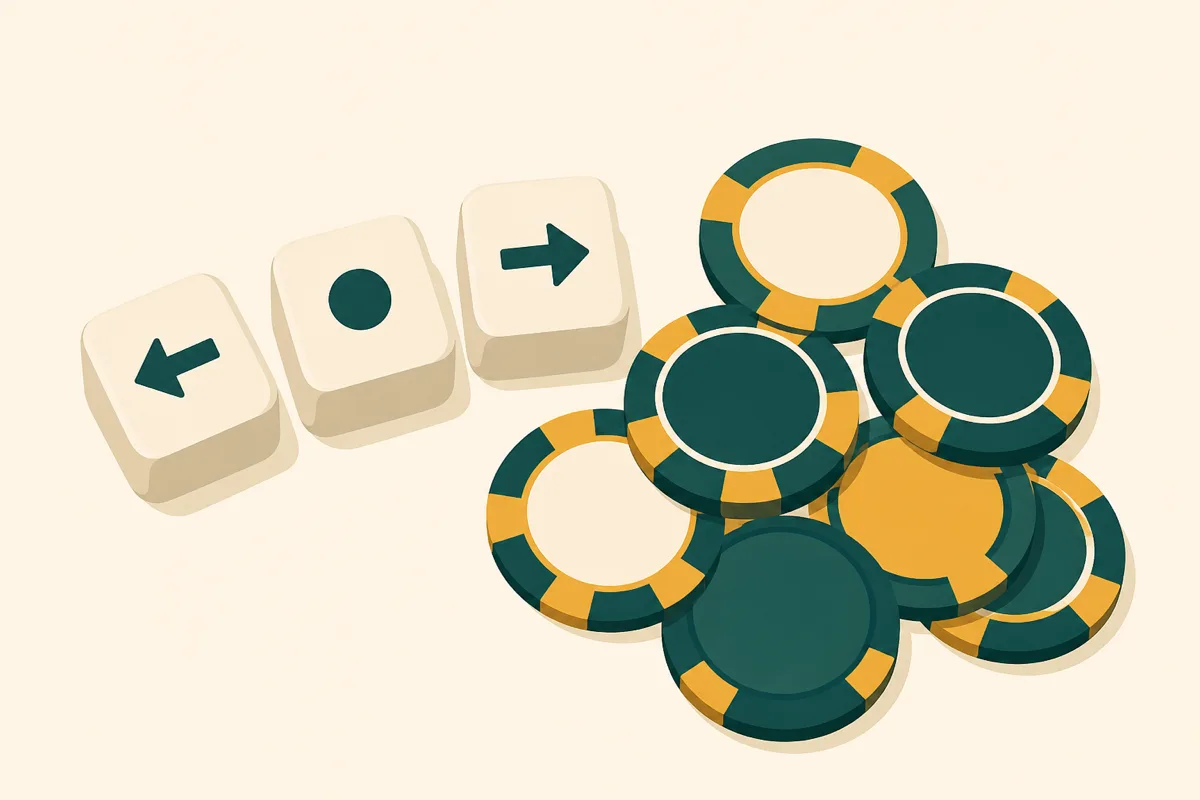
Every player starts with the same number of chips, commonly 3 each. LCR uses 3 special six-sided dice, each marked with one L face, one C face, one R face, and 3 blank (dot) faces, so most rolls land on a blank rather than an actual pass. A regular die and a separate token of any kind work fine if you don't have the branded dice on hand.
Gameplay
On your turn, roll one die for every chip you're currently holding, up to a maximum of 3. A player holding only 1 or 2 chips rolls just that many dice, never more than what they actually have in front of them.
Each die comes up one of four ways. An L passes one chip to the player on your left. An R passes one chip to the player on your right. A C sends one chip into the center pot, out of play for the rest of that hand. A blank face does nothing at all, that chip just stays with you. If you roll 2 or 3 dice at once, resolve each one individually, a single roll can easily send chips in two different directions plus keep one, all in the same turn.
A player who runs out of chips entirely doesn't roll anything on their turn, it's simply skipped until they receive a chip passed to them by another player. They stay in the game the whole time, just waiting, and the moment a chip lands in their hands again, they're back to rolling normally on their next turn.
Scoring
Chips are the entire scoring system in LCR, there's nothing separate to tally. Whoever ends up holding any chips after every other player has run out wins the entire center pot outright.
Variations and house rules
| Variant | What changes |
|---|---|
| More starting chips | Some groups start with 4 or 5 chips each instead of 3, for a longer game before anyone's eliminated from active rolling |
| Cash-stakes version | Some groups play with small bills instead of chips, turning the center pot into a real payout. Presented here as a known variant, not an endorsement, and it's worth agreeing on before anyone antes up |
LCR pairs naturally with another simple dice-based party game if your group wants a second quick option once a round wraps up.
FAQ
What do L, C, and R mean on the dice?
L passes a chip to the player on your left, R passes one to the player on your right, and C puts one into the center pot. The dice also have 3 blank faces, which do nothing at all.
How many dice do you roll each turn?
One die for every chip you're currently holding, up to a maximum of 3. If you only have 1 or 2 chips left, you roll just that many dice.
What happens if you run out of chips?
You stay in the game but don't roll on your turn until another player passes you a chip. Once you receive one, you're back to rolling as normal.
How do you win LCR?
Be the last player still holding any chips at all. That player takes everything that's landed in the center pot over the course of the game.
- Bunco rules — another simple social dice game, this one played across multiple tables
- Farkle rules — a dice-scoring game with its own set of combinations to learn
- Exploding Kittens rules — another fast, simple party card game
- Best card games for family game night — down-funnel listicle for simple, mixed-age games
- Best Family Board Games — quick dice and tile games alongside classic family staples