Bunco rules: how to play and score
* Difficulty is our editorial read on how hard the game is to pick up — not an official rating. Player counts and deck sizes come from the game's rulebook.
Bunco is a social dice game played with 3 dice per table. A full party plays across multiple tables of 4, working through 6 rounds, one per target number from 1 to 6. Each round, roll the dice trying to match that round's number. Score 1 point per matching die, a bigger bonus for rolling three of the target number (a "Bunco"), and a smaller bonus for rolling three of a kind that isn't the target. Whoever scores the most over the night wins.
Setup
Bunco has no single publisher and no one official rulebook, so the format below reflects the version most widely cited across current rule sources, not a locked standard. All you need at each table is 3 standard six-sided dice and a scorecard for tracking points.
| Group size | Table structure |
|---|---|
| 4 players | A single table, 2 fixed teams of 2, teammates seated across from each other. A complete, playable game on its own |
| 16 players (the full party format) | 4 tables of 4, one designated the "head table." The most common convention for a traditional Bunco night |
| Other multiples of 4 | Scales the same way, more tables of 4 rather than bigger tables |
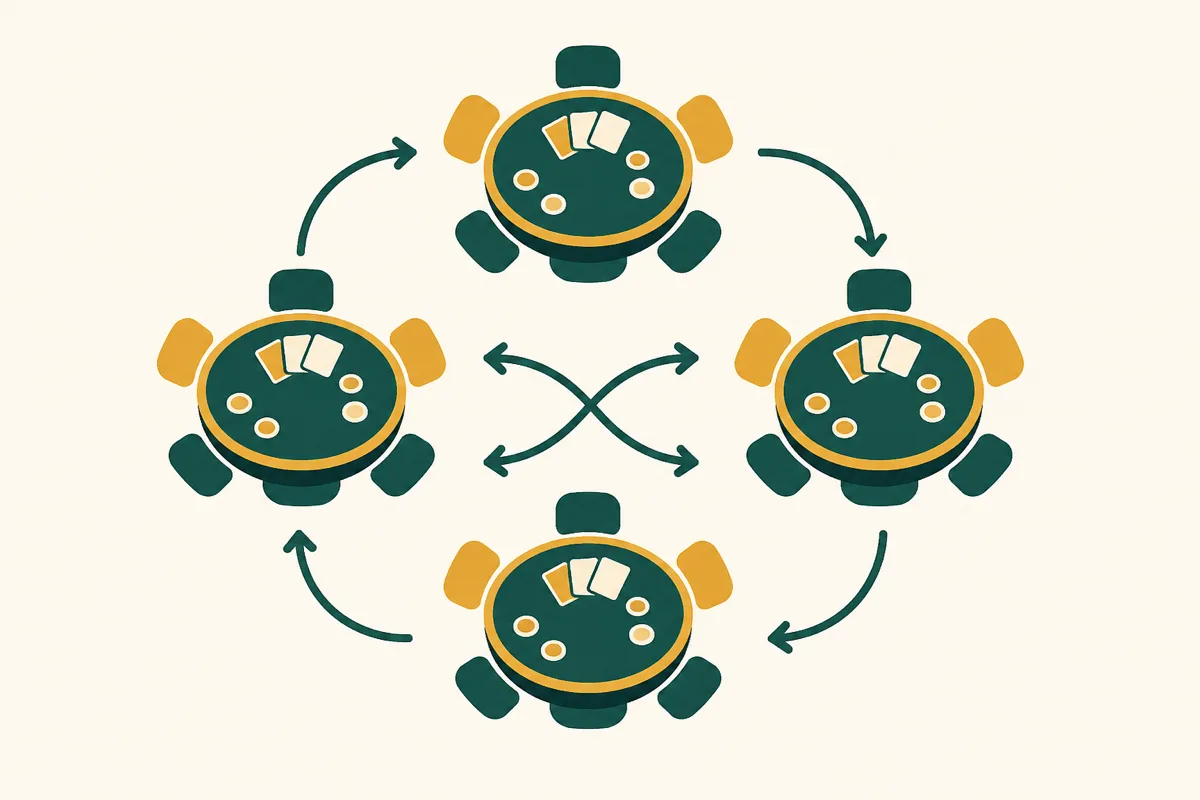
At every table, players split into 2 teams of 2 by seating. Whoever sits across from you is your partner for that round, and that pairing doesn't stay fixed for the whole night. Every time players rotate between tables, they get new seats and, with them, new partners.
Gameplay
Rolling for the round's number
Bunco moves through 6 rounds in order, round 1 targets the number 1, round 2 targets 2, and so on through round 6. On your turn, roll all 3 dice at once and check how many show the round's target number. You keep rolling as long as you keep scoring, and your turn ends the moment a roll comes up with no matching dice at all.
Scoring a Bunco
If all 3 dice land on the round's target number in a single roll, that's a Bunco, worth a large bonus on its own. Call it out right away. If you're at the head table, rolling a Bunco is also the signal that ends the round for every table at once, usually marked with a bell.
Scoring a mini Bunco
Rolling three of a kind of any number that isn't the round's current target is a "mini Bunco" or "baby Bunco." It still scores a bonus, just a smaller one than a full Bunco, and doesn't end the round the way a head-table Bunco does.
Scoring
| Roll | Points |
|---|---|
| Each die matching the round's target number | 1 point per die |
| Three of the round's target number ("a Bunco") | A large bonus, most commonly cited at 21 points |
| Three of a kind of a number that isn't the target ("a mini Bunco") | A smaller bonus, most commonly cited at 5 points |
| No matching dice on a roll | 0 points, and the turn ends |
Bunco's scoring figures aren't locked down by one official publisher the way a Hasbro or Mattel game's would be, so treat the numbers above as the widely used convention rather than an unbreakable rule. A single die matching the target scores 1 point on its own, and two matching dice on the same roll simply score 2, there's no separate bonus tier for a partial match short of all 3. Some households run 2 to 4 full 6-round cycles in one sitting for a longer party night, rather than stopping after a single pass through the numbers 1 through 6.
Want a printable card for the night, or a faster way to tally live at the table? The Bunco score sheet has printable individual and table-tally layouts, plus an on-screen counter for the 1/21/5-point rolls above, so you don't have to do the arithmetic by hand.
Variations and house rules
| Variant | What changes |
|---|---|
| Table rotation (the party format's signature mechanic) | After each round, the highest-scoring player or team at each table moves toward the head table, and the lowest-scoring player or team moves toward the last table, reshuffling partners and seats along the way |
| Single-table game | A perfectly valid scaled-down version with just 4 players and no rotation at all, since there's only one table to move between |
| Longer party format | Repeating the full 6-round cycle 2 to 4 times, rather than playing it just once, for a longer night |
If you like Bunco's mix of luck and social rolling but want something that plays without a full party of tables, another dice game with its own scoring quirks covers similar ground for a smaller table.
FAQ
How many people do you need to play Bunco?
A single table needs 4 players, split into 2 teams of 2. That's a complete, playable game. The larger "party" format most people picture scales that up to 16 players across 4 tables, but the underlying game is the same either way.
What counts as a Bunco?
Rolling all 3 dice and having them all land on the round's current target number. It's worth a large bonus (most commonly cited at 21 points) and, if it happens at the head table, ends that round for every table at once.
What's the difference between a Bunco and a mini Bunco?
A Bunco is three of a kind matching the round's target number. A mini Bunco (sometimes called a "baby Bunco") is three of a kind of any other number instead, worth a smaller bonus than a full Bunco.
How does the table rotation work in a Bunco party?
After each round, the winning player or team at each table moves toward the head table, while the losing player or team moves toward the last table. Players get new seats and new partners each time they move, which is part of what keeps a Bunco night feeling social rather than competitive between fixed teams.
Can you play Bunco with just one table?
Yes. A single table of 4 players split into 2 partnerships is a complete game on its own. You just lose the table-rotation element, since there's nowhere else to rotate to.
- Farkle rules — another dice game with its own scoring quirks
- Yahtzee rules — a dice-scoring game built around a fixed set of categories
- LCR rules — another simple social dice game, this one built around passing chips
- Best card games for family game night — down-funnel listicle for simple, mixed-age games
- Best Family Board Games — quick dice and tile games alongside classic family staples
- Bunco score sheet — printable scorecards, a table tally sheet, and a quick point counter