Sequence rules: how to play, jack powers, and how to win
* Difficulty is our editorial read on how hard the game is to pick up — not an official rating. Player counts and deck sizes come from the game's rulebook.
Sequence is a board-and-card hybrid for 2 players or 2 to 3 teams. Each side plays a card from its hand to place a chip on the matching space of a 10x10 board, working toward five chips in an unbroken row. Two-eyed jacks let you place a chip on any open space. One-eyed jacks let you pull an opponent's chip back off the board. Whoever completes the required number of sequences first wins.
Setup
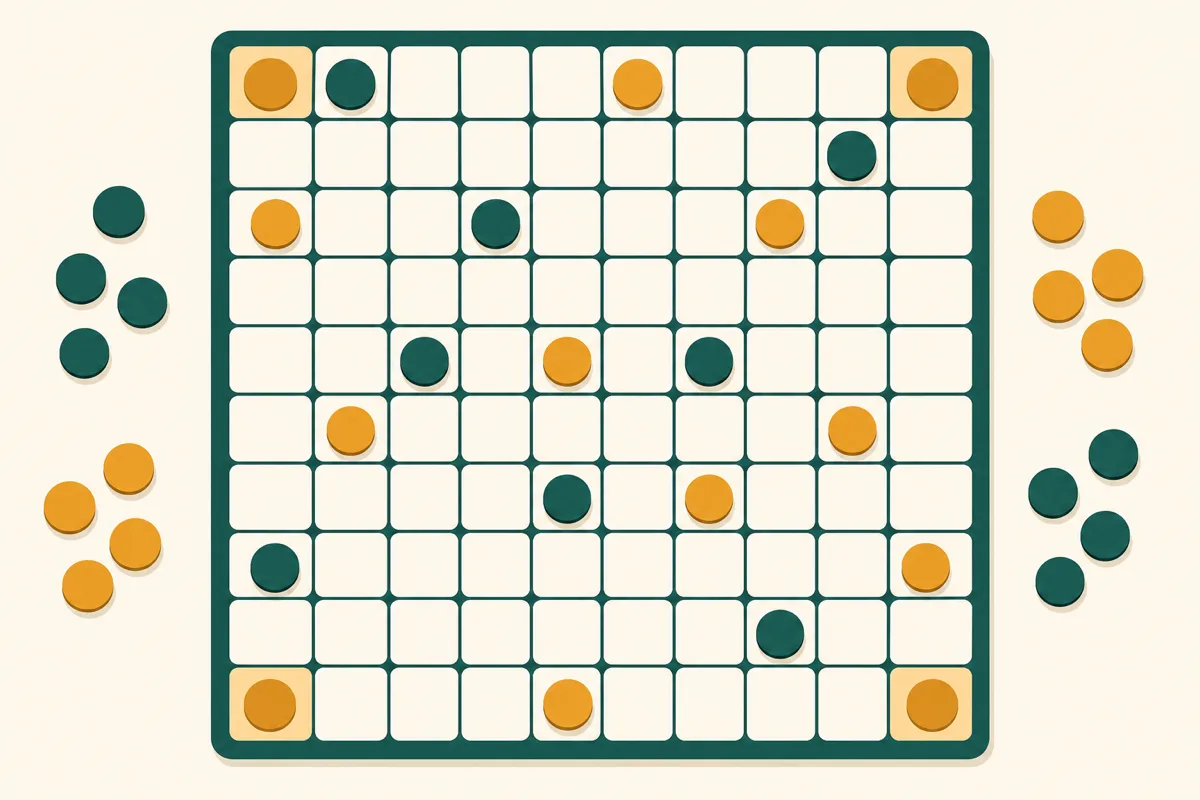
The Sequence board is a 10x10 grid printed with card images, 100 spaces in total. Four of those spaces, one in each corner, are wild for every side and count toward a sequence automatically. The other 96 spaces each show one of the 48 non-jack playing cards (every rank from ace through king except jacks, across all four suits), and every one of those 48 cards appears on the board twice, in two different spaces.
The deck that supplies those cards is two standard 52-card decks shuffled together, 104 cards before anything is set aside. All 8 jacks get pulled out of the drawable deck and split by function rather than mixed back in with everything else:
| Jack type | Which cards | Count | What it does |
|---|---|---|---|
| Two-eyed jack | Jack of diamonds, jack of clubs (from each of the 2 decks) | 4 | Place a chip on any open board space |
| One-eyed jack | Jack of hearts, jack of spades (from each of the 2 decks) | 4 | Remove one opponent chip from the board |
The remaining 96 cards form the drawable deck, matched one-to-one against the board's 96 non-corner spaces. Each side gets its own colored chip set, and hand size scales down as more players join the table.
| Players at the table | Cards dealt to each player |
|---|---|
| 2 | 7 |
| 3–4 | 6 |
| 6 | 5 |
| 8–9 | 4 |
| 10–12 | 3 |
Gameplay
Placing a chip
On your turn, you play one card from your hand and place one of your chips on a matching, open space on the board. If both copies of that card's space are already occupied, the card is a dead card for the moment, and you simply discard it and draw a new one without placing anything. Once a chip lands on a space, it stays there unless a one-eyed jack removes it.
Two-eyed jacks
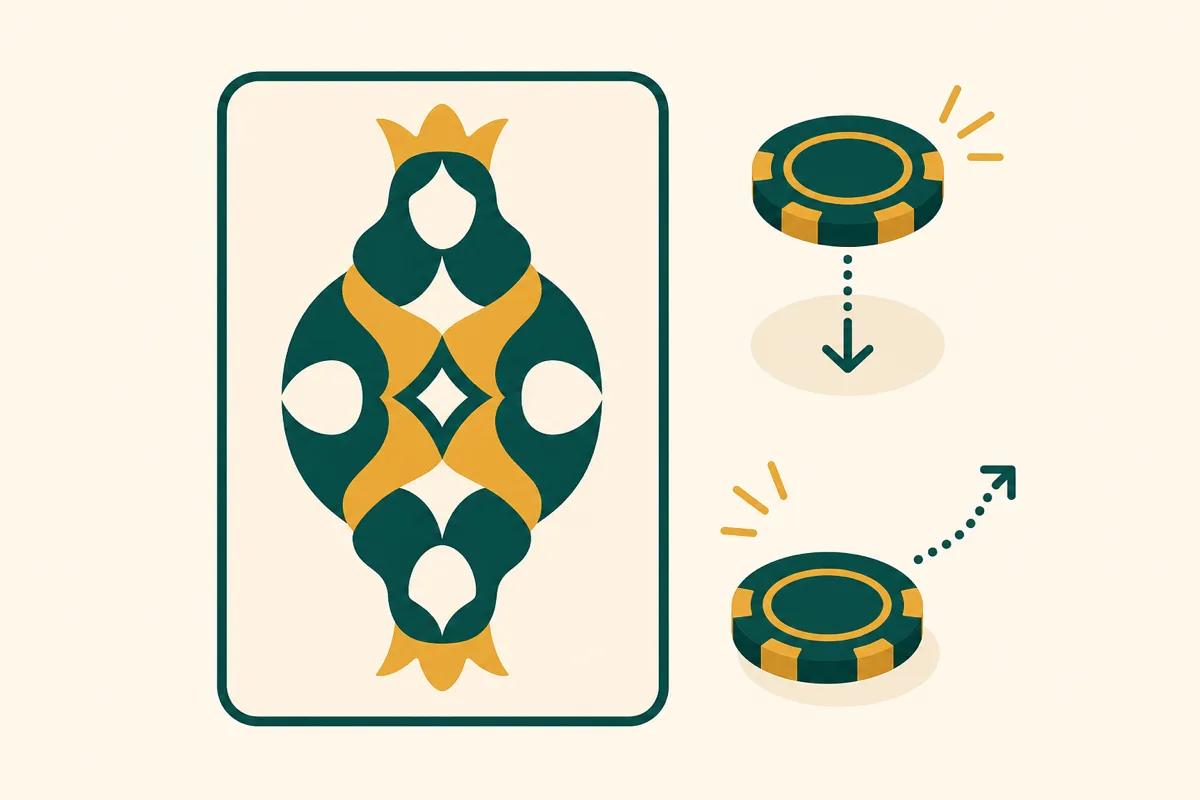
A two-eyed jack works as a placement wildcard. Play it instead of a normal card, and put a chip on any open space on the board, corner spaces excluded since those are already free for everyone. This is the card players hold onto to fill a gap in an almost-finished row, so a two-eyed jack showing up early in a hand is often worth saving rather than spending right away.
One-eyed jacks
A one-eyed jack does the opposite. Instead of placing a chip, you remove one opposing chip from anywhere on the board, breaking up whatever that side was building. The one real limit: a one-eyed jack can't touch a chip that's already part of a completed sequence. Once five chips lock in as a finished row, they're safe from removal for good.
After playing any card, whether it's a normal card or a jack, you draw back up to your starting hand size before the turn passes to the next player.
Scoring
Sequence doesn't run on points. A sequence is five of your own chips connected in an unbroken line, horizontally, vertically, or diagonally, with a wild corner space counting toward a line that runs through it. How many of these you need before the game ends depends on how many sides are actually playing.
| Format | Sequences needed to win |
|---|---|
| 2 players | 2 |
| 2 teams | 2 |
| 3 players | 1 |
| 3 teams | 1 |
A single chip can count toward two different sequences at once if the lines cross through it, which is why the board tends to get more contested near the middle as a hand goes on. First side to lock in the number of sequences shown above wins the game outright, and play stops the moment that happens, even mid-round.
Variations and house rules
Some tables shorten the game by agreeing on "first sequence wins" before dealing, which turns a match into a quicker single-round contest instead of the standard 2-sequence race. It's a common adjustment for a group short on time or playing several games in one sitting rather than an official alternate rule.
The 3-team format changes more than just the sequence count. Turn order has to rotate cleanly through 3 sides instead of 2, and because only 1 sequence is needed to win, games with 3 teams tend to move noticeably faster than the 2-player or 2-team versions, since there's less room for a losing side to catch up once an opponent starts connecting chips.
Sequence isn't the only game on this site built around methodically placing pieces toward a win condition. Kings Corner is another game where card placement builds toward a win condition, using a plain deck of cards and a tableau instead of a dedicated board and chips.
FAQ
How many sequences do you need to win in Sequence?
It depends on the format. A 2-player game or a 2-team game needs 2 completed sequences to win. A 3-player game or a 3-team game only needs 1, since the extra side splits the board's open spaces further and makes each individual sequence harder to protect.
What do the jacks do in Sequence?
Sequence uses 8 jacks split into two types. Two-eyed jacks (the jack of diamonds and jack of clubs from each deck) let you place a chip on any open space instead of matching a card. One-eyed jacks (the jack of hearts and jack of spades from each deck) let you remove one opposing chip from the board instead.
Can you play Sequence with 3 people?
Yes. A 3-player game plays with no teams at all, each player working alone, and the win target drops to a single completed sequence instead of the 2 required in a 2-player game.
What happens if someone breaks up your sequence with a one-eyed jack?
A one-eyed jack can remove any chip that isn't already part of a completed, locked-in sequence. If your chip gets pulled before your line of five is finished, that space opens back up and you'll need to place a new chip there again to rebuild the line.
Is Sequence more like a card game or a board game?
Both, genuinely. The board and its fixed card layout drive the win condition, but every move is triggered by playing a card from your hand, and hand management (holding a jack for the right moment, reading which cards are already dead) matters as much as the board position itself.