FreeCell rules: how to play and use your free cells
FreeCell is a one-player card game played with a standard 52-card deck, dealt entirely face-up across 8 tableau columns from the very start. Four free cells each hold one card temporarily, giving you extra room to maneuver. Build the four foundation piles up by suit from Ace to King to win.
Setup
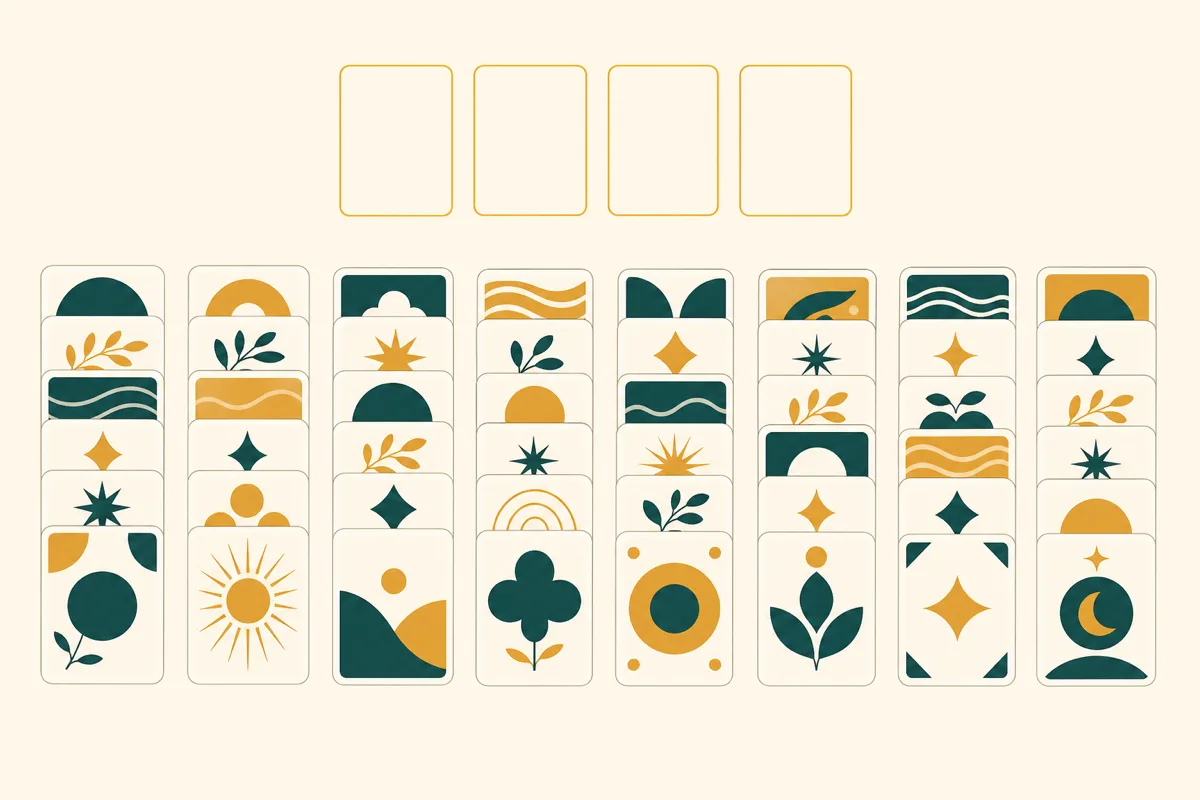
FreeCell uses one standard 52-card deck, no jokers, dealt across 8 tableau columns.
| Column | Cards dealt |
|---|---|
| Columns 1–4 | 7 cards each |
| Columns 5–8 | 6 cards each |
That's all 52 cards dealt out, since FreeCell has no separate stock or waste pile at all. Every single card is visible from the moment the deal is complete, which is the single biggest structural difference from Klondike, where most of the tableau starts hidden face-down.
Above the tableau, set aside 4 empty free cells and 4 empty foundation piles, one foundation per suit. Free cells each hold exactly one card at a time, acting as a small, flexible holding area rather than a discard pile or a stock.
Gameplay
Using free cells
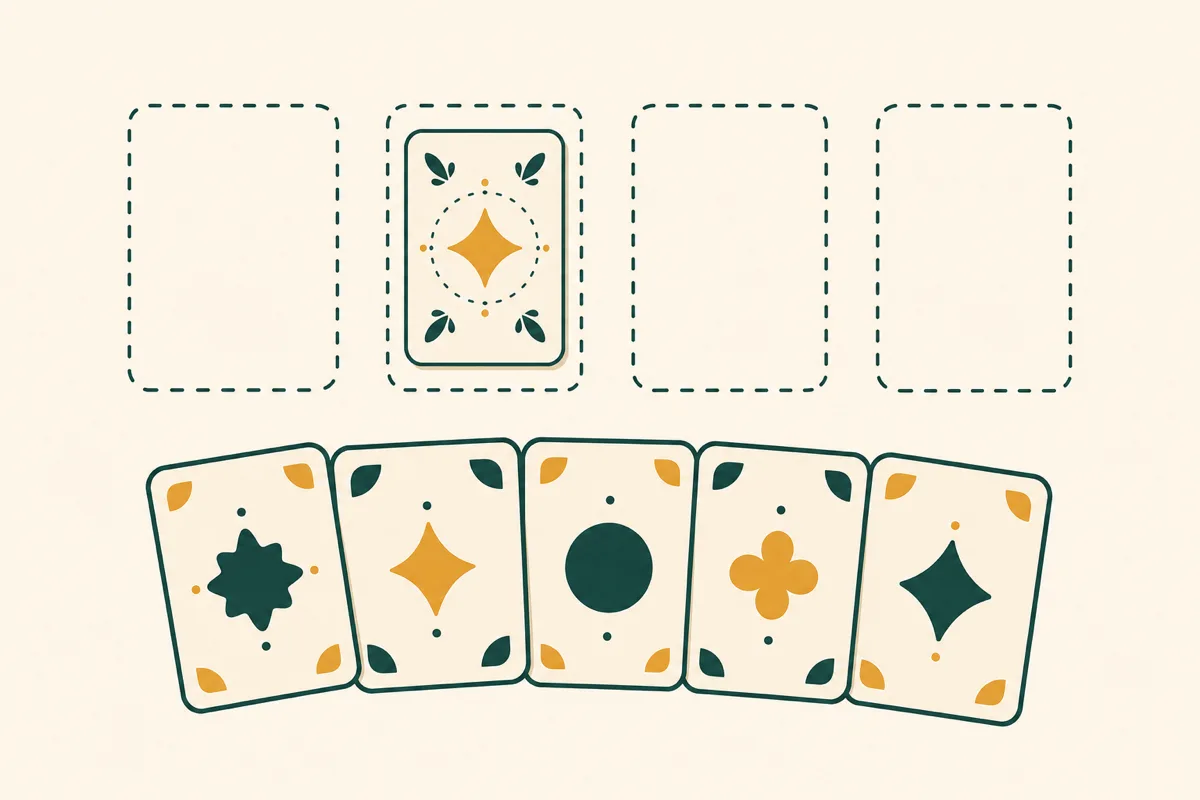
Any single card can be moved into an empty free cell at any time, parked there temporarily until you find a place to play it, and moved back out again whenever it becomes useful. Having all 4 free cells open at once, combined with any empty tableau columns, lets you move a whole multi-card sequence in one action, since most digital FreeCell implementations calculate how many cards you can shift at once based on how many free cells and empty columns are currently available.
Building the tableau
Cards build downward in the tableau in alternating colors, the same convention Klondike uses: a red 9 can hold a black 8, which can hold a red 7, and so on. Since every card is visible from the start, planning a sequence of moves is mostly a matter of working out an order, not a matter of hoping a hidden card underneath turns out to be useful.
Building the foundations
The four foundations build up from the Ace of each suit, exactly as in Klondike. Once a suit's Ace is available in the tableau or a free cell, move it up, then add that suit's 2, 3, and every following rank in order. Because there's no stock hiding extra cards, every Ace is visible and reachable from turn one, which is part of why FreeCell games tend to open up faster than a typical Klondike deal.
How FreeCell differs from Klondike
| Klondike | FreeCell | |
|---|---|---|
| Card visibility at deal | Most cards start face-down | Every card is face-up from the start |
| Temporary storage | No equivalent, only the waste pile from the stock | 4 free cells, each holding one card temporarily |
| Stock or hidden reserve | Stock pile of face-down cards, worked through gradually | None — the entire deck is dealt onto the tableau at once |
| Solvability | Not every deal is winnable, even with perfect play | The large majority of standard deals are winnable with correct play |
That solvability point is worth being precise about rather than repeating a number that's easy to inflate. Of the original 32,000 numbered deals from Microsoft's version of FreeCell, all but one have been proven solvable: deal #11982 is the one confirmed exception, worked out and verified by dedicated solvers in the 1990s. That works out to roughly 99.997% of that specific, well-documented set of deals, not a claim that literally every possible FreeCell shuffle in existence is winnable. A small handful of other numbered deals from later, larger deal sets have also since been identified as unsolvable, but the overall rate of unsolvable deals stays extremely low compared to standard solitaire, where unwinnable deals are common enough that no one bothers keeping an exact count.
FAQ
What are free cells used for?
Free cells are small temporary holding spots, 4 of them in a standard game, each able to hold exactly one card. You park a card there when you need to clear space in the tableau or free up a card underneath it, then move that parked card back out once you have somewhere useful to play it.
Can every FreeCell game be won?
Not every single possible deal, but the large majority can be. Of the original 32,000 numbered deals from Microsoft's FreeCell, all but one, deal #11982, have been proven solvable, a figure independently confirmed by dedicated solver communities rather than a marketing claim. That's a dramatically higher solvability rate than standard Klondike solitaire, where unwinnable deals are common enough that they're simply expected.
How is FreeCell different from regular solitaire?
The biggest difference is visibility: every card in FreeCell is dealt face-up from the start, while Klondike hides most of its tableau behind face-down cards that only reveal themselves as you clear the ones on top. That's exactly how Klondike solitaire compares to the game on this page: FreeCell replaces Klondike's stock pile with 4 free cells for temporary card storage, and it has no separate waste pile at all, since the whole deck is already out on the table from the first move.
- Solitaire rules (Klondike) — the standard single-deck version this page compares against
- Spider Solitaire rules — the two-deck, ten-column variant with its own difficulty tiers
- Best Family Board Games — quick dice and tile games alongside classic family staples
- Best 2 player card games — includes a note on Double Solitaire, a 2-player Klondike spin
- Chinese Checkers rules — another simple, low-competition family game night pick