Spider Solitaire rules: how to play, 1, 2 or 4 suits
Spider Solitaire is a one-player card game played with two combined standard decks, 104 cards total, dealt across ten tableau columns. You can move cards individually in descending order regardless of suit, but only a same-suit descending run can be moved together as a group. Clear all 8 same-suit King-to-Ace sequences off the tableau to win.
Setup
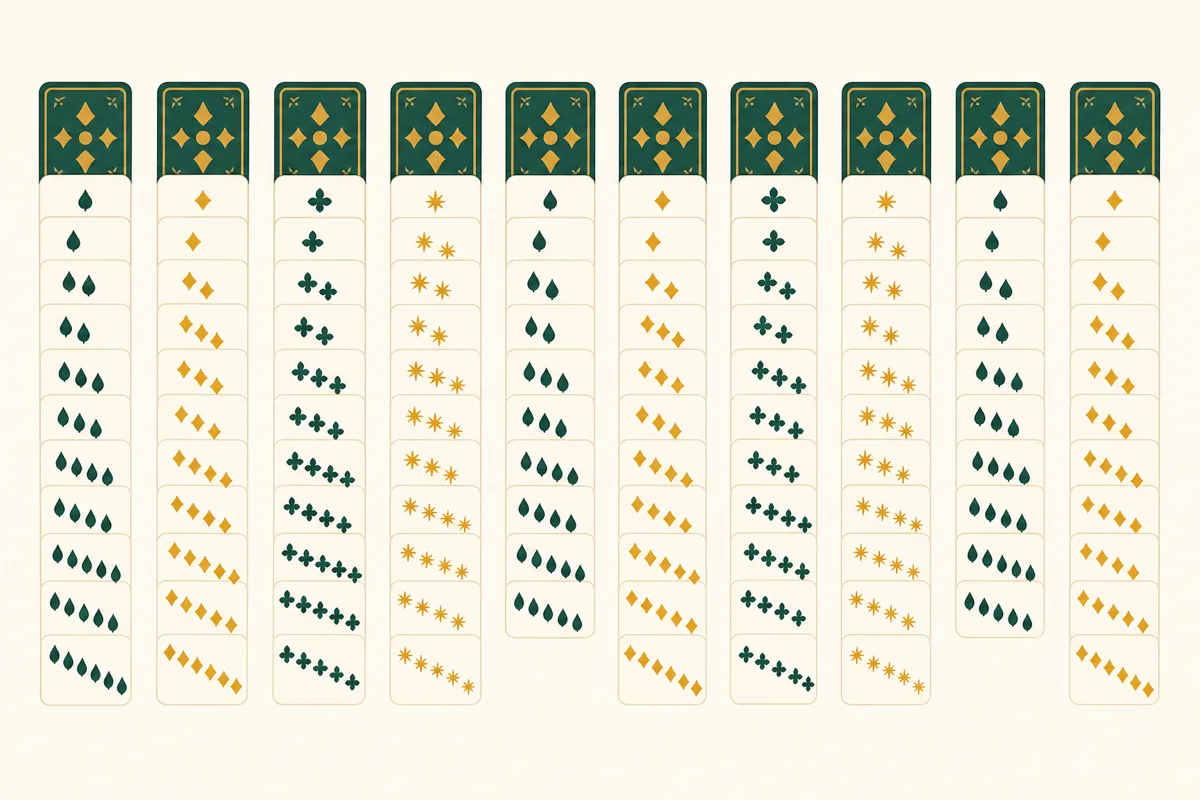
Spider Solitaire uses two full 52-card decks shuffled together, 104 cards in all, and no jokers. Deal them across 10 tableau columns.
| Column | Cards dealt | Face-up count |
|---|---|---|
| Columns 1–4 | 6 cards each | 1 (top card only) |
| Columns 5–10 | 5 cards each | 1 (top card only) |
That's 54 cards dealt into the tableau, leaving 50 cards in the stock. Unlike Klondike, Spider Solitaire has no traditional foundation piles at all. Instead, completed King-to-Ace same-suit sequences are removed from the tableau directly, and the game is won once all 8 of them (one for every suit represented across the two combined decks, doubled since there are two of each suit in play) have been cleared.
When the tableau runs out of legal moves, the stock deals out 10 cards at once, one face-up card added to the bottom of each of the 10 columns, rather than one card at a time the way Klondike's stock works.
Gameplay
Building sequences
Cards can be stacked in the tableau in descending order regardless of suit, so a black 8 can hold a red 7 or a black 7, unlike Klondike's alternating-color rule. This makes it easier to build a long chain quickly, though a chain that mixes suits can't be moved as a unit later.
Moving a group of cards
Only a same-suit descending run, cards of the exact same suit stacked in unbroken descending order, can be moved together as a group onto another card. A mixed-suit sequence has to be broken apart and moved one card at a time instead, which is the single biggest mechanical difference from Klondike's looser alternating-color group moves.
Clearing a completed run
Once a full King-to-Ace same-suit sequence is assembled in a single column, all 13 cards are automatically removed from the tableau and set aside as one of the 8 completed sequences needed to win. This happens the moment the sequence is complete, without needing a separate action to trigger it.
Dealing from the stock
When no more legal moves are available, use the stock to deal one card face-up onto each of the 10 columns at once. A common convention requires every column to have at least one card in it before you can deal from the stock, since dealing onto a genuinely empty column isn't allowed in most rule sets.
Difficulty variants
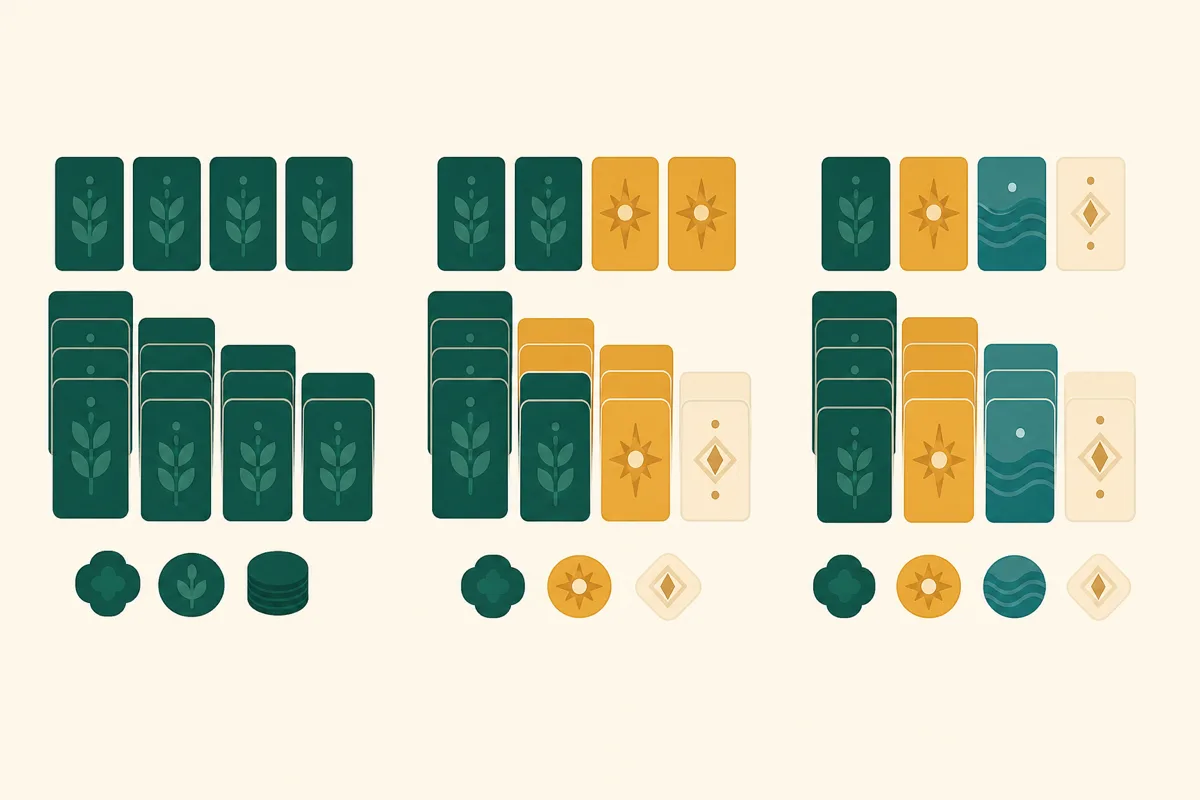
Spider Solitaire is commonly played at three difficulty tiers, and the suit count is the single factor that changes how often a legal same-suit group move is actually available to you.
| Variant | Suit count | Relative difficulty |
|---|---|---|
| 1-suit Spider | All cards are effectively one suit | Easiest — every descending run can be moved as a group, since suit never breaks a sequence |
| 2-suit Spider | Two suits in play | Moderate — group moves are available less often than 1-suit, more planning needed around suit breaks |
| 4-suit Spider | Full suit variety, the standard version | Hardest — group moves are the rarest, and untangling mixed-suit runs takes real strategy |
FAQ
How many decks do you need for Spider Solitaire?
Two standard 52-card decks combined, 104 cards total, no jokers. That's noticeably more than the single deck used in Klondike or FreeCell, and it's part of why Spider Solitaire's tableau spreads across 10 columns instead of 7 or 8.
What's the difference between 1-suit and 4-suit Spider Solitaire?
1-suit Spider uses cards that behave as a single suit throughout, which makes every descending run movable as a group and is by far the easiest version to win. 4-suit Spider, the standard full version, uses all four suits, so only same-suit runs can move together, and untangling mixed-suit sequences takes considerably more planning. 2-suit sits in between as a common stepping stone for players moving up from 1-suit.
Do you have foundations in Spider Solitaire?
No, not in the traditional sense used by Klondike or FreeCell. Instead of building suits up on separate foundation piles, a completed King-to-Ace same-suit sequence is removed directly from the tableau the moment it's assembled, and the game is won once all 8 of those sequences have been cleared.
Is Spider Solitaire harder than regular solitaire?
Generally yes, especially at the standard 4-suit difficulty. That's easiest to see against the standard Klondike solitaire rules, where every card is dealt only once and foundations build up gradually as you go. Spider Solitaire's same-suit-only group-move restriction and larger 104-card deck make careful planning more important, particularly in the higher suit-count variants.
- Solitaire rules (Klondike) — the standard single-deck version most people mean by "solitaire"
- FreeCell rules — the fully face-up variant where nearly every deal is solvable
- Best Family Board Games — quick dice and tile games alongside classic family staples
- Best 2 player card games — includes a note on Double Solitaire, a 2-player Klondike spin
- Yahtzee rules — another solo-friendly classic for game night