Golf card game rules: how to play 6-card golf and score it
* Difficulty is our editorial read on how hard the game is to pick up — not an official rating. Player counts and deck sizes come from the game's rulebook.
Golf is a card game for 2 to 4 players (more if you add a second deck) where each round is called a hole and the goal is to finish with the lowest-scoring cards in front of you. After nine holes, the player with the lowest total wins.
- Deal 6 cards face down to each player, laid out in two rows of three. Each player turns any 2 of them face up.
- On your turn, draw one card from the stock or the discard pile, then swap it into your grid or throw it away. A card taken from the discard pile has to be swapped in.
- The hole ends when one player has all 6 cards face up.
- Card values: ace 1, two minus 2, three through ten at face value, jack and queen 10, king 0. Two matching cards in the same column score 0.
- Play 9 holes and add up the scores. Lowest total wins.
Setup
What you need
One standard 52-card deck covers 2 to 4 players. With more than four players, shuffle a second deck in, and add a third once you go past eight. Some groups use two decks even with two or three players, which makes matching pairs easier to find. You also need something to keep score on, since a full game runs nine holes and the running total matters more than any single hole.
The deal
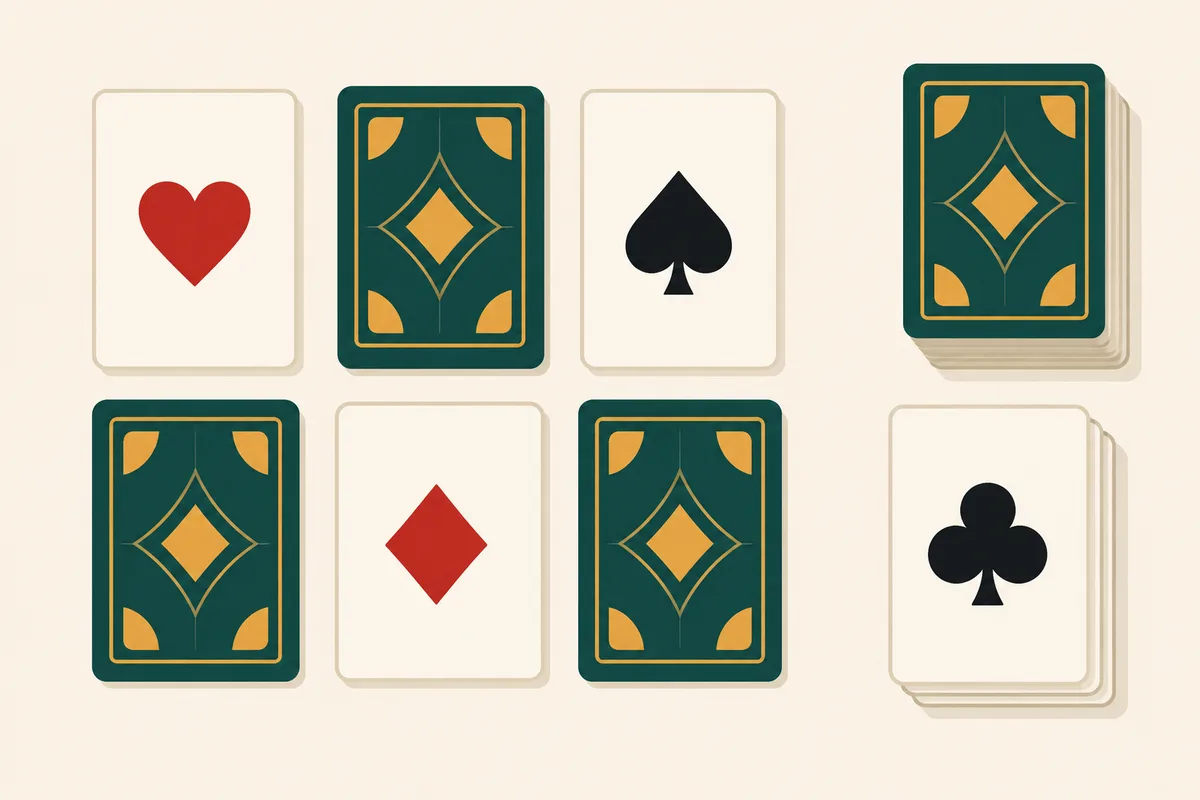
The dealer shuffles and gives each player 6 cards face down. Without looking at them, each player arranges their cards in a grid of two rows with three cards each, so the layout has three columns of two cards. The rest of the deck goes face down in the middle as the stock, and the dealer turns the top card face up next to it to start the discard pile.
Before anyone takes a turn, every player flips any two of their six cards face up. Which two is your call. The other four stay face down, and you can't peek at them. You only learn what they are when they leave your grid or get turned over.
Pass the deal to the next player for each new hole so the same person isn't dealing all night.
Gameplay
Play starts with the player to the dealer's left and moves around the table. Every turn is one draw and one decision.
Your three options on a turn
- Take the top card of the discard pile and swap it for any card in your grid, face up or face down. The card you remove goes face up on the discard pile. If you take the discard, you must swap it in. You can't pick it up and throw it straight back.
- Draw the top card of the stock and swap it into your grid the same way.
- Draw from the stock and discard it if it doesn't help you. In some versions you then also flip one of your face-down cards, so agree on this before the first hole.
The new card always goes into your grid face up, in the exact spot of the card it replaced. That means you can swap out a face-down card without ever learning what it was until it lands on the discard pile, which is part of the gamble.
How a hole ends
The hole ends as soon as one player has all six cards face up. What happens next depends on your table. Under the stricter rule, play stops right there. Some groups instead give every other player one final turn before scoring. Settle it before you deal.
When play stops, everyone turns over any cards still face down, and each grid is scored.
A few habits that save points
- Keep kings and twos. A king is free and a two takes points off your score, so swapping either one out is almost always a mistake.
- Build column pairs. If a 7 sits face up at the top of a column, a second 7 underneath wipes the whole column to zero.
- Watch what you throw away. The player after you gets first shot at your discard, so dumping the exact card they need to finish a pair hands them points.
- Don't rush to flip your last card. Ending the hole locks in whatever your grid shows, and if your table plays a final turn, everyone else gets one more chance to improve while you can't.
Scoring
Golf card game scoring works like the sport it's named after: the low score wins. Every card in your grid adds to your total for the hole, and you want that number as small as possible. Here are the standard values for 6-card golf.
| Card | Points |
|---|---|
| Ace | 1 |
| Two | Minus 2 |
| Three through ten | Face value (3 to 10) |
| Jack | 10 |
| Queen | 10 |
| King | 0 |
| Matching pair in the same column | 0 for that column |
How column pairs work
When both cards in a column have the same rank, that column scores zero no matter what the cards are worth. A pair of queens, normally 20 points, drops to 0. The rule cuts both ways, though: a pair of twos also scores 0, not minus 4, so two twos stacked in one column waste their bonus. Spread your twos across different columns.
Only vertical pairs count in the standard game. Two jacks side by side in the same row still score 10 each.
Scoring example
Say the hole ends and your grid looks like this:
- Top row: 8, 5, 2
- Bottom row: 8, king, jack
Column one holds two 8s, so it scores 0. Column two is a 5 plus a king, so 5 + 0 = 5. Column three is a two plus a jack, so minus 2 + 10 = 8. Your total for the hole is 0 + 5 + 8 = 13.
Counted card by card with no column rule, the same grid adds up to 29, so that one matched column saved you 16 points.
Keeping score across nine holes
Write each player's score after every hole and keep a running total. After the ninth hole, the lowest total wins. A hole can even finish below zero: twos in two different columns with kings filling the rest of the grid score minus 4. That's why one bad hole early doesn't decide the game. If you already play Five Crowns rules, the rhythm will feel familiar: many short rounds, one running total, low score takes it.
Enter each player's score after every hole. Lowest total wins, and a hole can score below zero.
For each hole, add up your six cards: ace 1, two minus 2, 3 to 10 face value, jack and queen 10, king 0, and a matching pair in the same column 0. For a negative score, tap ± next to the box. Your sheet stays on this device until you start a new game.
Variations
Golf has three common layout sizes. The 6-card game above is the standard version, and the 4-card and 9-card versions change how a hole feels.
| Version | Layout | Cards seen at the start | What scores zero | How a hole ends |
|---|---|---|---|---|
| 4-card golf | 2 × 2 square | You peek once at your 2 nearest cards, then they stay face down | Pairs only by house rule | A player knocks, everyone else gets one more turn |
| 6-card golf | 2 rows of 3 | Any 2 flipped face up | Matching pair in a column | One player has all 6 face up |
| 9-card golf | 3 × 3 square | 3 face up (some tables flip 2) | Three of a kind in a column | Any grid is fully face up, play stops at once |
4-card golf
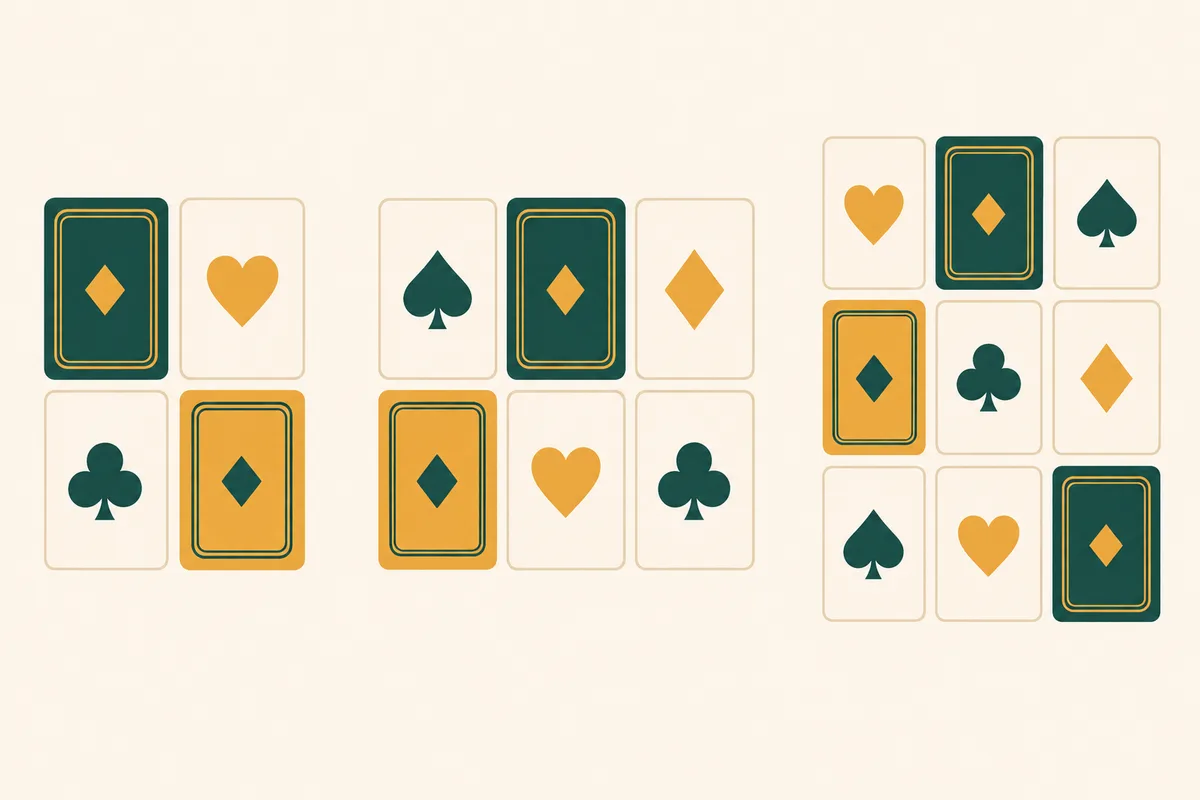
Each player gets four cards face down in a 2 × 2 square. Before play, you look once at the two cards nearest you and then put them back face down without showing anyone. After that, you have to remember them. Some tables let you pick any two cards to peek at, and some allow only one.
Turns work like 6-card golf, but nothing is face up in your own square, so memory matters a lot more. The hole doesn't end on its own. Instead, when you think you have the lowest score, you can use your turn to knock instead of drawing. Every other player then gets one more turn, and the hole ends.
Two scoring differences catch people out. In the basic 4-card rules a two counts as 2 points, not minus 2, while jacks and queens are still 10 and kings still 0. And cancelling pairs is a house rule here, not a given. Some groups that use it count a pair only when the two cards share a row or column, not when they sit in opposite corners. Because a knock can backfire, some house rules punish the knocker, for example by adding 10 points to their score or doubling it. Agree on the penalty before the first knock.
4-card golf works for 2 players and up, and with a big group of eight or more you shuffle two decks together.
9-card golf
The 9-card version, also called Nines or Crazy Nines, deals each player nine cards in a 3 × 3 square and needs two or more decks. Players usually start with three cards face up, though some tables flip only two.
Scoring follows 6-card golf with one big change: a pair no longer cancels. Only a full column of three matching cards scores zero, so you need three of a kind stacked vertically.
The ending is stricter too. As soon as any grid is completely face up, the hole is over. Nobody gets a final turn, and everyone flips their remaining cards and scores. Play runs nine holes, or until one player passes 50 points.
House rules
Jokers. Some groups add two jokers per deck. In one version, jokers are worth minus 2 and twos go up to plus 2. In another, each joker is worth minus 5, which lets a strong grid finish well below zero.
Matching cards outside the column. Some tables let a pair of equal cards anywhere in the layout score zero, not only in the same column. Another bonus rewards four equal cards sitting together in a square block (two side-by-side columns) with minus 20 points.
Peeking. A few groups skip the opening flip and start with every card face down, which makes the early turns pure guesswork.
Whatever you pick, write it at the top of the score sheet before the first hole. Most arguments over this game start with "that's not how we played it last time."
FAQ
How many cards do you get in the golf card game?
Six in the standard game, laid out in two rows of three. The 4-card version uses a 2 × 2 square and the 9-card version a 3 × 3 square, so ask which one your table means before the deal.
What are kings worth in the golf card game?
Zero. A king adds nothing to your score, which makes it the second-best card to hold after a two. Kings in the same column also count as a matching pair, but since each one is already worth 0, the pair doesn't change your total.
Can you play the golf card game with 2 players?
Yes. The 6-card game is played with one deck by 2 to 4 players, and it works well head to head. With just two people, some groups shuffle in a second deck so matching pairs turn up more often.
Do two twos in the same column count as minus 4?
No. Any matching pair in a column scores 0, and that includes a pair of twos. To keep both twos working for you, place them in different columns, where each one takes 2 points off your total.
Are jokers used in the golf card game?
Not in the standard game, which uses a plain 52-card deck. Tables that add them usually play two jokers per deck and score each one at minus 2, with twos moved up to plus 2 so there's only one negative card. Some groups make a joker worth minus 5 instead. Either way, check before the deal, because a joker rule changes which cards are worth keeping.
Does everyone get one more turn after a player flips their last card?
It depends on the table. In the strict version, the hole ends the moment one player has all six cards face up. Some groups instead give every other player one final turn. In 9-card golf, play always stops at once. Decide before you deal.
How many holes are in the golf card game?
Nine. Each deal is one hole, and you keep a running total across all nine. The lowest total at the end wins. For a longer evening, play a second nine and carry the totals forward.
- Five Crowns rules — another rounds-based card game where the lowest running total wins
- Hearts rules — a trick-taking game that also rewards the lowest score
- Rummy rules — the classic draw-and-discard game built on sets and runs
- Kings Corner rules — a quick family card game for 2 to 4 players
- Classic card games — every traditional deck game on the site in one place
- Best card games for family game night — picks for a mixed-age table