Pyramid Solitaire rules: how to play and win
Pyramid Solitaire is a one-player card game played with a standard 52-card deck. The deal forms a seven-row pyramid, 28 cards in all, with the remaining 24 cards set aside as a stock. Pair up any two exposed cards whose values add up to 13, or remove an exposed King on its own, until the whole pyramid is cleared.
Setup
Pyramid Solitaire uses one standard 52-card deck, no jokers, and it's a single-player game.
| Row | Cards dealt |
|---|---|
| Row 1 (top) | 1 card |
| Row 2 | 2 cards |
| Row 3 | 3 cards |
| Row 4 | 4 cards |
| Row 5 | 5 cards |
| Row 6 | 6 cards |
| Row 7 (base) | 7 cards |
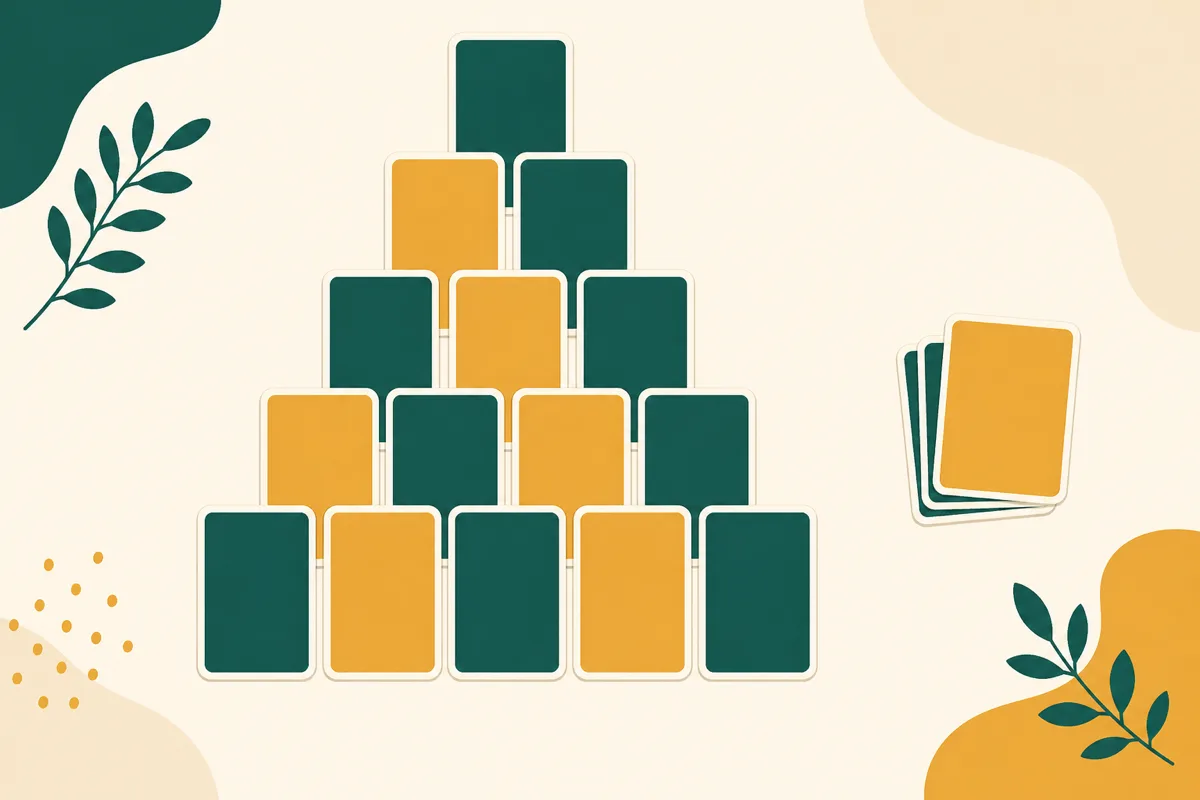
That's 28 cards arranged so each row overlaps the row below it, like a real pyramid. Every card in the pyramid deals face-up, but only a card that isn't covered by any card resting on top of it is actually playable. At the start, that means the full 7-card base row is open, along with the single card at the very top. Every other card stays locked until the cards covering it are cleared away.
The remaining 24 cards form a face-down stock pile off to one side, which you'll turn over as the pyramid opens up.
Gameplay
Pairing cards to 13
The entire game runs on one rule: any two exposed, playable cards whose values add up to exactly 13 can be removed together. Number cards count at face value, a Jack counts as 11, and a Queen counts as 12. So a 9 pairs with a 4, a 6 pairs with a 7, a Jack pairs with a 2, and a Queen pairs with an Ace. The two cards don't need to be next to each other or even in the same row, as long as both are currently uncovered and playable, including cards sitting on the waste pile or the top of the stock.
Removing a King alone
A King is worth 13 on its own, so it's the one card that never needs a partner. Any exposed King can be removed by itself the moment it's playable, which is often the fastest way to open up a row that a King is sitting in.
Drawing from the stock
Once no more legal pairs are available among the exposed cards, turn over the top card of the stock into a face-up waste pile, one card at a time. That new card is playable immediately, either paired with something else that's exposed or, if it's a King, removed on its own. The most commonly cited standard lets you cycle back through the stock up to three total passes once you've worked through it, rather than allowing unlimited redeals. Some easier variants only allow one or two passes, so treat three as the common convention rather than a fixed universal rule.
Scoring/win condition
There's no points system in standard Pyramid Solitaire. You either clear the pyramid or you don't.
The most commonly cited win condition is simple: once all 28 cards in the pyramid have been paired off or removed, you've won, regardless of what's still sitting in the stock or waste pile. A stricter variant does exist, sometimes described as the "official" or full-clear version, that also requires every stock and waste card to make its way to 13-pairs or a King before the game counts as won. That version is considerably harder, since it leaves far less room for cards to sit unused. Neither version is wrong, they're just different targets, and this page states both rather than picking one silently.
As with Klondike, not every Pyramid Solitaire deal is winnable, even with perfect play. That's a genuinely different situation from FreeCell, where the overwhelming majority of deals can be solved.
FAQ
How do you know which cards you can remove in Pyramid Solitaire?
A card is removable, either alone as a King or paired with another card that adds up to 13, only if nothing else in the pyramid currently rests on top of it. The base row's 7 cards and the single card at the very top are the only spots open at the very start of the game; everything else stays locked until the cards above it clear away.
Can you remove a King without pairing it?
Yes. A King is already worth exactly 13, the full target value on its own, so it never needs a partner card. Any King that's currently exposed and playable can be removed by itself as soon as it's your turn to act.
Is every Pyramid Solitaire deal winnable?
No. Like standard Klondike solitaire, some deals simply can't be won no matter how well you play them. That's a real difference from FreeCell, where the overwhelming majority of deals are solvable with correct play.
How is Pyramid Solitaire different from Klondike?
The core difference is the tableau shape and the win condition. Klondike builds descending, alternating-color columns and clears cards up onto four suit foundations; Pyramid Solitaire instead removes matching pairs that add to 13 from a triangular layout, with no foundations and no suit-building involved at all. Anyone who already knows the full Klondike solitaire rules will recognize the single deck and the face-down stock, but the actual clearing mechanic is a completely different puzzle.
- Solitaire rules (Klondike) — the standard single-deck version this page's pyramid layout is compared against
- Spider Solitaire rules — the two-deck, ten-column sibling spoke
- FreeCell rules — the fully face-up variant where nearly every deal is solvable
- Kings Corner rules — another game built around a tableau and a King-only rule for starting new piles
- Best 2 player card games — includes a note on Double Solitaire, a 2-player Klondike spin